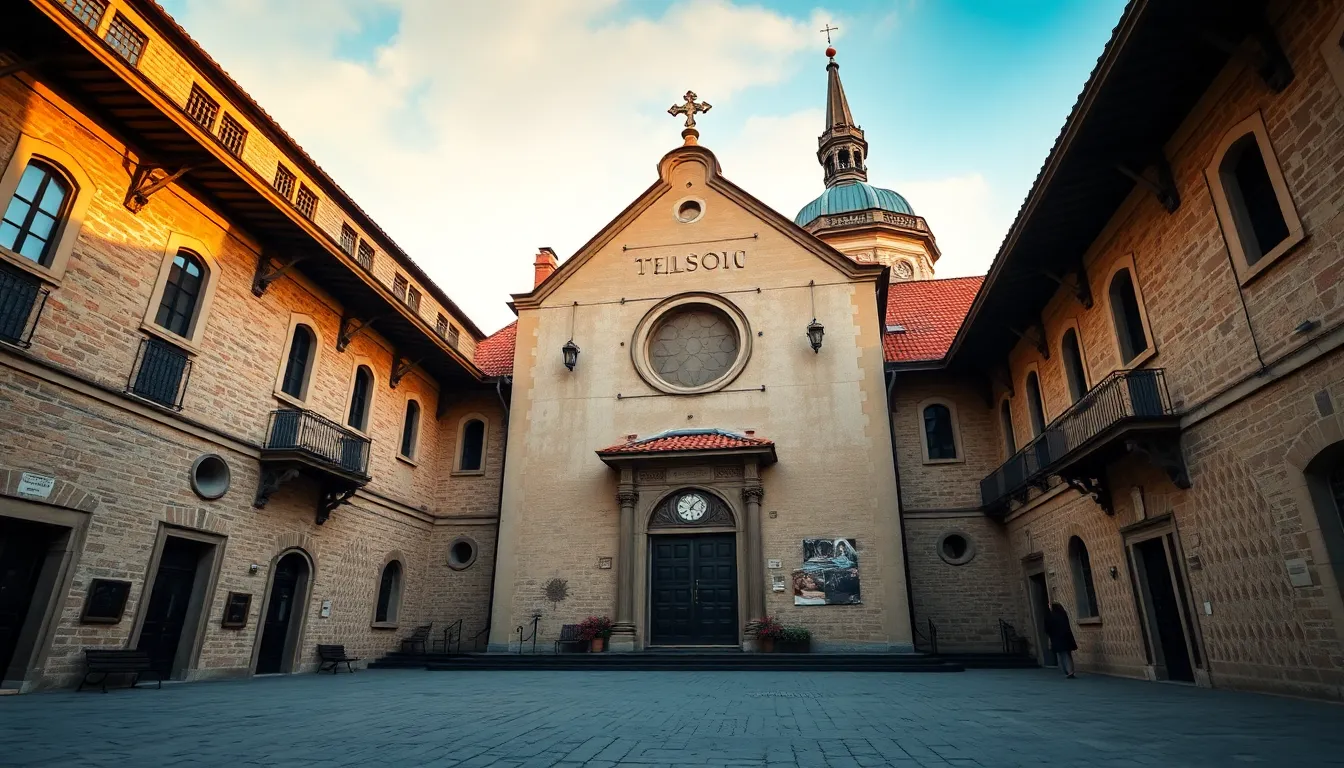
I bring groups to Zamosc partly to surprise them. They have spent days absorbing the weight of Jewish Poland, and then we arrive in this town in the southeast, and they walk into a perfectly preserved Renaissance square with arcaded townhouses painted in soft colors, and they are, for a moment, simply delighted. Zamosc is one of the most beautiful towns in Poland, an entire Renaissance city built to a single plan in the sixteenth century. And woven into that beauty is a Jewish story that reaches back to the town’s very founding, because Jews were here from the beginning, invited to help build the ideal city its founder imagined.
That is what makes Zamosc different from many of the places we go. This is not a town where a Jewish community existed at the margins. The Jews of Zamosc were part of the original design, present at the creation of one of the most remarkable urban experiments in European history. Their synagogue, beautifully restored, still stands at the heart of it. Let me tell you the story.
An Ideal City and Its Founders
The Vision of Jan Zamoyski
Zamosc was founded in 1580 by Jan Zamoyski, a powerful Polish nobleman and statesman who set out to build an ideal city. He hired an Italian architect, Bernardo Morando, and together they designed Zamosc according to Renaissance principles, a planned town with a grand central square, geometric streets, and fortifications, all conceived as a single coherent work. The result is so well preserved that the old town of Zamosc has been recognized as a UNESCO World Heritage Site, sometimes called the Pearl of the Renaissance or the Padua of the North.
Zamoyski wanted his city to prosper, and he understood that prosperity required merchants, craftsmen, and traders. So he invited various communities to settle, including Sephardic Jews originally from the Mediterranean world, and later Ashkenazi Jews as well. From the town’s earliest decades, a Jewish community took root within the walls of the ideal city.
Jews at the Founding
The early Jewish settlers of Zamosc were granted the right to live, trade, and worship. They built their quarter in the northeastern part of the old town, near the square, and at its center they built a synagogue. The Jewish community grew and became an integral part of the town’s commercial and cultural life over the following centuries. By the period before the war, Jews made up a substantial share of Zamosc’s population, and the town had become a notable center of Jewish life in the region, including a connection to the Haskalah, the Jewish Enlightenment movement, which had a following here.
This is the deeper significance of Zamosc for heritage groups. It shows Jewish life not as something tolerated on the edge of Polish society but as part of the fabric of one of Poland’s proudest creations from its very first years. Our broader guide to Jewish heritage in Poland traces how this pattern of invitation and settlement built the largest Jewish civilization in the Diaspora, and Zamosc is one of its clearest illustrations.
The Renaissance Synagogue
A Building Restored to Its Beauty
The synagogue of Zamosc was built in the early seventeenth century, around 1610 to 1620, in a Renaissance style that fits the town around it. It is a striking building, with a high vaulted main hall, decorative stucco work, and the dignity of a structure built by a confident, established community.
Like so many synagogues in Poland, it survived the war as a building while the community that prayed in it did not. During the occupation it was used for other purposes, and in the postwar decades it served various functions, including for a time as a library. But in recent years the synagogue underwent a careful and impressive restoration, completed in the past decade and a half, and it now stands as one of the most beautifully restored Renaissance synagogues in Poland.
Today the building serves as a cultural and educational center dedicated to the Jewish heritage of Zamosc and the region. When your group steps inside, you encounter the restored main hall with its vaulting and ornamentation, exhibitions on the history of the community, and the sense of a space that has been returned, with great care, to something close to its original beauty. After the heaviness of so many sites in Poland, the restored synagogue of Zamosc offers something groups need: a place where Jewish heritage is presented in its fullness, not only its destruction.
Walking the Jewish Quarter
Beyond the synagogue itself, the old Jewish quarter of Zamosc can still be walked. The streets near the synagogue carry the footprint of the community that lived here. A good guide can help your group read the quarter, pointing out where Jewish life unfolded within the larger plan of the Renaissance town. The proximity matters. The synagogue stands only steps from the grand central square, a physical reminder that the Jewish community was not pushed to the outskirts but lived at the center of the ideal city.
What Happened to Jewish Zamosc
I would be failing the people of Zamosc if I told only the beautiful part of the story. The Jewish community of Zamosc, like the Jewish communities across Poland, was destroyed during the war. Under the occupation, the Jews of Zamosc were confined, subjected to forced labor and brutal conditions, and ultimately deported. Most were sent to the Belzec extermination camp, a short distance to the south, where they were murdered. The centuries-old community that had been present at the founding of the ideal city was erased.
I tell groups this part of the story inside the restored synagogue, because the contrast is the point. The beauty of the restored building is real and worth celebrating. But it is the beauty of a survivor, a structure that outlived the people it was built to serve. Holding both truths together, the founding and the destruction, the beauty and the absence, is the work of bearing witness honestly. For groups continuing on to sites of remembrance, our guides to Majdanek near Lublin and the Lodz Ghetto carry that work further with the gravity those places demand.
Why Zamosc Belongs on Your Itinerary
Zamosc serves a specific and important purpose in a Poland heritage journey. It shows Jewish life integrated into Polish achievement at the highest level, present at the creation of a UNESCO-recognized masterpiece. It offers a beautifully restored synagogue that lets groups experience Jewish heritage in its dignity rather than only its loss. And its location in the southeast pairs naturally with Lublin and the Belzec region, allowing a thoughtful route through a part of Poland many groups never reach.
I often place Zamosc on a day when a group needs lighter footing, a chance to encounter beauty and to celebrate what was built before turning back to the harder sites. That balance is not avoidance. It is how a community sustains the capacity to bear witness across a full journey. Zamosc gives the grief context and gives the group breath.
FAQ: Zamosc Jewish Heritage
What is Zamosc and why is it significant?
Zamosc is a town in southeastern Poland founded in 1580 by Jan Zamoyski as an ideal Renaissance city, designed by the Italian architect Bernardo Morando. Its remarkably preserved old town is a UNESCO World Heritage Site. From the town’s earliest decades, a Jewish community settled within its walls, making Jewish life part of the original design of one of Poland’s most celebrated urban creations.
What is the synagogue of Zamosc like?
The synagogue of Zamosc was built around 1610 to 1620 in a Renaissance style matching the town. It features a high vaulted main hall and decorative stucco work. After surviving the war as a building while its community was destroyed, it underwent a careful restoration completed in recent years and now serves as a cultural and educational center for the Jewish heritage of Zamosc and the region. It is one of the most beautifully restored Renaissance synagogues in Poland.
Can you still see the Jewish quarter in Zamosc?
Yes. The old Jewish quarter, in the northeastern part of the old town near the central square, can still be walked. The synagogue stands at its heart, only steps from the grand square, reflecting how the Jewish community lived at the center of the town rather than on its margins. A knowledgeable guide can help your group read the quarter and understand how Jewish life unfolded within the Renaissance plan.
What happened to the Jewish community of Zamosc?
The Jewish community of Zamosc was destroyed during the war. Under the occupation, the town’s Jews were confined, subjected to forced labor, and ultimately deported. Most were sent to the Belzec extermination camp to the south, where they were murdered. A community that had existed since the town’s founding in the sixteenth century was erased.
How does Zamosc fit into a Poland heritage itinerary?
Zamosc shows Jewish life integrated into Polish achievement at the highest level and offers a beautifully restored synagogue that lets groups experience Jewish heritage in its dignity. Its location in the southeast pairs naturally with Lublin and the surrounding region. I often place Zamosc on a day when a group needs lighter footing and a chance to celebrate what was built, which helps sustain the capacity to bear witness across a longer journey. Heritage Tours can build it into your group’s route.
If your community would value a day in the Pearl of the Renaissance and its restored synagogue, I would be glad to help you plan it. You can learn more about how we design these journeys at our Poland destination page or our group heritage tours page, where group leaders travel free with fifteen or more participants. When you are ready, contact us and we will start the conversation.