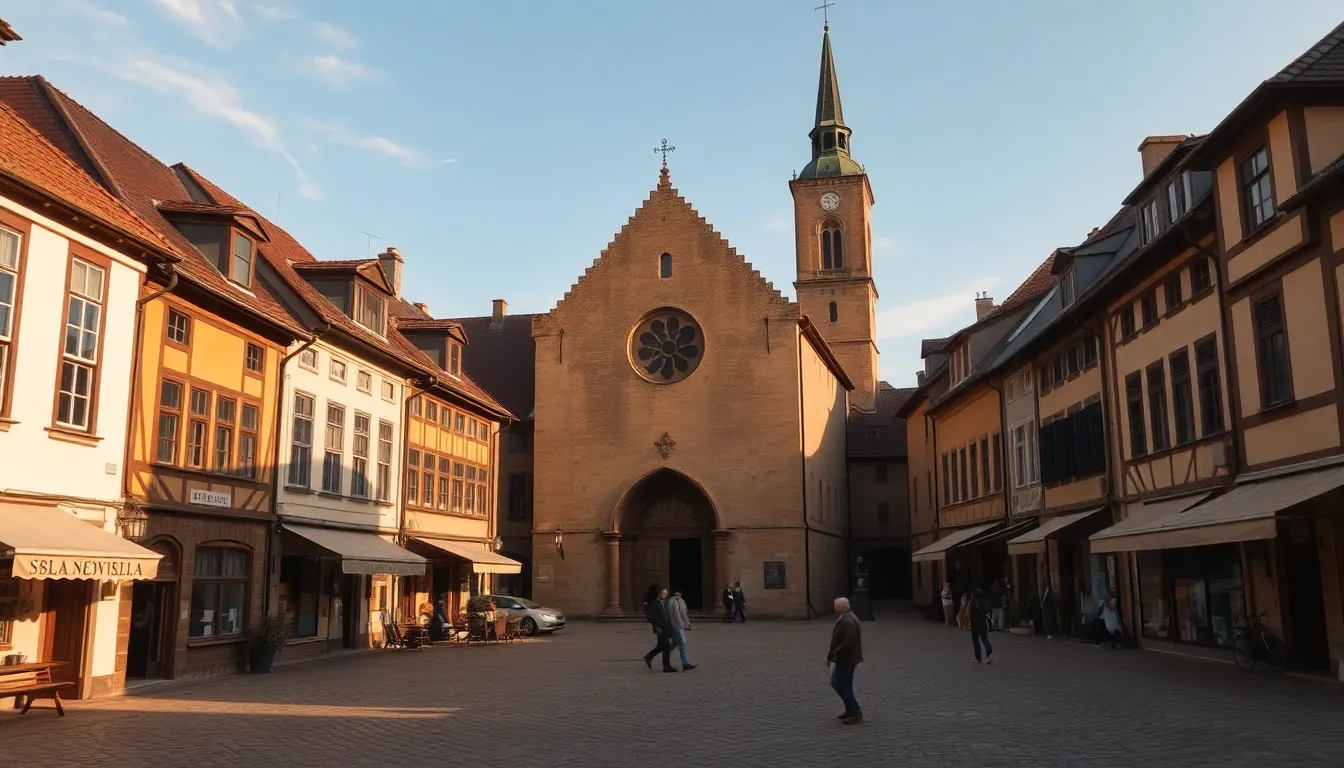
On the third or fourth day of a Poland journey, I like to take a group somewhere most tourists never go. A small town in the east, far from the cities, with a faded market square and a synagogue that now holds grain or tools or nothing at all. We stand in the square, and I ask the group to imagine it on a Thursday morning before the war. The market full. Yiddish in the air, mixed with Polish. A water carrier, a matchmaker, children running between the stalls, the rabbi’s house on one corner and the study house beside the synagogue. Then I tell them that this whole world, the one we are standing in, was erased so completely that most people today have never heard the word for it.
The word is shtetl. It means, simply, a small town. But it came to mean something far larger, a whole way of being Jewish that flourished for centuries across Poland and Eastern Europe and then was destroyed almost entirely in five years. If you are a rabbi or a pastor planning to bring your community to Poland, understanding the shtetl is essential. Without it, your group will see only the death camps and the empty cemeteries, and they will miss the living world that was lost. This is an introduction to that world.
What a Shtetl Actually Was
The Yiddish word shtetl, a diminutive of shtot (town), refers to the small market towns of Eastern Europe where Jews made up a large part, sometimes the majority, of the population. They were not ghettos. A ghetto was a place of confinement imposed from outside. A shtetl was a community that built itself, with its own institutions, its own rhythms, and a remarkable degree of self-government.
A typical shtetl was organized around a few fixed points. At the center stood the synagogue and, beside it, the beit midrash, the study house, where men gathered to learn at all hours. There was a marketplace, the economic heart of the town, busiest on market day when Polish peasants came in from the countryside to trade. There was a ritual bath, the mikveh, a cemetery on the edge of town, a kosher slaughterhouse, and a network of charitable societies that cared for the sick, buried the dead, dowered poor brides, and fed travelers. The community was governed by its kahal, the communal council, which collected taxes, ran the institutions, and settled disputes under Jewish law.
This was not wealth. Most shtetls were poor. But they were complete. A person could be born, educated, married, employed, governed, judged, comforted, and buried entirely within the structures the community had built for itself.
The Inner Life of the Shtetl
What made the shtetl extraordinary was not its buildings. It was the texture of life inside them.
A World Shaped by the Calendar
Time in the shtetl moved by the Jewish calendar. The week climbed toward Shabbat, when the market closed, the candles were lit, and the town went quiet. The year turned through the festivals, the solemn awe of the High Holidays, the harvest joy of Sukkot, the lights of Hanukkah, the costumes and noise of Purim, the deep cleaning and retold Exodus of Passover. A child growing up in a shtetl absorbed this rhythm before they could read. It was the architecture of their entire sense of time.
A World of Study and Argument
Learning was the highest value. Boys began in the cheder, the religious primary school, often before they were five, and the most gifted went on to yeshivas that could be famous across the Jewish world. But study was not confined to the elite. In the study house, a shoemaker and a merchant might sit late into the night working through a page of Talmud together. The shtetl prized the scholar above the rich man, at least in principle, and it produced an intellectual ferment far out of proportion to its poverty.
A World That Created a Culture
The shtetl gave the Jewish world some of its most enduring creations. The Hasidic movement, with its emphasis on joy, prayer, and the charismatic rebbe, was born and spread in these towns. Klezmer music, played at weddings and celebrations, grew out of shtetl life. The Yiddish literature of Sholem Aleichem, whose Tevye the Dairyman became Fiddler on the Roof, of I. L. Peretz, of Mendele Mocher Sforim, drew its characters and its humor and its heartbreak straight from the shtetl. When you read those stories or hear that music, you are hearing the voice of this vanished world.
How the World Ended
By the early twentieth century the shtetl was already changing. Young people were drawn to the cities, to Warsaw and Lodz, to America, to new political movements, to secular ideas. Emigration thinned the towns. The world of the shtetl was loosening even before the catastrophe.
Then came the Holocaust, and it did not loosen the shtetl. It annihilated it. Town after town across eastern Poland was emptied in a matter of hours or days. The Jews were marched to nearby forests and shot, or deported to the death camps. In a place like Tykocin, where Jews had lived for three centuries and made up more than half the town, the entire Jewish population was murdered in the Łopuchowo Forest in a single August day in 1941. What had taken three hundred years to build was destroyed before nightfall.
When it was over, the shtetl was gone, not damaged but gone, as a living form of life. The buildings that survived stood empty. The descendants were scattered across the world. The Yiddish-speaking, self-governing, study-saturated Jewish town of Eastern Europe ceased to exist.
What Remains, and How Groups Encounter It
This is the part that matters for your journey. The shtetl world is gone, but it has not left nothing. When I bring a group into the old towns, here is what we find.
The Surviving Synagogues
A handful of shtetl synagogues survived, often because the Nazis used them as warehouses or stables. The Great Synagogue of Tykocin, built in 1642, still has its painted walls, its raised central bimah, its women’s gallery. To stand inside is to stand in a space built by and for a community that is no longer there. For many groups it is the most affecting site of the entire trip.
The Market Squares
The market square is often the most intact part of a former shtetl, because the town kept using it. We stand in these squares and reconstruct what was there, the Jewish shops that lined them, the market days, the daily commerce that was the lifeblood of the community.
The Cemeteries
The Jewish cemeteries of the small towns are, very often, the last physical record of who lived there. The Hebrew names on the stones are the names of the shtetl. We visit these with the reverence they demand.
The Family Towns
For groups with members descended from Polish Jews, the most powerful encounter is reaching the specific town a family came from. We work hard to include these stops. To stand in the square your great-grandmother walked across, to find the cemetery where her parents are buried, is to make the abstract loss intensely, unforgettably personal.
Why the Shtetl Belongs in Your Itinerary
I have led groups that visited only the death camps and the major museums. They came home shattered, and they had every reason to be. But something was missing, and it took me years to name it. They had witnessed the destruction without ever meeting what was destroyed.
When a group spends time in the shtetl world first, the death camps land differently. The murdered are no longer a number. They are the people who lived in that town, prayed in that synagogue, argued in that study house, danced at weddings to that music. The grief becomes specific, and a specific grief is one a person can actually carry and honor. This is why I build the shtetl into every Poland journey I lead. It gives the loss a face.
FAQ: The Shtetl World of Poland
What does the word “shtetl” mean?
Shtetl is a Yiddish word meaning “small town.” It refers to the small market towns of Eastern Europe where Jews made up a large part or the majority of the population. A shtetl was not a ghetto imposed from outside but a self-governing Jewish community with its own synagogue, study house, market, charitable societies, and institutions, built up over centuries.
Is a shtetl the same as a ghetto?
No. A ghetto was a district of forced confinement, imposed on Jews by an outside authority, as the Nazis did during the Holocaust. A shtetl was a community that built and governed itself, with a rich inner life of religion, learning, and culture. Confusing the two erases what the shtetl actually was, a thriving form of Jewish life, not a place of imprisonment.
What happened to the shtetls of Poland?
The Holocaust destroyed the shtetl world. Across eastern Poland, the Jewish populations of these towns were murdered, shot in nearby forests or deported to the death camps, often in a matter of hours or days. In Tykocin, for example, the entire Jewish community was murdered in a single day in 1941. The buildings that survived stood empty, and the shtetl ceased to exist as a way of life.
What can heritage groups still see of the shtetl world today?
Groups can visit surviving synagogues such as the Great Synagogue of Tykocin, walk the old market squares, and stand in the Jewish cemeteries that often hold the last record of who lived there. For groups with family roots in a specific town, reaching that town makes the history deeply personal. A good guide reconstructs the vanished life so the remnants become meaningful.
Why should we visit shtetl sites and not only the Holocaust memorials?
Visiting the shtetl world first gives the destruction a context and a face. Without it, a group witnesses the death camps without ever meeting the living communities that were destroyed. When the murdered are understood as the people of a specific town, with their own synagogue, learning, and music, the grief becomes specific and bearable, and the journey honors what was built, not only what was lost.
Meeting the World That Was Lost
The shtetl is gone. No itinerary can bring it back. But to walk its squares, stand in its surviving synagogues, and read the names on its gravestones is to refuse to let it be forgotten. It is to give your community a true encounter with the world the Holocaust set out to erase, and in remembering it, to honor the people who lived there.
If you are planning a heritage journey through Poland and you want the shtetl woven into it with care, I would be glad to help. You can read more in our guide to Jewish heritage in Poland, explore the wider journey at our Poland destination page, and learn how the group leader experience works through our group heritage tours. For group leaders bringing fifteen or more participants, you travel free.
When you are ready to begin, reach out to us. I have been helping group leaders plan journeys like this for over forty years, and I would be honored to help you plan yours.