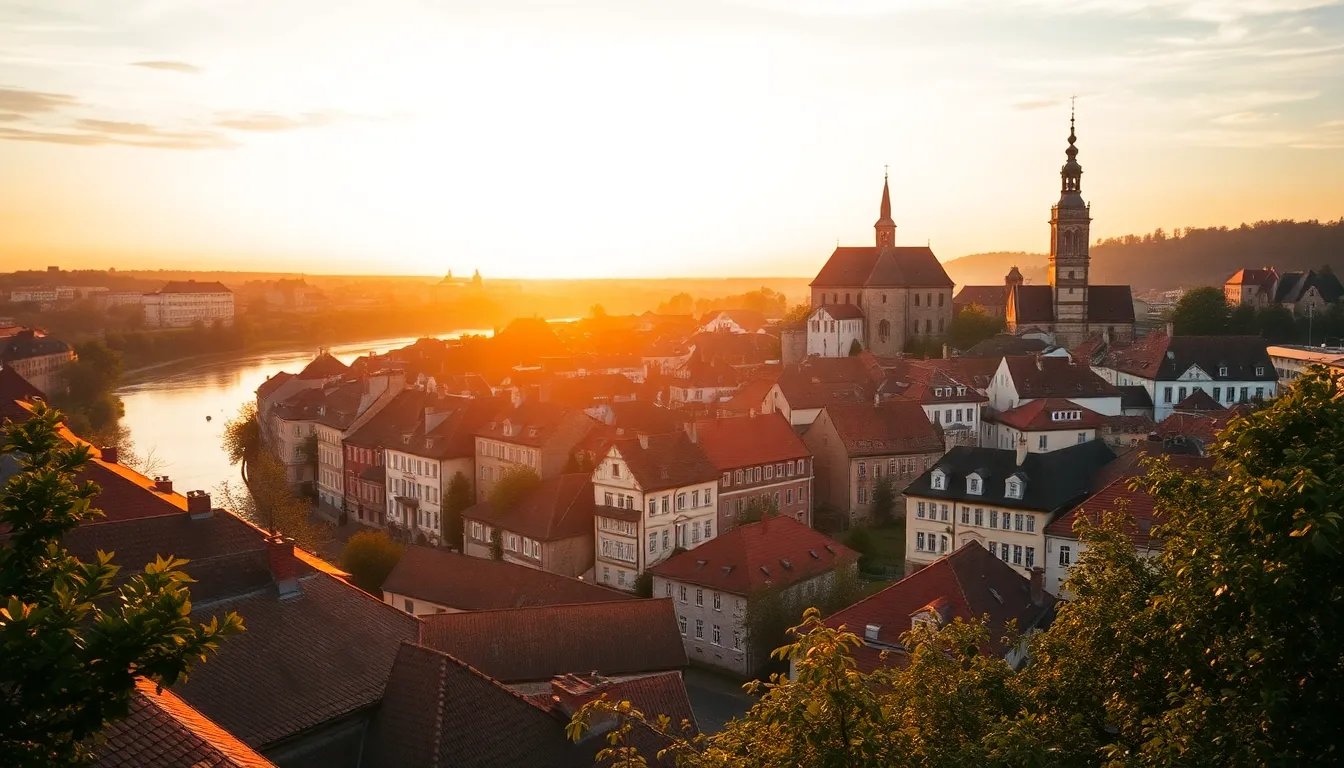
There is a town in Poland that almost no foreign group visits, and every time I bring one there, the leader asks me why it took them this long to hear about it. Sandomierz sits on a bluff above the Vistula in southeastern Poland, between Krakow and Lublin, and it is one of the most beautiful and best-preserved old towns in the country. It survived the wars that flattened so much of Poland. The medieval streets are real. The cathedral is original. And the Jewish heritage, while emptied of the community that built it, is among the best-preserved in its region.
For a heritage group, Sandomierz offers something the major cities do not: a complete, intact old town where Polish Catholic and Jewish life sat side by side for seven hundred years. This is an orientation to the town and the wider stretch of Vistula towns it anchors. If you are routing a group between Krakow and the eastern sites, this is a stop worth knowing.
Sandomierz and the Vistula Towns
A Town That Survived
Most of Poland’s heritage carries the mark of destruction. Sandomierz is an exception. The town came through the Second World War largely intact, which means the medieval and Renaissance core you walk through is genuine, not rebuilt. For a group accustomed to reconstructions, the difference is immediate. These are the actual streets, the actual market square, the actual gates that merchants and pilgrims and Jewish traders walked for centuries.
Sandomierz grew rich on the Vistula trade. It was one of the most important towns in medieval Poland, a royal town on the river route that carried grain and goods toward the Baltic. The string of towns along this stretch of the Vistula, Sandomierz chief among them, formed a commercial and religious corridor that shaped southeastern Poland. A group that understands the river understands why these towns mattered.
Why a Group Should Come Here
I bring groups to Sandomierz because it is a place where the layers sit together visibly and intact. In a single afternoon your community can walk the Catholic cathedral, the Jewish street, the old market, and the gates, all within a few minutes of each other, all original. It is human-scaled and walkable in a way the big cities are not, which makes it ideal for a group that wants to feel a place rather than be processed through it.
The Cathedral and the Catholic Heritage
The Cathedral Basilica of the Nativity of the Blessed Virgin Mary is the heart of Catholic Sandomierz. A Romanesque prayer house stood on the site in the early twelfth century, and the building was rebuilt as a Gothic church in the fourteenth. It is one of Poland’s ancient architectural monuments, and its interior carries centuries of religious art and the long continuity of worship that the town never lost.
Around the cathedral, the old town holds a remarkable density of monuments for a place its size: the Opatow Gate, the last of the medieval town gates still standing, the Renaissance town hall on the market square, the underground merchant tunnels carved beneath the streets, and the castle above the river. For a Christian group, the cathedral and the surrounding ecclesiastical buildings give a compact, unbroken picture of Polish Catholic life across the medieval and Renaissance centuries. Nothing here was rebuilt to look old. It simply is old.
The Jewish Heritage of Sandomierz
Seven Centuries of Community
Jews first arrived in Sandomierz in the thirteenth century, and the first synagogue was built here in 1255. By the sixteenth century the town held one of the largest Jewish communities in Poland. Before the Second World War, Jews made up around forty percent of the town’s population. This was not a marginal presence. Jewish life was woven into the commercial and daily fabric of Sandomierz for seven hundred years.
The Surviving Synagogue
The synagogue your group can visit stands on the old Jewish street. It was built in 1758 after an earlier synagogue burned, and it is considered one of the best externally preserved Jewish monuments in its region. Inside, remnants of polychrome decoration survive, painted with zodiac signs and biblical scenes in the eighteenth and nineteenth centuries. The building was devastated by the Germans in the war and rebuilt afterward, and since the 1970s it has housed the state archive. The structure stands, the painted traces remain, and the street still carries the name and shape of the community that lived here.
The Weight of What Was Lost
In October 1942, around 3,200 Jews were deported from Sandomierz to the Belzec death camp. The community that had lived here for seven centuries was destroyed in a matter of days. Walking the Jewish street with that knowledge, your group feels the absence that sits under the intact buildings. The town survived. Its Jewish community did not. For a Jewish group, Sandomierz holds both the long flourishing and the swift erasure in a single, walkable space.
Practical Orientation for Group Leaders
Where It Fits in a Route
Sandomierz sits roughly between Krakow and Lublin, which makes it a natural stop on a route connecting the two. I often place it as a break in a longer drive, a half-day or full-day stop that gives the group an intact, human-scaled town after the intensity of the larger heritage sites. There are hotels in the town for groups that want an overnight, which I recommend if your schedule allows, because the old town is at its most beautiful in the early morning and evening light.
Pacing
The town is compact and walkable, which makes it easy on mixed-age groups. The cathedral, the synagogue, the market square, and the gates are all within a short walk of each other. A good guide can take a group through the Catholic and Jewish heritage in a single unhurried afternoon, leaving room for the underground tunnels or the castle if time allows.
When to Visit
Late spring through early fall gives the best weather and the best light on the river bluff. Sandomierz is lovely in autumn, when the colors come to the Vistula valley and the crowds, never large here, thin further.
FAQ: Sandomierz and the Vistula Towns
What is Sandomierz known for?
Sandomierz is one of Poland’s best-preserved medieval old towns, sitting on a bluff above the Vistula in the southeast. It survived the Second World War largely intact, so its cathedral, market square, town gates, and Jewish street are original rather than rebuilt. It was a major royal trading town on the Vistula river route.
What Jewish heritage can a group see in Sandomierz?
The main site is the synagogue on the old Jewish street, built in 1758 and considered one of the best externally preserved Jewish monuments in its region, with surviving traces of painted decoration inside. Jews lived in Sandomierz for seven centuries and made up around forty percent of the population before the war. The community was deported to Belzec in 1942.
What is the Sandomierz cathedral?
The Cathedral Basilica of the Nativity of the Blessed Virgin Mary stands at the heart of the old town. A Romanesque prayer house occupied the site in the early twelfth century, and the building was rebuilt as a Gothic church in the fourteenth. It is one of Poland’s ancient architectural monuments and the center of the town’s Catholic heritage.
How does Sandomierz fit into a Poland itinerary?
It sits between Krakow and Lublin, making it a natural stop on a route connecting the two. Most groups visit for a half-day or full day, with an overnight option for those who want the early and late light on the river bluff. The compact, walkable old town suits mixed-age groups well.
Is Sandomierz suitable for older travelers?
Yes. The old town is small and walkable, with the cathedral, synagogue, market square, and gates all close together. There is some gentle elevation on the bluff, but no demanding walking. A good guide can cover the heritage in an unhurried afternoon.
If Sandomierz fits the route you are building for your community, I would be glad to help you place it. Start with the full Poland heritage travel guide, then explore our group heritage tours and our Poland destination planning. When you are ready, reach out through our contact page.