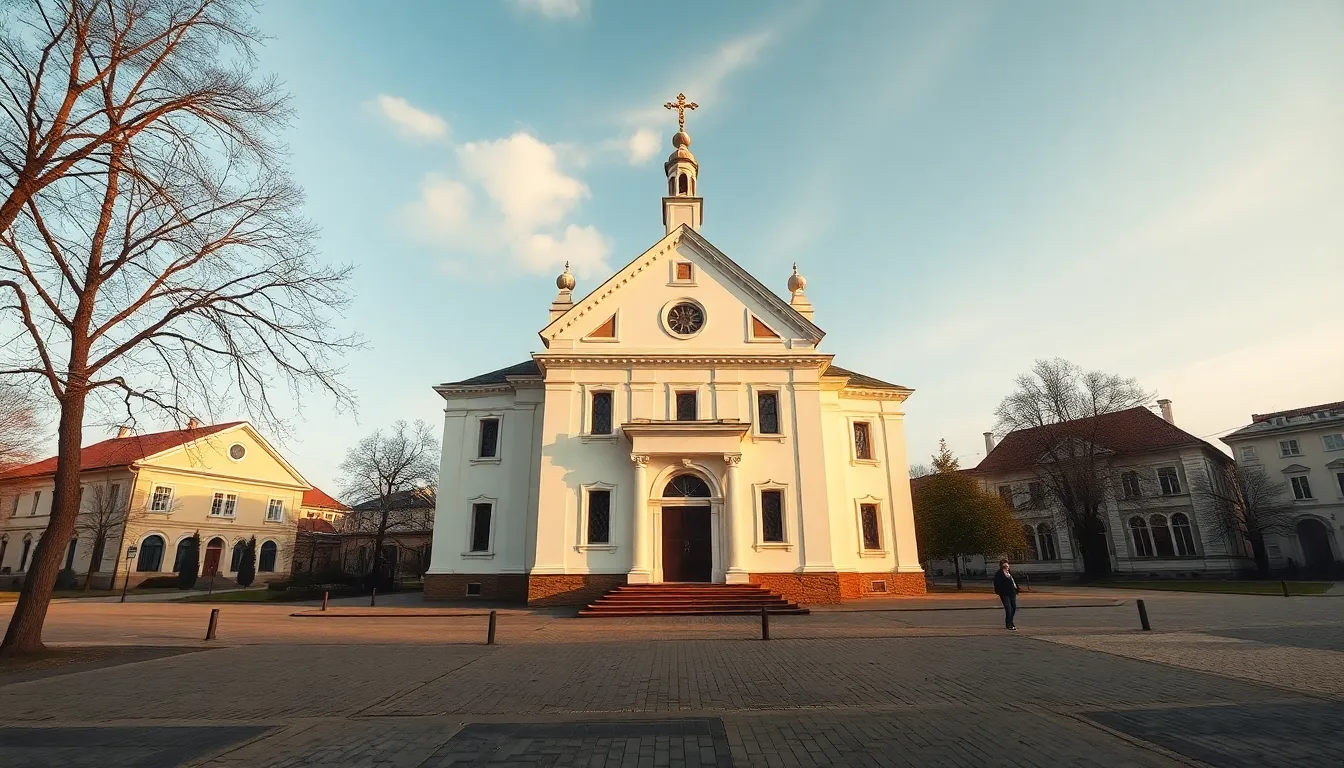
There is a small town in northeastern Poland called Tykocin, and I have watched it undo people. We arrive after a quiet drive through farmland, we walk into a white baroque synagogue that has stood since 1642, and something happens. The building is perfect. The walls are covered in Hebrew prayers. The bimah rises in the center. And then your guide tells you that in August 1941, the entire Jewish community of this town, every man, woman, and child, was marched into the Lopuchowo forest nearby and shot in a single day. The synagogue survived. The community did not.
I have spent more than forty years bringing groups to Poland, and the northeast holds a particular kind of heritage. This was the heartland of the shtetl, the small-town Jewish world that shaped so much of Ashkenazi life, and it was destroyed in a way that differs from Auschwitz. Here, much of the killing happened in forests, town by town, by bullets rather than by gas. Let me walk you through this region and how to bring your community here with the care it requires.
The World the Northeast Held
Before the war, northeastern Poland was one of the densest centers of Jewish life on earth. This region, stretching around Bialystok and into the borderlands that touched Lithuania and Belarus, was the world of Litvak Jewry and the shtetl. Towns that look small and ordinary today were once majority Jewish, full of synagogues, study houses, markets, and the daily rhythm of a self-contained community.
This is the world of the storybooks and the family trees, the place that Sholem Aleichem wrote about and that millions of Jewish families across America and Israel come from. It produced great rabbis, Yiddish writers, labor organizers, and ordinary families who lived here for centuries. Understanding the northeast means understanding that what was lost here was not only people but an entire civilization of small-town life.
Bialystok: The City at the Center
Bialystok is the largest city in the region, with around 300,000 people today. Before the war it was a major industrial and Jewish center, with Jews making up roughly half the population. It was a city of textile mills, political movements, and a famous Jewish cultural life. The doctor who invented Esperanto, Ludwik Zamenhof, grew up here in a city where many languages met.
The Great Synagogue Memorial
The most important site in Bialystok is also one of the most painful. The city’s Great Synagogue was a magnificent domed building. In June 1941, the Germans locked hundreds, by some accounts up to two thousand, of the city’s Jews inside it and set it on fire. Today a memorial stands at the site: a twisted metal sculpture echoing the collapsed dome. It is a quiet place in a modern city, easy to miss, and standing there with a group is a sobering way to begin understanding what happened in Bialystok.
The Ghetto and the Uprising
Bialystok had a ghetto, and in August 1943 it had an uprising. When the Germans moved to liquidate the ghetto, a Jewish resistance organized and fought, knowing they could not win. The Bialystok ghetto uprising is less famous than Warsaw’s, but it carries the same weight: a community choosing resistance in the face of certain death. There are memorials marking the ghetto area and the uprising, and a good guide can help your group walk this history through what is now an ordinary urban neighborhood.
Branicki Palace and the City’s Other Layers
Bialystok is not only a site of loss. The Branicki Palace, an eighteenth-century baroque residence sometimes called the “Versailles of Podlasie,” anchors the city center with its gardens and grandeur. It gives your group a sense of the city’s older history and a place to breathe between the heavier sites.
Tykocin: The Shtetl Preserved and Destroyed
If you visit one place in the northeast outside Bialystok, make it Tykocin. It is about a forty-minute drive from the city, and it is the most complete picture of shtetl life and shtetl death in the region.
The Synagogue
The Tykocin synagogue, built in 1642, is one of the oldest and best-preserved synagogues in Poland. Its interior is largely intact: the painted walls, the Hebrew inscriptions, the central bimah. It functions today as a museum. Walking in, your group sees not a ruin but a living-looking space, which makes the history that follows even harder to absorb.
The Lopuchowo Forest
On August 25 and 26, 1941, the German police and their auxiliaries marched the Jews of Tykocin into the Lopuchowo forest and shot them over pits. Around 2,000 people were murdered. There are memorial stones in the forest today. Many groups walk from the synagogue, where the community lived and prayed, to the forest, where it ended. That walk, from the heart of the town to the killing ground a few kilometers away, communicates the geography of the Holocaust in the east more powerfully than any lecture. I always build quiet time into this part of the day.
Treblinka and the Eastern Camps
The northeast is also the approach to Treblinka, the death camp where roughly 800,000 Jews were murdered, including most of the Warsaw Ghetto. Treblinka is different from Auschwitz: the Germans dismantled it, so there are no buildings, no barracks, no structures to walk through. What remains is a field of 17,000 stones, each one representing a destroyed community. The absence is the point. Many group leaders tell me Treblinka stays with their community longer than any other site. Depending on your route, it pairs naturally with a northeast itinerary, since it sits between this region and Warsaw.
Leading a Group Through This Region
A Different Kind of Holocaust History
I want to prepare you for something. The Holocaust your group encounters in the northeast is the “Holocaust by bullets,” the mass shootings in forests and fields that preceded and ran alongside the death camps. It is more intimate and, in some ways, harder. There is no famous gate, no infamous name everyone recognizes. There is a beautiful synagogue and a forest a short walk away. Brief your group on this beforehand. People process forest killing sites differently than they process camps, and they should know what they are walking into.
Sequencing and Reflection
Do not stack these sites without room to breathe. After the Tykocin forest, your group will need quiet. After the Bialystok synagogue memorial, give people space before moving on. The emotional arc of the day matters as much as the sites themselves. This is something Heritage Tours builds into every northeast itinerary.
Where It Fits
The northeast pairs naturally with Warsaw, about two and a half to three hours away, and with Treblinka in between. For groups building a wider route, our Poland heritage travel guide shows how these regions connect, and the contrast with the Galicia trail in the south helps your group understand that Jewish Poland was not one world but many.
The Free Leader Program
If you are organizing a heritage group of 15 or more, your travel is covered. You fly free, stay free, and tour free. For the person doing the work of preparing a congregation for a journey this heavy, that support matters. You can see how it works across our group heritage tours and read more about the country on our Poland destination page.
FAQ: Bialystok and Northeastern Jewish Heritage
What is Tykocin known for?
Tykocin is a small town near Bialystok with one of the oldest and best-preserved synagogues in Poland, built in 1642 and intact inside. It is also the site of one of the early mass shootings of the Holocaust: in August 1941, around 2,000 of the town’s Jews were marched into the nearby Lopuchowo forest and murdered. The contrast between the preserved synagogue and the forest killing site makes Tykocin one of the most affecting stops in the region.
Why is northeastern Poland significant for Jewish heritage?
The northeast was one of the densest centers of Jewish life in Europe and the heartland of the shtetl, the small-town Jewish world that shaped so much of Ashkenazi and Litvak culture. Towns that look ordinary today were once majority Jewish. Many Jewish families across America and Israel trace their roots to this region.
What happened to the Jews of Bialystok?
Before the war, Jews made up roughly half of Bialystok. In June 1941, the Germans burned hundreds of the city’s Jews inside the Great Synagogue. A ghetto was established, and in August 1943 it rose in armed revolt during its liquidation. The Bialystok ghetto uprising is one of the major acts of Jewish resistance in the Holocaust, less famous than Warsaw’s but no less significant.
Is Treblinka part of a northeast itinerary?
Often, yes. Treblinka, where roughly 800,000 Jews were murdered, sits between the northeast and Warsaw, so many groups include it on the route. The Germans dismantled the camp, so there are no buildings, only a field of 17,000 memorial stones representing destroyed communities. The absence makes it one of the most powerful memorial sites in Poland.
How should a group prepare emotionally for this region?
The Holocaust here is the “Holocaust by bullets,” mass shootings in forests rather than killings in camps. It is intimate and difficult in a different way. Brief your group beforehand so they understand what forest killing sites involve. Build quiet time into the day, especially after the Tykocin forest, and do not stack the heavier sites without room to reflect.
If you are considering bringing your community to the Jewish heartland of northeastern Poland, I would be glad to help you plan it with the care it deserves. This region asks something real of a group, and the preparation matters as much as the visit. Reach us any time through our contact page.