Most people think of Morocco as a travel destination. Souks, tagine, the Sahara. But when you step inside the Ibn Danan Synagogue in Fez, or stand beneath the minaret of the Hassan II Mosque at dawn, or walk the ruins of a Roman basilica at Volubilis, something else becomes clear. This is a place where three Abrahamic faiths left their marks, not just in stone but in the way people lived together for centuries.
I’ve been bringing faith communities to Morocco for decades, and the question I hear most often is, “I didn’t know Morocco had all of this.” It does. And for Jewish, Christian, and Muslim heritage travelers, what Morocco holds is not a museum. Much of it is still alive.
Why Morocco Is a Faith Destination, Not Just a Heritage Destination
Heritage is about what happened. Faith is about what still happens. In Morocco, those two things overlap in ways you don’t find in most countries.
Jewish pilgrims still travel to the graves of venerated sages in the Moroccan countryside. The call to prayer still echoes through medinas built a thousand years ago. And at Volubilis, the ruins of North Africa’s earliest Christian churches still stand in the sun.
For group leaders, whether you’re a rabbi, a pastor, or a community organizer, Morocco offers your group the chance to witness all of this in a single week. That’s rare. Our Morocco heritage guide covers the country’s full story, but this post focuses on the sacred spaces specifically.
Jewish Sacred Sites
The Fez Mellah and Its Synagogues: Where Prayer Continued for Centuries
The mellah of Fez is the oldest Jewish quarter in Africa. At its peak, thousands of Jewish families lived here, prayed here, conducted business, and raised children within walking distance of some of the Islamic world’s greatest mosques. The synagogues in the mellah were the spiritual anchor of that community.
Today, the mellah is quieter. But the prayer spaces remain, and walking through them with your group carries a weight that catches people off guard. For a deeper look at Morocco’s Jewish history across the country, our Jewish heritage guide covers each city’s story.
The Graves of Tzaddikim: Jewish Pilgrimage Sites in Morocco
This is the part of Morocco’s Jewish sacred geography that most travelers don’t know about. Across the countryside, in small towns and villages, the graves of tzaddikim, righteous sages, are still visited by Sephardic and Mizrachi Jewish pilgrims every year. The Hiloula pilgrimages to these sites are a living tradition, not a historical footnote.
The most visited include Rabbi Amram Ben Diwan near Ouezzane, Rabbi Haim Pinto in Essaouira, and several sites in the Draa Valley. For Jewish groups, adding one or two of these to the itinerary transforms the trip from heritage tourism into something closer to pilgrimage.
The Ibn Danan Synagogue: Active Prayer Space Restored
In the heart of the Fez mellah, the Ibn Danan Synagogue has been carefully restored. It’s small, beautiful, and structurally intact. The mikveh (ritual bath) below the synagogue is still visible. Standing inside, your group can see how Jewish worship functioned in Morocco, how the space was designed for prayer, study, and community gathering.
This is not a relic. It’s a prayer space that has been given back its dignity.
Islamic Sacred Sites for Non-Muslim Visitors
Hassan II Mosque, Casablanca: What You’ll Experience Inside
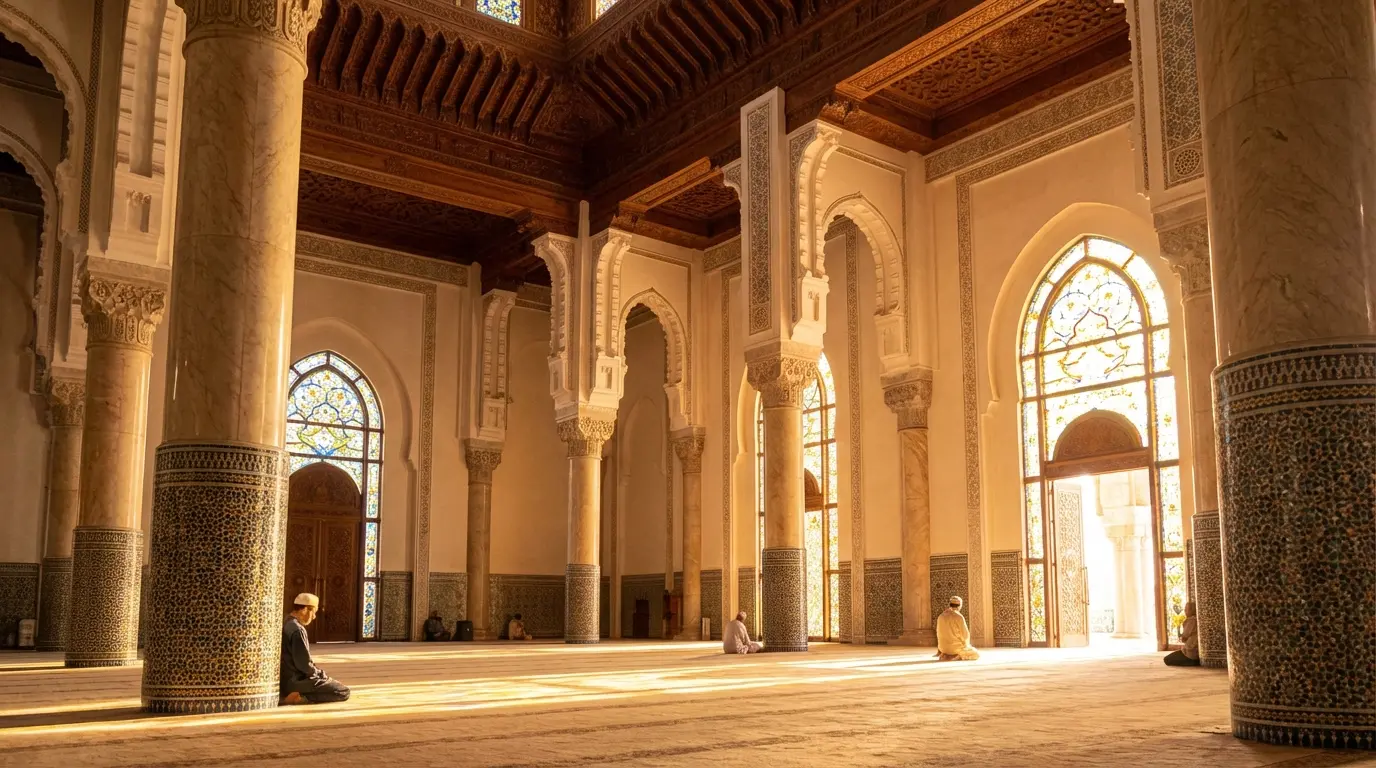
The Hassan II Mosque is the third largest mosque in the world. Its minaret rises 210 meters. The interior holds 25,000 worshippers, and the roof opens to the sky. For non-Muslim visitors, it’s one of the few mosques in Morocco that offers guided interior tours.
What makes this visit meaningful for faith travelers is not just the scale. It’s the intention behind the architecture. Every detail, the carved cedarwood, the zellige tilework, the marble floors, was designed as an act of worship. For your group, regardless of their own faith tradition, being inside this space is an encounter with devotion expressed through craft.
The Fez Medina: A City Built Around Worship
Fez’s medina is a UNESCO World Heritage Site, the largest car-free urban area in the world, and at its center sits the Qarawiyyin Mosque, founded in 859 CE. The mosque itself is generally not open to non-Muslim visitors, but the madrasa complexes nearby, particularly the Bou Inania Madrasa, are open and are among the finest examples of Islamic architecture in North Africa.
Walking through the medina, your group will hear the call to prayer echo through narrow streets. That sound has been part of this city’s daily rhythm for over a thousand years.
How to Visit a Mosque Respectfully as a Non-Muslim Guest
Most mosques in Morocco are closed to non-Muslim visitors, with a few important exceptions like the Hassan II Mosque. When you do visit a mosque or sacred Islamic site, here’s what your group should know.
Remove your shoes before entering. Women should bring a scarf to cover their hair. Dress modestly, covering shoulders and knees. Speak quietly. Don’t walk in front of anyone who is praying. Photography may be restricted, so ask first.
None of this is complicated. It’s the same respect you’d show entering any house of worship that isn’t your own. Brief your group before the visit, and they’ll be fine.
Morocco’s Early Christian History
Volubilis: Roman Basilica and the First Churches of North Africa
Before Morocco was an Islamic kingdom, before the Jewish communities established themselves in the mellahs, North Africa was part of the Roman Empire. Volubilis, near Meknes, holds the ruins of a Roman city that included Christian basilicas dating to the 3rd century CE.
For Christian groups, Volubilis is a revelation. The connection between North Africa and early Christianity is well documented but rarely visited. Standing in the remains of a basilica that predates most European churches gives your group a sense of how far and how early the faith spread.
The Coptic and Catholic Presence in Modern Morocco
Morocco today has small but active Catholic and Protestant communities, particularly in Casablanca, Rabat, and Tangier. Catholic churches built during the French protectorate period still hold services. The Cathedral of the Sacred Heart in Casablanca, though no longer used for worship, is an architectural landmark worth seeing.
For Christian group leaders, knowing that their faith tradition has a living presence in Morocco, however small, adds a layer of meaning to the visit.
Interfaith Reflection: What Morocco Shows Faith Communities
The Story of How Three Faiths Shared a Country for Centuries
Morocco’s history is not a story of perfect harmony. There were periods of tension, periods of prosperity, and periods of loss. But the fact remains that for hundreds of years, Jewish, Muslim, and Christian communities lived in the same cities, walked the same streets, and contributed to the same culture.
The mellahs were separate quarters, yes. But they were inside the city walls, not outside them. Jewish advisors served Muslim sultans. Muslim rulers protected Jewish communities. The relationship was complicated, real, and enduring.
For faith communities visiting Morocco together, or even a single congregation visiting on their own, this history raises questions worth sitting with. What does coexistence look like? What does it cost? What does it create?
Planning Your Group’s Spiritual Itinerary in Morocco
A spiritual itinerary through Morocco doesn’t have to choose between traditions. The best trips we’ve designed include Jewish, Islamic, and Christian sacred sites in the same week, because that’s what Morocco actually is.
Our 10-day Morocco itinerary shows what this looks like day by day. And if you’re a group leader considering this trip, our group leader guide walks through the planning process.
The first step is simple. Tell us about your community, what matters to them, what questions they’re carrying, and we’ll build an itinerary around that. Reach out through our group tour page whenever you’re ready.
Frequently Asked Questions
Can non-Muslims visit mosques in Morocco? Most mosques in Morocco are closed to non-Muslim visitors. The major exception is the Hassan II Mosque in Casablanca, which offers guided tours of its spectacular interior. Some historic madrasas (Islamic schools) are open to all visitors and offer a similar experience of Islamic architecture and sacred space.
What Jewish pilgrimage sites are in Morocco? Morocco has dozens of Jewish pilgrimage sites, primarily the graves of tzaddikim (righteous sages) scattered across the country. The most visited include Rabbi Amram Ben Diwan near Ouezzane, Rabbi Haim Pinto in Essaouira, and several in the Draa Valley. Sephardic and Mizrachi communities still make annual Hiloula pilgrimages to these sites.
Does Morocco have Christian heritage sites? Yes. Volubilis, near Meknes, holds the ruins of Roman-era Christian basilicas dating to the 3rd century CE. Morocco also has active Catholic and Protestant churches in Casablanca, Rabat, and Tangier, many built during the French protectorate period. The early Christian history of North Africa is well documented but rarely included on standard tours.
What makes the Hassan II Mosque significant for faith travelers? Beyond its scale, the third largest mosque in the world, the Hassan II Mosque represents devotion expressed through extraordinary craftsmanship. The carved cedarwood, zellige tilework, and marble were created by thousands of Moroccan artisans. For faith travelers of any background, being inside this space is an encounter with the relationship between worship and beauty.
What are the graves of tzaddikim in Morocco? Tzaddikim are righteous Jewish sages whose graves became sites of veneration and pilgrimage. In Morocco, these graves are found across the country, from northern cities to remote southern villages. Families visit to pray, light candles, and ask for blessings. The tradition is particularly strong in Sephardic and Moroccan Jewish communities and continues to this day.