Why Greece’s Most Important Heritage Sites Aren’t the Famous Ones
Greece is one of the most written-about countries on earth. Everyone knows the Parthenon, the Acropolis, the islands. And those places are genuinely extraordinary. But after more than forty years in this work, I can tell you that the sites that move people most are rarely the famous ones. They are the places where a group stands in a small synagogue in a mountain town and learns that Jewish worship has happened in that room for over two thousand years. Or where a pastor reads from Acts on the exact shore where Paul first stepped onto European soil, and the group goes quiet.
Greece is full of these places. They are not in the standard guidebooks, not on the typical tour route, and most visitors never know they exist. But for faith communities, they are the reason to come.
Ioannina: The Romaniote Jews and Their Unique 2,000-Year Tradition
In the mountains of northwestern Greece, the city of Ioannina holds one of the most remarkable Jewish stories in the world, and almost nobody knows it.
The Romaniote Jews of Ioannina are not Sephardic. Their community predates the Spanish expulsion by over a thousand years. Their liturgical traditions, their music, their customs developed entirely independently. When Sephardic Jews arrived in Greece after 1492, the Romaniote communities were already ancient.
The Ioannina Synagogue, known as Kehila Kedosha Yashan, still stands. The Jewish museum in the old quarter tells the story of a community that numbered roughly 2,000 before the war. In March 1944, nearly all were deported to Auschwitz. Fewer than 100 returned.
What survives in Ioannina is precious precisely because it is so rare. The Romaniote tradition exists almost nowhere else on earth. For a Jewish congregation, visiting Ioannina is not a detour from the main itinerary. It is a pilgrimage to one of the oldest continuous Jewish traditions in the Diaspora.
Rhodes’ La Juderia: One of the Best-Preserved Jewish Quarters in Europe
The Jewish Quarter of Rhodes, known as La Juderia, sits inside the medieval walled city. The narrow streets, the stone archways, the small courtyards are still intact. It is one of the best-preserved Jewish quarters anywhere in Europe, and walking through it feels like stepping into another century.
At its heart is the Kahal Shalom Synagogue, built in 1577 and still in active use. It is the oldest synagogue in Greece, and during summer months, services are still held for the small remaining community and visitors who come to pray.
Before the war, roughly 2,000 Jews lived in La Juderia. In July 1944, nearly all were deported. The Square of the Jewish Martyrs, at the center of the quarter, now holds a memorial with a seahorse fountain. The names are inscribed. Standing there with a group and reading them aloud is something that stays with people long after the trip ends.
What makes Rhodes different from many Holocaust memorial sites is that the physical space survived. The homes, the streets, the synagogue. You can see where people lived, where they worshipped, where they gathered. That physical continuity gives the memorial a particular power.
Berea (Veria): Where Paul Preached to the Noble Bereans
In the book of Acts, chapter 17, Paul arrives in Berea after being forced out of Thessaloniki. What he finds there is a Jewish community that responds to his teaching by going home and checking the scriptures for themselves. The text calls them “more noble” than the Thessalonians because they examined the evidence rather than simply accepting or rejecting what they heard.
The modern city of Veria, about an hour west of Thessaloniki, preserves this heritage. The Bema of the Apostle Paul, a small monument and mosaic at the traditional site where Paul preached, sits in a quiet neighborhood. It is not grand. There are no crowds. But for a Christian group studying Acts, standing there and reading the passage aloud is the kind of moment that gives a heritage trip its meaning.
Veria also has a small but well-preserved Jewish quarter with several surviving synagogues, a reminder that Paul’s audience in Berea was the local Jewish community.
Nea Anchialos: Early Christian Basilicas Almost No One Visits
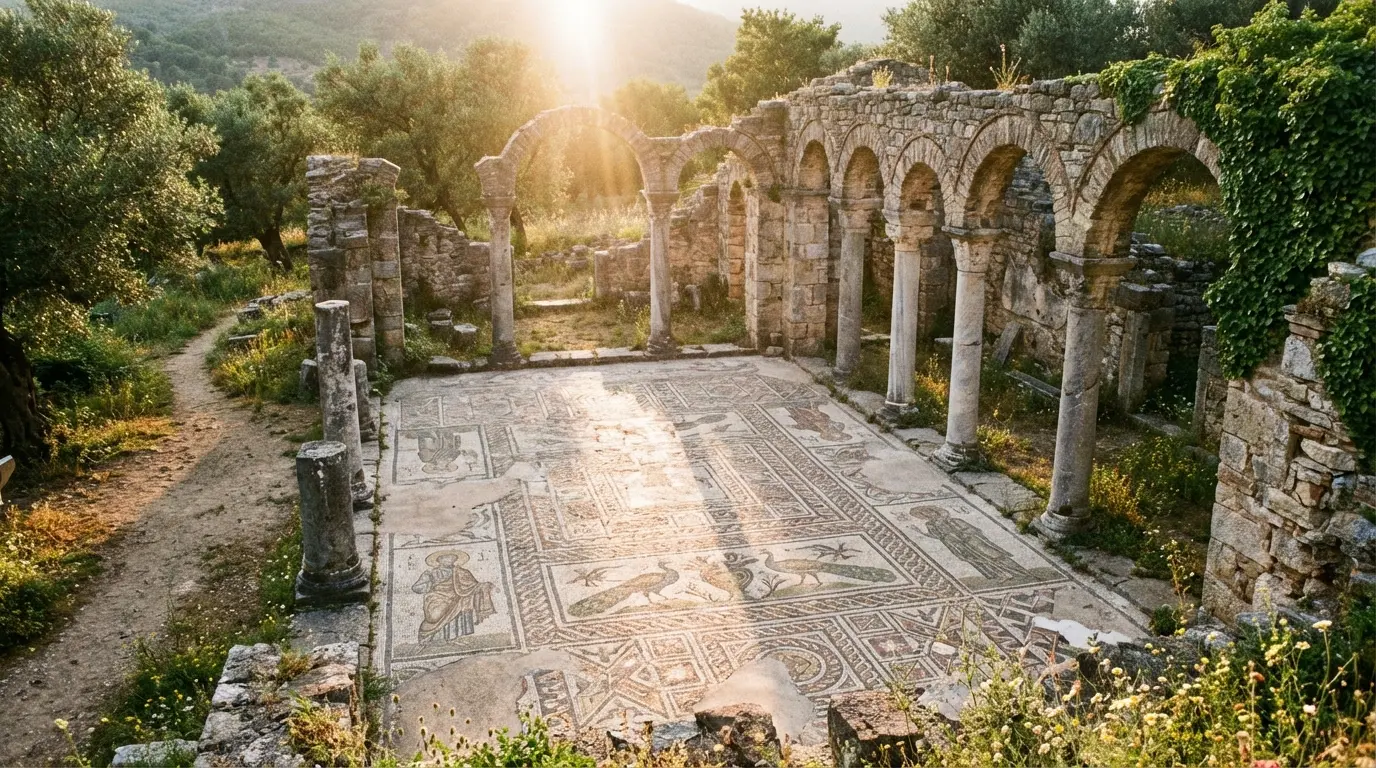
South of the city of Volos, the archaeological site of Nea Anchialos contains a remarkable collection of early Christian basilicas dating from the fourth to sixth centuries. The floor mosaics are among the finest surviving examples of early Christian art in Greece.
This is not a site that appears in any standard tour package. Most visitors to Greece have never heard of it. But for a group interested in the development of the early church, Nea Anchialos offers something rare: a chance to see how Christian communities worshipped in the centuries immediately after the faith’s establishment in Greece. The basilicas are well-excavated, the mosaics are beautiful, and you will very likely have the site to yourselves.
Kavala (Ancient Neapolis): Where Paul First Set Foot in Europe
Kavala, in northeastern Greece, was the ancient port of Neapolis. According to Acts 16, this is where Paul and his companions landed after crossing from Troas. It is, by the biblical account, the place where the gospel first physically arrived on European soil.
The modern city still has its ancient harbor. The fortress above offers a view of the coastline Paul would have seen as his ship approached. A short drive inland brings you to Philippi, where Paul established the first Christian community in Europe and where the archaeological remains include a Roman forum, a theater, and a structure traditionally identified as the prison where Paul and Silas were held.
Kavala and Philippi together form a natural half-day experience that most Greece tours overlook entirely. For a church group, this is not a minor stop. This is where Europe’s Christian story begins.
How to Add These Sites to Your Greece Group Itinerary
None of these sites appear on a standard Greece tour package. That is the point. A heritage journey to Greece should not follow the same path that every tourist follows.
At Heritage Tours, we build custom itineraries that can include Ioannina, Rhodes, Veria, Kavala, and Nea Anchialos alongside the better-known heritage sites in Athens and Thessaloniki. We have local operators on the ground in these smaller cities, which means access to sites that require local knowledge and relationships to visit properly.
Group leaders travel free with fifteen or more participants, and the financial benefit makes it easier to build a more thoughtful, less standard itinerary. If your congregation is considering Greece, it is worth knowing what exists beyond the guidebook.
Frequently Asked Questions
What is the Romaniote Jewish tradition and how is it different from Sephardic? The Romaniote Jews are Greek-speaking Jews whose presence in Greece dates back over 2,000 years, well before the Sephardic expulsion from Spain in 1492. Their liturgical customs, melodies, and religious practices developed independently. The community in Ioannina is the primary surviving center of this tradition, and it is genuinely distinct from the Sephardic communities of Thessaloniki and Rhodes.
Is Rhodes’ Jewish Quarter accessible for group tours? Yes. La Juderia sits inside the medieval walled city of Rhodes, and the streets are pedestrian-friendly. The Kahal Shalom Synagogue and the Square of the Jewish Martyrs are both open to visitors. Groups should plan for about two hours to walk the quarter at a meaningful pace. A local guide with knowledge of the community’s history makes a significant difference.
Where did Paul first arrive in Europe? According to Acts 16, Paul sailed from Troas (in modern Turkey) to Neapolis, the ancient port of Kavala in northeastern Greece. From there, he traveled inland to Philippi, where he established the first Christian community in Europe.
What is La Juderia in Rhodes? La Juderia is the Jewish Quarter within the medieval walled city of Rhodes. It includes the Kahal Shalom Synagogue (built in 1577, the oldest in Greece still in active use), the Jewish Museum, and the Square of the Jewish Martyrs. The quarter’s physical structure is remarkably well-preserved.
Are these hidden heritage sites accessible by bus for large groups? Most are, with some planning. Kavala, Veria, and Nea Anchialos are all accessible by coach. Ioannina requires either a domestic flight or a longer drive from Thessaloniki. Rhodes requires a short flight or ferry. We handle the routing for each group so that the travel between sites is smooth and the time is spent where it matters, at the sites themselves.