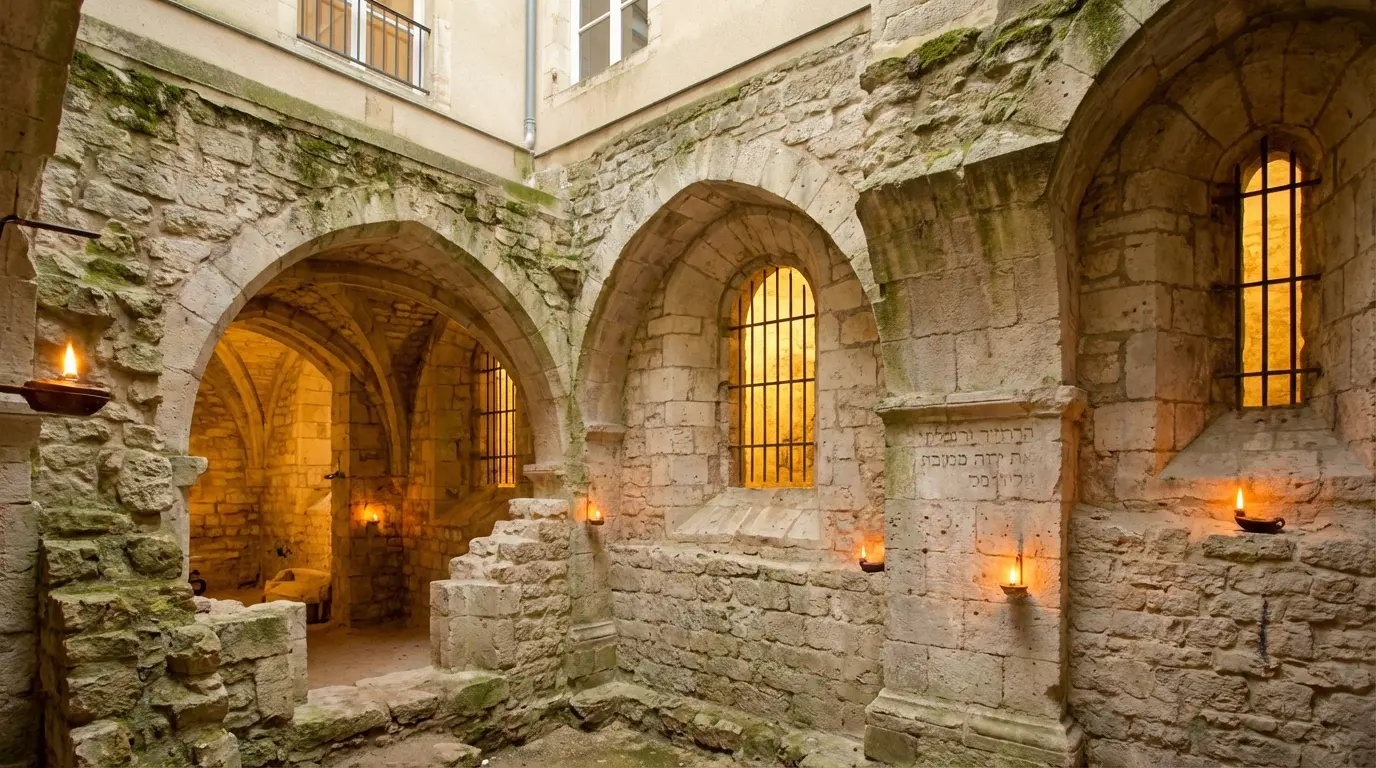
The France Most Heritage Travelers Never See
Everyone knows Notre Dame. Everyone knows Lourdes. But the heritage sites that leave the deepest impression on a group are often the ones that don’t appear in any standard travel guide. I have learned this over four decades of leading heritage journeys: the most meaningful moments happen in places most travelers walk right past.
France is full of these places. A medieval town in Champagne where one of Judaism’s greatest minds lived and taught. A cluster of synagogues in Provence that survived centuries of persecution because of an unlikely protector. Hidden cemeteries in Alsace where the headstones tell the story of communities that thrived for generations.
If you are a rabbi, a pastor, or a community leader planning a group trip to France, these are the places that will set your journey apart. For a broader overview of France as a heritage destination, start with our France heritage travel guide.
Troyes: Walking in Rashi’s Footsteps
Rashi, Rabbi Shlomo Yitzchaki, was born in Troyes in 1040. He wrote the most widely studied commentary on the Torah and Talmud, work that every yeshiva student in the world encounters. His explanations remain the first reference point for anyone learning a page of Gemara.
Yet Troyes, a quiet town about ninety minutes from Paris, receives almost no English-speaking heritage visitors. The town has a Rashi heritage trail that winds through the medieval quarter where he lived. There is an interpretive center dedicated to his life. The old streets where he walked to the study house are still there, narrow and stone-paved.
For a rabbi bringing a synagogue group to France, Troyes is not a detour. It is a destination. Standing where Rashi studied and taught gives the trip a gravity that Paris alone cannot provide. Our Jewish heritage in France guide covers Troyes in full detail.
The Comtat Venaissin: Jewish Communities Under Papal Protection
This is one of the most remarkable stories in European Jewish history, and almost nobody in the English-speaking world knows it.
In 1394, King Charles VI expelled all Jews from the Kingdom of France. In 1290, England had done the same. Spain followed in 1492. Across Europe, Jewish communities were being uprooted and scattered.
But in the Comtat Venaissin, a small territory in Provence controlled by the Pope, Jews were allowed to stay. The papal authorities offered protection, and Jewish life continued in towns like Carpentras, Cavaillon, Avignon, and L’Isle-sur-la-Sorgue. These communities became known as the “Pope’s Jews.”
The synagogue in Carpentras, dating to 1367, is the oldest still in use in France. The synagogue in Cavaillon, built in the 15th century, is now a museum. Walking into these buildings, you feel the weight of continuity. Communities worshipped here for centuries while the rest of Europe was closed to them.
This is the kind of story that transforms a heritage trip from a tour into a pilgrimage. It gives your group something to reflect on together.
Alsace’s Hidden Synagogues and Cemeteries
Alsace, in northeastern France along the German border, has one of the oldest Jewish histories in Western Europe. Before the Shoah, Alsace was home to a dense network of small Jewish communities, each with its own synagogue and cemetery.
Many of those synagogues still stand, though some are now repurposed. The cemeteries, however, are extraordinary. In towns like Jungholtz, Rosenwiller, and Haguenau, the Jewish cemeteries hold headstones dating back centuries. The inscriptions tell stories of families, scholars, and community leaders whose names are otherwise lost to time.
These are not tourist sites. There are no gift shops. Sometimes you need a local contact to unlock the gate. But for a group with the right guide, visiting these cemeteries is one of the most moving experiences available in Jewish heritage travel anywhere in Europe.
Heritage Tours works with local custodians and historians to arrange access to these smaller sites, the kind that general tour companies simply cannot reach.
Vezelay and Cluny: Christian Sites Beyond the Cathedral Circuit
For Christian heritage groups, France’s hidden depth lies beyond the famous cathedrals.
Vezelay sits on a hill in Burgundy, crowned by the Basilica of Sainte-Madeleine. This is where Bernard of Clairvaux preached the Second Crusade in 1146. The Romanesque architecture is among the finest in Europe, and the basilica’s carved tympanum of Christ in Glory is a masterpiece of medieval art. Vezelay is a UNESCO World Heritage Site, yet it remains remarkably uncrowded compared to the major cathedrals.
Cluny was once the heart of the most powerful monastic network in Christendom. The Abbey of Cluny, founded in 910, shaped European Christianity for centuries. Though much of the abbey was destroyed during the French Revolution, the remains and the museum give a real sense of its scale and significance.
Neither Vezelay nor Cluny appears on most tourist itineraries for France. For a pastor building a trip that goes beyond the expected stops, these sites offer a depth of encounter that the famous cathedrals, for all their beauty, sometimes cannot.
How to Build These Hidden Gems Into a Group Itinerary
The practical question is how to fit these lesser-known sites into a trip that also includes the landmarks your group expects to see.
The answer is thoughtful routing. Troyes sits naturally between Paris and Alsace. The Comtat Venaissin communities are a day’s drive from Avignon, which many groups visit anyway for the Papal Palace. Vezelay and Cluny can be woven into a route through Burgundy that connects Paris to Provence.
Heritage Tours builds custom itineraries that include these hidden sites without turning the trip into a marathon. The goal is balance: enough well-known landmarks to orient the group, enough unexpected discoveries to make the journey feel personal.
For a day-by-day example of how this works, see our 10-day heritage itinerary for France.
FAQ: Off-the-Beaten-Path Heritage Travel in France
Where did Rashi live and can you visit his hometown in France? Rashi lived in Troyes, in the Champagne region of France. The town has a heritage trail through the medieval quarter where he lived, along with an interpretive center about his life and scholarship. Troyes is about ninety minutes from Paris by car.
What is the Comtat Venaissin and why does it matter for Jewish heritage travel? The Comtat Venaissin was a papal territory in Provence where Jews were allowed to live even after being expelled from the rest of France in 1394. The synagogues in Carpentras and Cavaillon are among the oldest in Europe and stand as living evidence of this remarkable chapter.
Are there medieval Jewish synagogues still standing in France? Yes. The Carpentras synagogue dates to 1367 and remains in use. The Cavaillon synagogue, from the 15th century, is now a museum. In Alsace, several historic synagogues survive, though some have been repurposed.
What are the best off-the-beaten-path Christian heritage sites in France? Vezelay and Cluny are two of the most important yet least visited. Vezelay’s Romanesque basilica is a UNESCO site, and Cluny was the center of medieval monasticism. Both offer a depth of experience that the famous cathedrals do not always provide.
Can a heritage tour group visit smaller, less-touristed towns in France? Absolutely. Heritage Tours works with local operators and site custodians to arrange access to smaller communities, cemeteries, and historic synagogues that are not open to general visitors. These stops often become the most memorable part of the trip.
The most meaningful moments in heritage travel are rarely the ones you expect. If you want to build a France journey that goes deeper than the guidebook, visit our France destination page or reach out to us. We would be glad to help you find the places that matter most.