When most Christian groups think about Egypt, they think about the Old Testament. The Exodus, the plagues, the Red Sea, Moses on the mountain. All of that is here, and it matters. But there is a second Egypt that many Christian travelers walk right past, and for the right group it is the more moving of the two.
Egypt holds one of the oldest continuous Christian communities on earth. The Coptic Orthodox Church traces itself to the apostle Mark in the first century, which means there were believers worshipping in Egypt while the New Testament was still being written. The churches in Cairo’s Coptic quarter were already ancient when European Christianity was young. The desert monasteries here are where Christian monasticism itself was invented. And the Holy Family, fleeing Herod, sheltered in Egypt, leaving a trail of sites you can still walk.
This itinerary is built for Christian groups who want to trace that story on the ground. It complements the Exodus spine of our 8-day Egypt heritage itinerary, but its center of gravity is the early church, not the early Israelites.
A Word on What Makes This Trip Different
A Coptic heritage trip asks for a different posture than an Exodus trip. The Exodus is about movement, going out, crossing, climbing. Coptic heritage is about continuity, the astonishing fact of a faith community that has held its ground in the same places, through Roman persecution and centuries as a minority, for nearly two thousand years.
So I pace this trip slower. We sit in services. We let the liturgy, much of it still sung in Coptic, the last living descendant of the language of the pharaohs, wash over the group. We spend real time in the monasteries rather than photographing them and moving on. The meaning here is in duration, not spectacle.
Recommended base: a hotel near Old Cairo, within easy reach of the Coptic quarter, with day trips out to the desert monasteries.
Day 1: Coptic Cairo, the Heart of the Story
We begin where the Christian story in Egypt is most concentrated, the Coptic quarter of Old Cairo, built around the old Roman fortress of Babylon.
The Hanging Church, Al-Mu’allaqa, suspended above the old Roman water gate, is one of the oldest churches in Egypt. It carries centuries of Coptic liturgical life in its icons, its worn wooden screens, its very stones. For a Christian group, standing in a place where worship has continued unbroken for well over a thousand years reframes what the faith actually is. Not new. Not fragile. Older than almost anything in the Christian world the group came from.
Nearby sits the Church of Saints Sergius and Bacchus, Abu Serga, built over a crypt where tradition holds the Holy Family sheltered during their flight into Egypt. To stand in that crypt and read the flight narrative from Matthew 2 is to find a chapter of the New Testament with a physical location you can occupy.
The Coptic Museum, in the same quarter, holds the richest collection of Coptic art and manuscripts anywhere, including early texts that connect directly to the formation of Christian Egypt.
I also bring groups to Ben Ezra Synagogue, a few steps away, because the Jewish and Christian communities of Cairo lived side by side for centuries as minorities in a Muslim-majority city. The proximity tells its own story about the layered religious history of this ground.
Day 2: The Wadi Natrun Monasteries
Today we drive into the desert, because Christian monasticism was, quite literally, invented in the Egyptian desert, and the monasteries of Wadi Natrun are where that tradition has lived continuously since the fourth century.
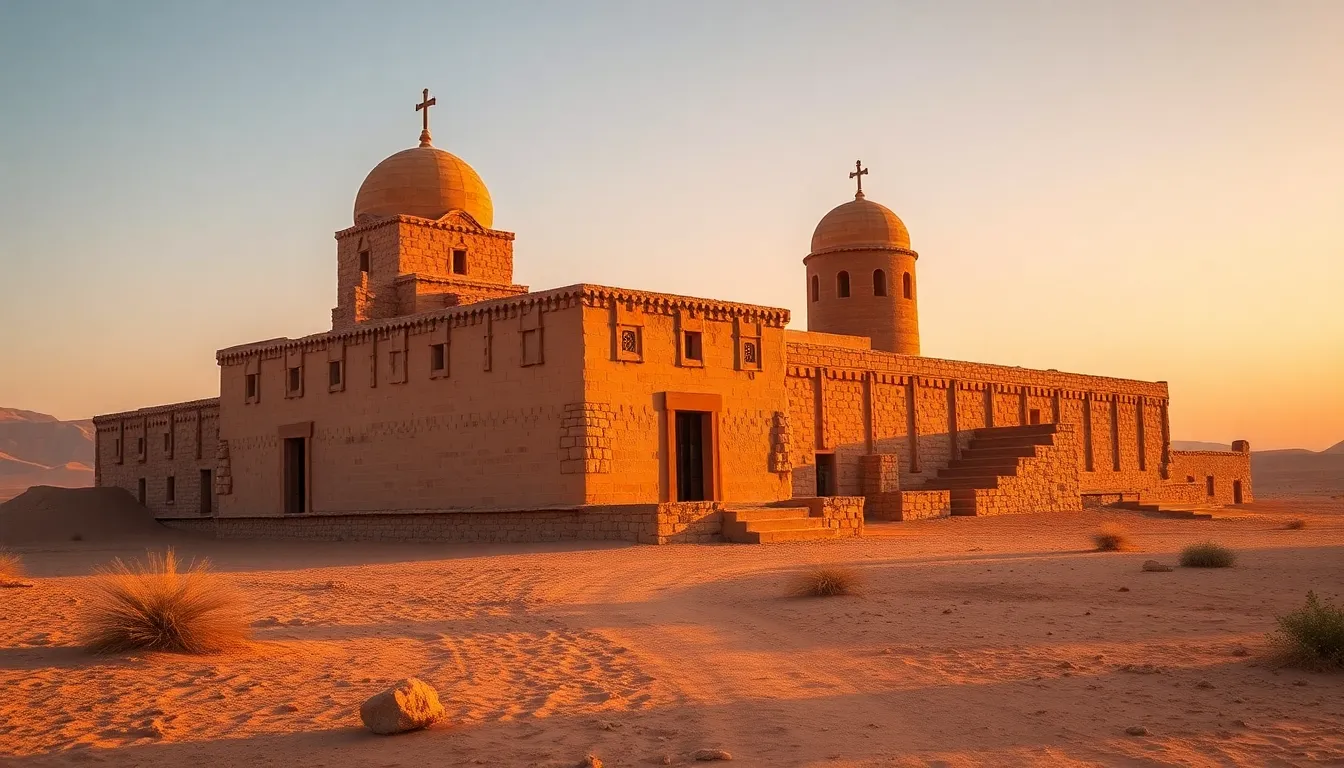
Wadi Natrun, between Cairo and Alexandria, holds several monasteries still active today, including the Monastery of Saint Macarius and the Monastery of the Syrians, Deir al-Surian. These are not ruins. They are working communities of monks living a form of life that has barely changed in 1,600 years. The fortified walls, the ancient churches, the keeps where monks once sheltered from raiders, all of it is alive.
For a Christian group, time in a working desert monastery is the heart of this itinerary. The desert fathers, the men and women who went into this wilderness in the early centuries seeking God in radical simplicity, shaped Christian spirituality far beyond Egypt. Benedict, the whole Western monastic tradition, traces back to what began in this sand.
I keep this day unhurried. We attend part of a service if the timing allows, we talk with a monk where it is possible, and we let the silence of the desire that drew people here for seventeen centuries do its work.
Day 3: The Holy Family Trail
The third day follows the flight into Egypt, the journey the Holy Family is said to have taken fleeing Herod, which the Coptic tradition maps across a long trail of sites through Egypt.
Depending on your group’s time, we focus on the accessible sites in and around Cairo. The crypt at Abu Serga, if not covered on Day 1. The area of Maadi on the Nile, where tradition holds the family took a boat to continue south. For groups with more days, the trail extends well beyond Cairo, and we can build a longer Holy Family-focused route.
What I want groups to feel here is that Egypt is one of the very few places on earth where you can trace this early chapter of the New Testament on actual ground. The flight into Egypt is a few verses in Matthew. In Egypt it becomes a landscape, a river journey, a series of places where, by tradition, a refugee family found shelter. For Christian travelers, that is a quiet and powerful gift.
Day 4: Connecting to the Wider Story
A Coptic heritage trip stands on its own, but it gains depth when it touches the Old Testament spine that runs through the same country.
For groups with time, I link the Coptic days to the Sinai, where Saint Catherine’s Monastery sits at the base of Mount Sinai. Saint Catherine’s, built in the sixth century and occupied by Orthodox monks for nearly 1,500 years, is one of the oldest continuously functioning monasteries in the world. Its icon collection is among the finest anywhere, including icons that survived the Byzantine iconoclasm only because of the monastery’s isolation, and its library holds some of the most important early biblical manuscripts outside the Vatican. For a group steeped in Coptic and early Christian heritage, Saint Catherine’s is the natural culmination.
For how the Sinai portion works, see our 8-day heritage itinerary and our Exodus-focused itinerary. For the timing of Coptic feast days, especially Coptic Christmas on January 7 and Coptic Easter, see our guide to the best time to visit Egypt, since being present for a Coptic service shapes the whole experience.
Our Egypt heritage destination page and our group heritage tours page cover how we structure these combined Christian heritage journeys.
FAQ: Coptic Heritage Itinerary
What is Coptic Christianity, and why does it matter for Christian travelers?
The Coptic Orthodox Church is one of the oldest Christian communities on earth, tracing itself to the apostle Mark in the first century. Its churches in Cairo were ancient when European Christianity was young, and the desert monasteries of Egypt are where Christian monasticism began. For Christian travelers, it is a chance to encounter the earliest, most continuous expression of the faith on its home ground.
Can we attend a Coptic service?
Yes, and I encourage it. Coptic liturgy, much of it still sung in the Coptic language, the last descendant of ancient Egyptian, is one of the most moving experiences on this itinerary. We time visits to allow part of a service where possible. Being present for Coptic Christmas in January or Coptic Easter in the spring adds a depth that an ordinary day visit cannot.
Is this itinerary only for Christian groups?
Its center of gravity is the early Christian story, so it speaks most directly to Christian communities. That said, mixed groups and groups interested in the layered religious history of Egypt find real value in it, especially since the Coptic and Jewish quarters of Old Cairo sit side by side and tell a shared story of minority communities holding their ground for centuries.
How much walking does a Coptic heritage trip involve?
The Coptic Cairo sites involve moderate walking on uneven old streets and church floors. The monasteries involve some walking across desert compounds. It is gentler than the Sinai portion of our other itineraries, but not effortless. For groups with significant mobility needs, see our accessible Egypt itinerary.
Can we combine Coptic heritage with the Exodus sites?
Yes, and many groups do. The Coptic story and the Exodus story run through the same country, often the same neighborhoods. A combined itinerary can give a Christian group both the New Testament flight into Egypt and the Old Testament Exodus, ending at Mount Sinai and Saint Catherine’s, which closes both stories at once.
If you lead a Christian community and you want Egypt’s deep Christian story, the early church, the desert monasteries, the flight into Egypt, traced on the ground rather than read about from a distance, I would love to talk with you.
Every congregation comes to this story with different questions. Some want the monasteries. Some want the Holy Family trail. Some want both woven into the Exodus journey. Tell me what your people are seeking, and we will build the route around it. Reach out when you’re ready, and let’s start the conversation.