Prague’s Josefov: The Medieval Jewish Quarter That Wasn’t Supposed to Survive
The Jewish presence in Prague dates back over a thousand years. By the Middle Ages, the community in Josefov had built synagogues, a cemetery, a town hall with its own clock (its hands move counterclockwise, following Hebrew script), and a network of institutions that made it one of the most significant Jewish centers in Europe.
Josefov endured centuries of persecution, expulsion decrees, and forced confinement within the ghetto walls. And then, in the twentieth century, it faced something no one could have anticipated. The Nazis occupied Prague in 1939. They systematically destroyed Jewish communities across Bohemia and Moravia, confiscating Torah scrolls, ritual objects, books, and records. But they did not destroy Josefov itself. Instead, they planned to preserve it as a “Museum to an Extinct Race,” a monument to a people they intended to wipe from the earth.
The collection they assembled is still there. The synagogues of Josefov, including the Spanish Synagogue, the Maisel Synagogue, and the Klaus Synagogue, now house one of the largest collections of Judaica in Europe. The objects were gathered from communities that no longer exist.
The Old-New Synagogue, built around 1270, survived all of it. It is the oldest active synagogue in Europe. Services are still held there. For Jewish groups visiting with a rabbi, praying in a space that has held continuous Jewish worship for over 750 years is not a historical exercise. It is a living connection.
The Pinkas Synagogue, just steps away, carries a different kind of weight. Its walls are covered with the names of 78,000 Czech and Moravian Jews murdered in the Holocaust, written in careful script, organized by their home communities. Upstairs, a permanent exhibition displays drawings made by children held at the Terezin concentration camp. Most of those children did not survive.
The Dohany Street Synagogue: The Largest in Europe, and What Stands in Its Shadow
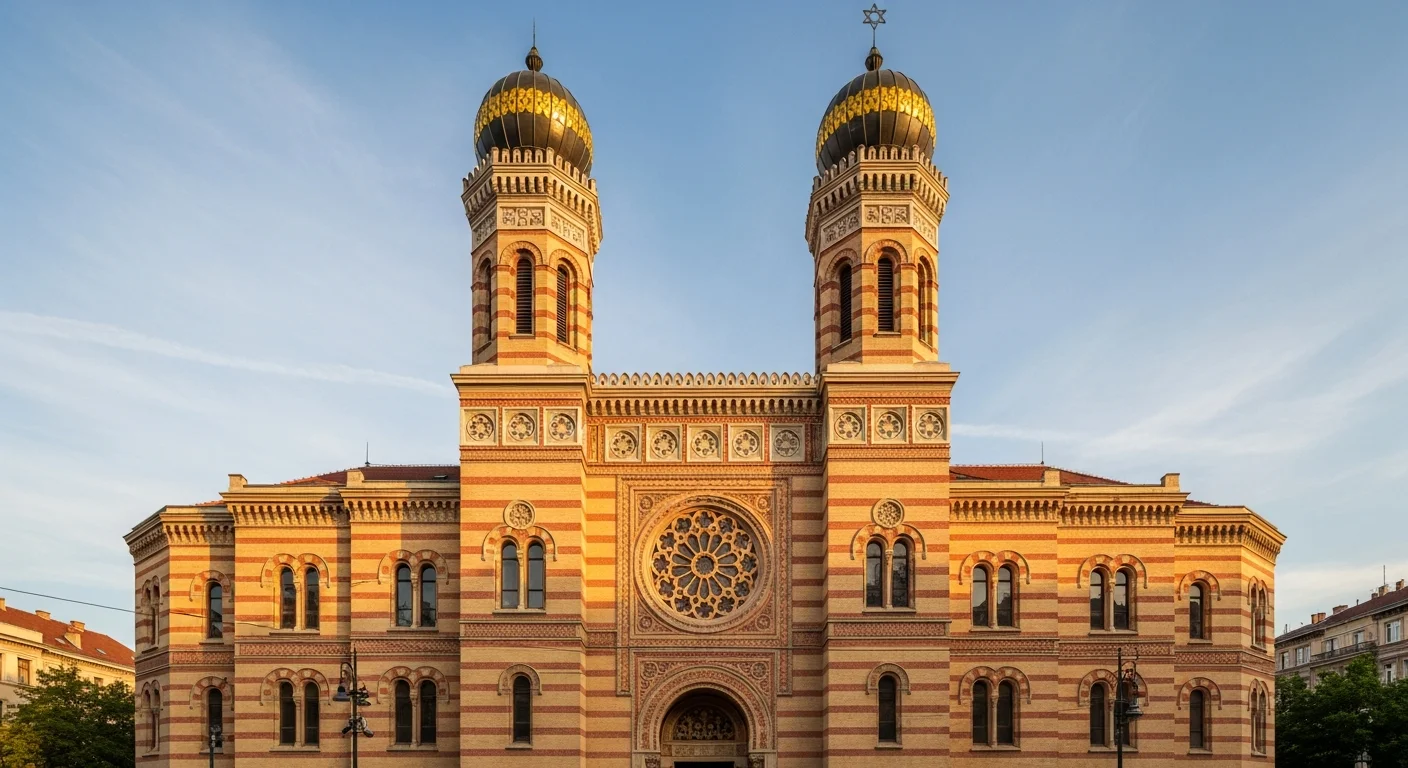
Budapest’s Dohany Street Synagogue was completed in 1859 and seats nearly 3,000 people. Its scale is intentional. The Jewish community of Budapest in the nineteenth century was prosperous, confident, and deeply integrated into Hungarian cultural and intellectual life. The synagogue was built to reflect that standing.
The architecture is Moorish Revival, with striped brickwork, onion domes, and an interior that feels more like a cathedral than a traditional synagogue. Theodor Herzl, the founder of modern Zionism, was born in a house on the same street in 1860, just a year after the synagogue opened. A plaque marks the site.
But the Dohany Synagogue’s story does not end with the nineteenth century. During the winter of 1944-1945, the area around the synagogue became the Budapest ghetto. Tens of thousands of Jews were confined in the surrounding blocks. Thousands died of starvation, disease, and violence during those months. Many were buried in mass graves in the synagogue’s courtyard because the living could not transport the dead to the cemetery.
After the war, the courtyard was transformed into the Memorial Garden. The Tree of Life memorial, a metal weeping willow designed by Imre Varga, stands there. Each leaf bears the name of a murdered family. It is one of the most visited Holocaust memorials in Central Europe, and one of the most personal. People leave stones on the leaves, as is Jewish custom.
Behind the memorial garden, the Raoul Wallenberg Memorial Park honors the Swedish diplomat who saved thousands of Budapest Jews by issuing protective passports. His story is part of Budapest’s story, and groups should hear it here.
Vienna: The City Where Jews Helped Create the Modern World
Vienna’s Jewish community before 1938 was not just large. It was, by many measures, one of the most consequential Jewish communities in history.
Sigmund Freud, the founder of psychoanalysis, lived and worked at Berggasse 19 in Vienna for nearly fifty years. His apartment is now a museum. Theodor Herzl, who conceived the idea of a Jewish state and organized the First Zionist Congress, was a Viennese journalist and playwright. Gustav Mahler, whose symphonies are performed by every major orchestra in the world, directed the Vienna Court Opera. Ludwig Wittgenstein, one of the most important philosophers of the twentieth century, grew up in a prominent Viennese family. Stefan Zweig, whose memoir “The World of Yesterday” remains one of the great accounts of a civilization’s collapse, wrote from Vienna until exile became unavoidable.
These were not peripheral figures. They shaped how the modern world understands the mind, the nation, music, language, and memory. And they were all part of the same Jewish community in the same city.
In 1938, following the Anschluss, that community was destroyed with stunning speed. Of roughly 185,000 Jews in Vienna, about 120,000 fled. Approximately 65,000 who remained or could not escape were murdered. The great synagogues were burned during Kristallnacht in November 1938. Only the Stadttempel survived, because it was built into a residential block and could not be set on fire without destroying the surrounding buildings.
Today, the Stadttempel still holds services. The Jewish Museum Vienna, located on Dorotheergasse, tells the story of the community’s rise and destruction with care and honesty. The Judenplatz Holocaust Memorial sits on the site of a medieval synagogue, marking both the ancient and modern destruction of Jewish life in the city.
Terezin and Auschwitz-Birkenau: The Shadow Over the Circuit
No guide to Jewish heritage in Central Europe can avoid speaking directly about the destruction.
Terezin, sixty kilometers from Prague, was a fortress town converted by the Nazis into a concentration camp and transit point. Over 33,000 people died there. Another 88,000 were deported from Terezin to Auschwitz-Birkenau and other extermination camps. The camp was used for propaganda, presented to the Red Cross as a “model settlement.” The reality was systematic cruelty, starvation, and death.
While Auschwitz-Birkenau is in Poland, not in the Prague-Budapest-Vienna circuit, its shadow is over everything in this region. Many of the Jews deported from Prague, Budapest, and Vienna were sent there. Groups traveling this circuit often choose to extend their trip to include Krakow and Auschwitz, or to visit on a separate journey.
For heritage groups, the question is not whether to acknowledge the destruction. It is how to hold it alongside the beauty, the intellectual achievement, and the spiritual depth that preceded it. The answer, in our experience, is that you do not try to reconcile them. You hold both. You stand in the Old-New Synagogue where Jews have prayed for 750 years, and you stand at the wall of 78,000 names. Both are true.
What Jewish Groups Can Experience Today: Prayer, Memory, Community
Jewish heritage travel in Central Europe is not only about the past. In each of these cities, Jewish life continues.
In Prague, the Old-New Synagogue holds regular Shabbat services. The Jewish community, though small, is active. In Budapest, the Dohany Street Synagogue and several smaller synagogues hold services. The kosher restaurant scene in Budapest’s Jewish quarter has grown in recent years. In Vienna, the Stadttempel hosts services, and the city’s Jewish community, rebuilt partly by immigrants from the former Soviet Union, maintains schools, cultural centers, and communal life.
For groups traveling with a rabbi, Heritage Tours can arrange participation in Shabbat services in Prague or Budapest. A Shabbat dinner with the local community, when available, can be one of the most meaningful moments of the trip. It connects the group to the living thread of Jewish life in a place where that thread was nearly severed.
How to Build a Meaningful Jewish Heritage Circuit
A Jewish heritage circuit through Prague, Budapest, and Vienna works best over ten days. This allows three to four days in Prague (including a full day at Terezin), three days in Budapest, and two to three in Vienna.
The order matters. We recommend starting in Prague because Josefov and Terezin carry the heaviest emotional weight. Placing them early allows the group to process and reflect over the remaining days. Budapest, with its mix of memorial and living Jewish culture, offers a middle ground. Vienna closes the journey with intellectual and cultural depth.
Heritage Tours designs these circuits around what your group can experience together, not just what they can see. If you are a rabbi considering this journey for your congregation, we would welcome a conversation about what it could include. Learn more about our East and Central Europe heritage journeys.
FAQ
What is the largest synagogue in Europe and where is it located? The Dohany Street Synagogue in Budapest is the largest synagogue in Europe, with seating for nearly 3,000 people. It was built in 1859 in a Moorish Revival style. Behind the synagogue, the Memorial Garden holds a Holocaust memorial and the graves of Jews who died in the Budapest ghetto.
Why did Prague’s Jewish quarter survive World War II? The Nazis preserved Prague’s Josefov quarter because they planned to turn it into a “Museum to an Extinct Race.” They collected Judaica from destroyed Jewish communities across Bohemia and Moravia and stored them in Josefov’s synagogues. That collection is still housed there today, making it one of the largest collections of Judaica in Europe.
What Jewish heritage sites are in Vienna? Vienna’s key Jewish heritage sites include the Stadttempel (the only synagogue to survive Kristallnacht), the Jewish Museum Vienna on Dorotheergasse, the Judenplatz Holocaust Memorial, and the Sigmund Freud Museum at Berggasse 19. The Judenplatz also contains the excavated remains of a medieval synagogue destroyed in 1421.
Can Jewish groups attend services at the Dohany Street Synagogue? Yes. The Dohany Street Synagogue holds regular services. Jewish groups visiting with a rabbi can attend. Heritage Tours can also arrange Shabbat services at other active synagogues in Budapest and Prague, and in some cases facilitate Shabbat dinners with the local Jewish community.
How long does it take to properly visit Prague’s Josefov quarter? A meaningful visit to Josefov requires at least a full day. The quarter includes six historic synagogues and the Old Jewish Cemetery, each requiring time and attention. The Pinkas Synagogue alone, with its 78,000 inscribed names, deserves at least thirty to forty-five minutes. Groups that try to see everything in a half-day invariably feel they have not had enough time.