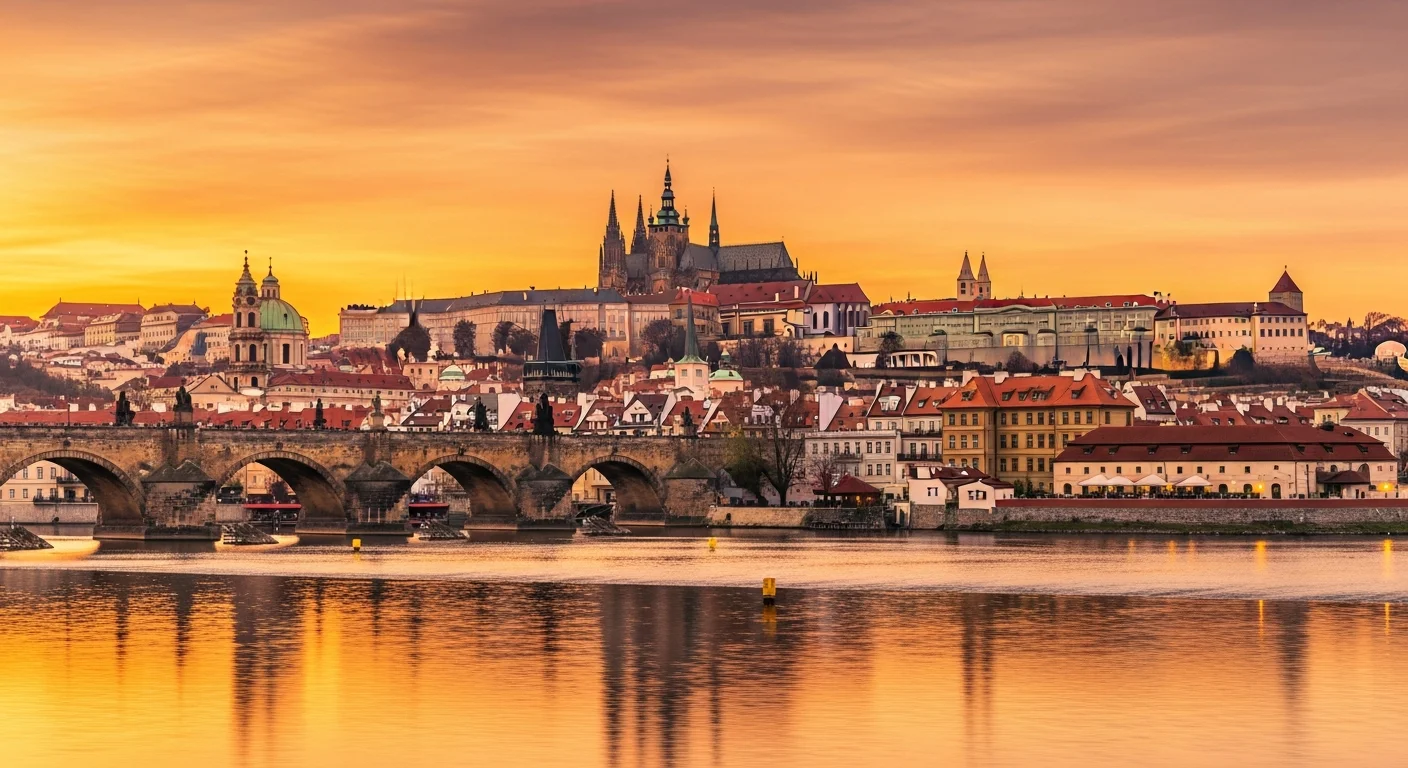
Days 1 through 3: Prague, Josefov, the Old Cemetery, and What Remains
Prague is where the circuit begins, and where the weight of Central European heritage is felt most immediately.
Day 1: Arrival and Orientation
Arrive in Prague. Transfer to hotel. If the group arrives early enough, an evening walk through the Old Town Square provides a first impression of the city. The Astronomical Clock, the Tyn Church, and the general atmosphere set the stage. No structured heritage visits today. Let the group settle.
Day 2: The Jewish Quarter (Josefov)
This is the day that defines the trip for many participants. Begin at the Old-New Synagogue, built around 1270 and still holding services. Walk through the Pinkas Synagogue, where 78,000 names of Czech Jewish Holocaust victims cover the walls. Spend at least forty-five minutes at the Old Jewish Cemetery, where roughly 12,000 tombstones are layered over an estimated 100,000 burials spanning six centuries.
Visit the Spanish Synagogue, the Maisel Synagogue, and the Klaus Synagogue, which together house one of the largest collections of Judaica in Europe, assembled by the Nazis from destroyed communities across Bohemia and Moravia.
Allow time for the group to process what they have seen. A late afternoon break before dinner is recommended.
Day 3: Prague Castle and Christian Heritage
Morning at Prague Castle. St. Vitus Cathedral, the spiritual seat of Bohemian Christianity, is the centerpiece. The cathedral’s stained glass by Alphonse Mucha tells the story of Czech saints. For groups interested in the Reformation, the legacy of Jan Hus, burned at the stake in 1415, is woven through Prague’s churches and public spaces.
Afternoon is flexible. The group can visit the Charles Bridge, the Lesser Town, or take free time in the city. Some groups use this afternoon for a quieter second visit to Josefov.
Day 4: Terezin, the Day Trip You Cannot Skip
Terezin is about sixty kilometers from Prague, roughly one hour by bus. It requires a full day.
A word about what your group will encounter. Terezin was a fortress town that the Nazis converted into a concentration camp and transit point. Over 33,000 people died there. Another 88,000 were deported from Terezin to Auschwitz and other extermination camps. The Nazis used Terezin for propaganda, staging a documentary and a Red Cross visit to present it as a “model settlement.” The reality was starvation, disease, and death.
The visit includes the Small Fortress (used as a Gestapo prison), the Ghetto Museum, the Magdeburg Barracks, the crematorium, and the memorial. The children’s drawings exhibit, showing artwork created by young prisoners (most of whom did not survive), is among the most affecting things in Central Europe.
Group leaders should prepare participants before this visit. A briefing the evening before, explaining what Terezin was and what the group will see, helps enormously. After the visit, return to Prague. Keep the evening unscheduled. Give people space.
For rabbis, a memorial prayer at Terezin can anchor the visit spiritually. For pastors, a moment of group reflection or silence serves a similar purpose. Heritage Tours can help arrange this.
Days 5 through 7: Budapest, the Dohany Synagogue, and a City That Survived
Travel from Prague to Budapest by train (approximately four hours). The train journey itself provides a transition, time for the group to rest, read, and begin shifting toward what Budapest holds.
Day 5: Arrival and the Jewish Quarter
Arrive in Budapest. Transfer to hotel. Afternoon visit to the Dohany Street Synagogue, the largest in Europe. Behind it, the Memorial Garden holds the graves of thousands who died in the Budapest ghetto and the Tree of Life memorial. This is a place of prayer and mourning, not a tourism stop.
If time allows, walk through the surrounding Jewish quarter. The neighborhood has a living character, kosher restaurants, small synagogues, bookshops, and cafes alongside the memorials.
Day 6: The Danube, Castle Hill, and Christian Heritage
Morning at the Shoes on the Danube Bank, the memorial marking where Jews were shot along the river in 1944 and 1945. Then cross to Buda for Castle Hill, the Matthias Church (a coronation church that survived Ottoman conversion and wartime damage), and the Fisherman’s Bastion with its views over the Danube.
Afternoon at St. Stephen’s Basilica, named for Hungary’s first Christian king and home to the relic of Stephen’s right hand. For Christian groups, this is a significant site. For all groups, the basilica’s scale and the history it represents are worth the time.
Day 7: Budapest at Your Group’s Pace
A day for the group to choose. Options include the Hungarian Parliament (one of the largest in the world), the thermal baths at Szechenyi or Gellert, the Central Market Hall, or a return visit to a site from the previous days that the group wants to spend more time with.
For groups with a rabbi, this is also a good day to visit one of Budapest’s smaller active synagogues, the Kazinczy Street Orthodox Synagogue, for example, or to arrange a meeting with the local Jewish community.
Day 8: Shabbat in Budapest or En Route to Vienna
For Jewish groups observing Shabbat, this day is spent in Budapest. Attend Shabbat services at the Dohany Street Synagogue or a smaller congregation. Heritage Tours can arrange a Shabbat dinner with the local community when available. These dinners, when they happen, are often the most remembered evening of the entire trip.
For groups not observing Shabbat, this is the travel day. The train from Budapest to Vienna takes approximately two and a half hours. Arrive in Vienna by midday. Use the afternoon for an orientation walk through the Innere Stadt, Vienna’s first district, past St. Stephen’s Cathedral, the Hofburg, and the Graben.
Groups that observe Shabbat in Budapest travel to Vienna on Sunday morning.
Days 9 and 10: Vienna, One Day for Jewish Heritage, One Day for Christian
Day 9: Jewish Vienna
Morning at the Jewish Museum Vienna on Dorotheergasse. The museum tells the story of Vienna’s Jewish community, from medieval settlement through the intellectual flowering of the nineteenth and early twentieth centuries to the destruction after 1938.
Walk to Judenplatz. The Holocaust memorial by Rachel Whiteread sits in the center of the square, on the site of a medieval synagogue destroyed in 1421. The underground museum below shows the synagogue’s excavated foundations. A memorial plaque lists the names of Austrian Jews murdered in the Holocaust.
Afternoon at the Sigmund Freud Museum at Berggasse 19, where Freud lived and worked for nearly fifty years. For groups interested in the broader Jewish intellectual legacy of Vienna, the apartments and haunts of Herzl, Mahler, and Zweig are nearby.
Visit the Stadttempel, Vienna’s main synagogue, the only one to survive Kristallnacht because it was embedded in a residential building.
Day 10: Christian Vienna and Departure
Morning at St. Stephen’s Cathedral, where Christian worship has continued since the twelfth century. The Habsburg crypts beneath the Kapuzinerkirche (Church of the Capuchins) hold the remains of the dynasty that shaped Central European Christianity for six hundred years.
For groups departing later in the day, a visit to the Augustinerkirche (where Habsburg weddings and funerals were held) or the Karlskirche rounds out the Christian heritage.
Departure from Vienna.
Practical Notes for Group Leaders on This Circuit
Inter-city travel: Trains are the most practical option. Book group tickets in advance. The trains are comfortable, have onboard facilities, and allow the group to sit together.
Currencies: Prague uses Czech crowns. Budapest uses Hungarian forints. Vienna uses euros. Advise your group to exchange or withdraw currency upon arrival in each city. Credit cards are widely accepted in all three cities, but smaller heritage sites and restaurants may prefer cash.
Pacing: Do not schedule Terezin and the Pinkas Synagogue on the same day. The emotional weight requires space. The itinerary above separates them deliberately.
Flexibility: This itinerary is a framework. Heritage Tours adjusts the structure based on your group’s specific interests, religious observances, mobility needs, and what matters most to your community.
How Heritage Tours Adjusts This Itinerary for Your Group
No two groups are the same. A Jewish congregation led by a rabbi will spend more time in the Jewish Quarter and less at Prague Castle. A Christian group led by a pastor may want a full day at Vienna’s churches and only a half-day at the Jewish Museum. Some groups want to add Bratislava as a stop between Budapest and Vienna. Others want to extend the trip to include Krakow and Auschwitz.
Heritage Tours coordinates the entire circuit as a single trip. Hotels, transfers, guides, site access, and inter-city travel are handled as one package. Group leaders with fifteen or more participants travel free.
If this itinerary looks like something your community would value, we would welcome the chance to talk about how to shape it for your group. Learn more about our East and Central Europe heritage journeys.
FAQ
Is 10 days enough for a heritage circuit through Prague, Budapest, and Vienna? Yes. Ten days allows three to four days in Prague (including Terezin), three days in Budapest, and two to three in Vienna. It is enough time to visit the major heritage sites without feeling rushed. Groups that want to add Bratislava or extend to Krakow should plan twelve to fourteen days.
How do you get from Prague to Budapest with a large group? Direct trains run between Prague and Budapest, taking approximately four hours. Group train tickets can be booked in advance. The journey is comfortable and gives the group time to rest between cities. Heritage Tours arranges group train travel as part of the circuit.
Where should a heritage group spend Shabbat on a Central European circuit? Budapest is the most common choice. The Jewish community there offers Shabbat services at the Dohany Street Synagogue and other congregations. Shabbat dinners with the local community can sometimes be arranged. Prague is also an option, particularly at the Old-New Synagogue.
Is it worth adding Terezin to a Prague-Budapest-Vienna itinerary? For heritage groups, especially Jewish groups, Terezin is essential. It is the most significant Holocaust site in the Czech Republic and provides critical context for the Jewish heritage sites in Prague. It requires a full day from Prague, and that day is among the most meaningful of the entire circuit.
What is the best order to visit Prague, Budapest, and Vienna? Starting in Prague and ending in Vienna works best for most heritage groups. Prague’s Josefov and Terezin carry the heaviest emotional weight and are best experienced early in the trip when the group is together and fresh. Vienna provides a more reflective, culturally rich close.