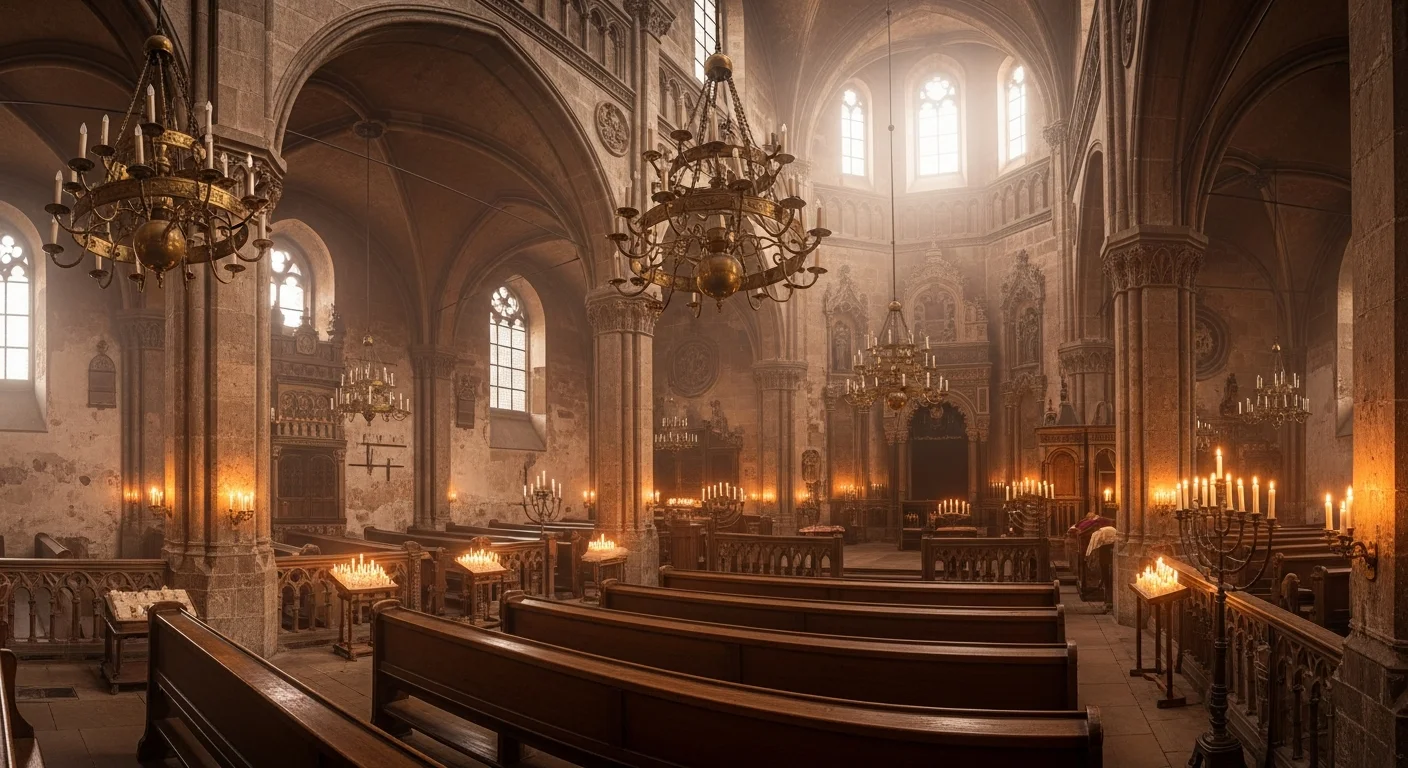
The Pinkas Synagogue in Prague: 78,000 Names on the Wall
Most visitors to Prague’s Jewish Quarter head first to the Old-New Synagogue or the Old Jewish Cemetery. The Pinkas Synagogue is quieter and smaller, and it is the place that stays with you longest.
The walls of the Pinkas Synagogue are inscribed with the names, dates of birth, and dates of death of 78,000 Czech and Moravian Jews murdered during the Holocaust. The names are written in small, careful letters, organized by community. They cover every wall, floor to ceiling.
There is no dramatic architecture here. No soaring ceiling or famous artwork. There are names. Tens of thousands of them, in rows so dense that your eyes cannot take them all in. Some families have clusters of names together, parents and children, gone in the same month. The silence inside is total. People do not speak.
After the Communist government whitewashed the names in the 1960s (claiming water damage), the inscriptions were painstakingly restored after 1989. Every name was rewritten.
For groups visiting with a rabbi or pastor, this is often the moment when the history of Central Europe becomes personal. It is not a statistic here. It is a name, a birthday, a town.
Terezin: The Camp 60 km from Prague That Most Groups Skip
Terezin is about an hour’s drive from Prague. It was a fortress town that the Nazis converted into a concentration camp and transit point, primarily for Czech Jews.
The Nazis called it a “model camp” and used it for propaganda. They filmed a staged documentary showing happy prisoners. The Red Cross was given a carefully managed tour. Behind the propaganda, over 33,000 people died in Terezin from disease, starvation, and abuse. Another 88,000 were deported from Terezin to Auschwitz and other extermination camps.
Many group itineraries in Central Europe skip Terezin. The reasons are understandable. It is not in Prague. It requires a dedicated half-day or full day. It is not an easy experience.
But for heritage groups, particularly Jewish groups led by a rabbi, Terezin is not optional. This is where Czech Jewish life was funneled toward destruction. The small fortress, the barracks, the memorial, and the crematorium are all preserved and open to visitors. There is a museum with children’s drawings made by young prisoners, most of whom did not survive.
If your group is visiting Prague for heritage, Terezin belongs in the itinerary. It requires advance planning for group access and, ideally, a guide who can provide context before you arrive. Heritage Tours arranges this as part of the Prague portion of any Central European circuit.
Vienna’s Judenplatz: The Memorial Beneath the Cobblestones
In the center of Vienna’s Judenplatz stands a concrete block that looks, at first glance, like a library turned inside out. The shelves face outward. The books have no titles. The door has no handle.
This is Rachel Whiteread’s memorial to the 65,000 Austrian Jews murdered in the Holocaust. It sits on the exact site of a medieval synagogue that was destroyed in 1421 during a pogrom. The books represent lives that were closed, stories that cannot be opened or read.
Beneath the memorial, excavations have uncovered the foundations of that medieval synagogue. You can visit the underground museum and stand in the space where the synagogue once stood.
Most tourists in Vienna never see Judenplatz. The square is a few minutes’ walk from St. Stephen’s Cathedral, but it is not on the standard walking route. Tour buses do not stop here. There is no gift shop.
For heritage groups, this quiet square holds more than many of Vienna’s famous landmarks. It connects the medieval expulsion of Jews from Vienna to the modern catastrophe, in a single location.
Bratislava: A Jewish Heritage That Most Travelers Never Reach
Bratislava sits between Budapest and Vienna, less than an hour from each by train. Almost no heritage tour itineraries include it. That is a missed opportunity.
Before the war, Bratislava (then called Pressburg) was one of the most important centers of Jewish learning in Europe. The Pressburg Yeshiva, founded by Rabbi Moses Sofer (the Chatam Sofer) in the early nineteenth century, was one of the most influential Orthodox yeshivot in the world. Rabbis trained there shaped Jewish thought across Europe and beyond.
Today, the Chatam Sofer Memorial sits in an underground chamber beneath a highway overpass. The Communist-era construction of the road destroyed the old Jewish cemetery, but the tombs of the Chatam Sofer and other prominent rabbis were preserved in a sealed underground space. Visiting it requires advance arrangement, and few tourists know it exists.
Bratislava’s old Jewish quarter is largely gone, replaced by postwar construction. But the memorial, the remnants, and the story itself make a half-day visit from Vienna or Budapest worth the time. For Jewish groups, standing at the tomb of the Chatam Sofer is a direct connection to one of the great teachers of European Orthodoxy.
Adding Bratislava to a Central European circuit adds almost no travel time. Heritage Tours can build it into the Budapest-to-Vienna segment of a group trip as a meaningful stop along the way.
The Old Jewish Cemetery in Prague: Six Centuries of Layers
The Old Jewish Cemetery in Josefov deserves its own section here because most visitors do not understand what they are looking at.
The cemetery was used from approximately 1439 to 1787. An estimated 100,000 people are buried in it. The cemetery is small, perhaps a city block in area. Because the Jewish community was confined to the ghetto and could not expand the cemetery’s boundaries, burials were stacked in layers, sometimes twelve deep. Over the centuries, the ground rose several meters.
The roughly 12,000 surviving tombstones are crowded together at odd angles, pushed up and tilted by centuries of earth shifting beneath them. Some of the oldest stones are from the fifteenth century. Rabbi Judah Loew ben Bezalel, the famous Maharal of Prague associated with the legend of the Golem, is buried here.
Walking through the cemetery takes time. The paths are uneven. The stones require close attention. Groups that rush through miss the fact that they are walking on layers of history, literally. Allow at least forty-five minutes, and ideally more. Wear sturdy shoes. And understand that for many visitors, particularly those with Central European Jewish roots, this is not a historical site. It is a family site.
How to Add These to a Group Circuit Itinerary
Each of these sites fits naturally into a Prague-Budapest-Vienna heritage circuit. Terezin is a day trip from Prague. The Pinkas Synagogue and Old Jewish Cemetery are in Prague’s Josefov quarter. Judenplatz is a short walk from central Vienna. Bratislava is a train stop between Budapest and Vienna.
The question is not whether to include them. It is whether to prioritize them over the headline sites that every itinerary already covers. Our recommendation: do both. A ten-day circuit has room for the Dohany Synagogue and the Pinkas Synagogue, for St. Vitus Cathedral and Judenplatz, for the main attractions and the places that require a little more effort to reach.
Heritage Tours builds itineraries that include these secondary sites because they are often the ones that matter most. If you are planning a heritage circuit for your congregation or community, we would be glad to show you how these fit. Learn more about our East and Central Europe heritage journeys.
FAQ: Hidden Heritage Sites in Central Europe
Is Terezin worth visiting from Prague on a heritage trip? Yes. Terezin is one of the most significant Holocaust sites in Central Europe. Over 33,000 people died there and 88,000 were deported to Auschwitz. It requires a half-day to full day from Prague. For Jewish heritage groups, it belongs in the itinerary. Group access should be arranged in advance.
What is the Pinkas Synagogue in Prague? The Pinkas Synagogue is a memorial inside Prague’s Jewish Quarter. The names of 78,000 Czech and Moravian Jews killed during the Holocaust are inscribed on its interior walls. It is part of the Jewish Museum in Prague and can be visited along with the Old Jewish Cemetery and other synagogues in the quarter.
Is Bratislava worth including in a Central European heritage circuit? For Jewish groups, yes. Bratislava was home to the Pressburg Yeshiva, one of the most important centers of Jewish learning in Europe. The underground Chatam Sofer Memorial preserves the tombs of its most prominent rabbis. It is located between Budapest and Vienna and can be added as a half-day stop.
Where is Vienna’s Judenplatz memorial? Judenplatz is a small square in Vienna’s first district, a few minutes’ walk from St. Stephen’s Cathedral. The Holocaust memorial by Rachel Whiteread sits in the center of the square. Beneath it, an underground museum preserves the foundations of a medieval synagogue destroyed in 1421.
How much time do you need at Prague’s Old Jewish Cemetery? Allow at least forty-five minutes to walk through the cemetery meaningfully. The paths are uneven and the tombstones require close attention. If your group includes members with mobility concerns, be aware that the ground is irregular and can be challenging. Many visitors find they want more time than they expected.