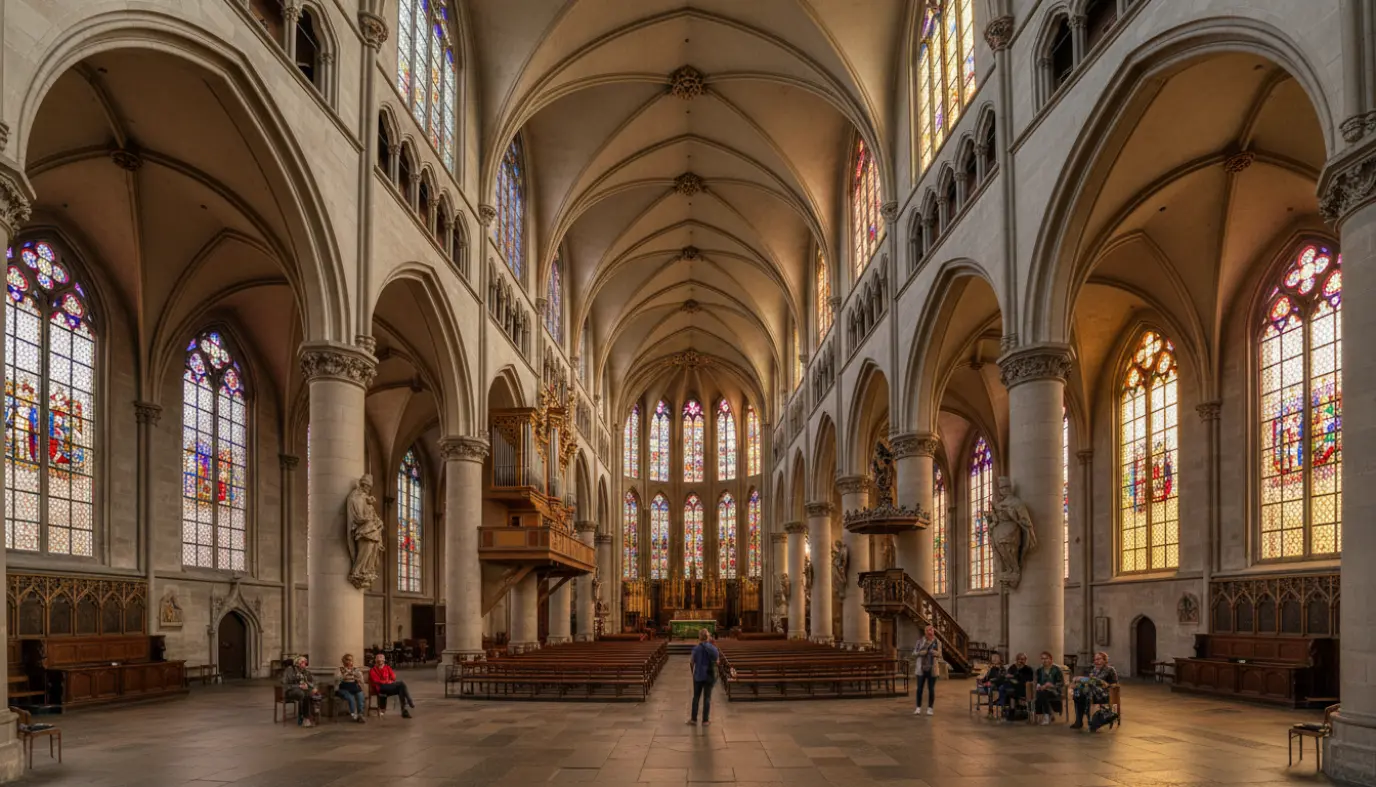
What Makes a Site “Spiritual” vs. Just Historical?
There are heritage buildings you admire and heritage buildings that change something in you. The difference is not always obvious from a guidebook description. A medieval church can be a beautiful museum or it can be a place where the walls still hold the weight of centuries of prayer. The distinction often depends on whether the site is still alive, whether people still come to worship, mourn, or celebrate in that space, or whether the doors only open for tourists.
In the Netherlands, many heritage sites fall into both categories. The Portuguese Synagogue is a stunning architectural monument and an active house of worship. The Anne Frank House is a historical exhibit and a place where people of every faith tradition confront the deepest questions about humanity. St. Bavo Church in Haarlem is a tourist destination and a place where sacred music has been performed continuously for centuries.
For a faith traveler, the question is not “what should I see?” The question is “where will I feel something?” This guide tries to answer that honestly, for both Jewish and Christian groups.
For Jewish Groups: The Sites That Still Hold a Living Flame
Jewish heritage in the Netherlands is marked by both extraordinary flourishing and devastating loss. The sites that carry the most spiritual weight are the ones where both realities are present, where you can feel what was built, what was destroyed, and what has persisted.
The Portuguese Synagogue is the anchor. The Jewish Historical Museum tells the story. Westerbork holds the grief. And the National Holocaust Names Memorial makes the loss personal. Together, these sites form a spiritual journey that moves from celebration through destruction to remembrance. A rabbi leading a group through these sites in sequence will find that the experience builds on itself, each site preparing the group for the next.
But there are quieter moments too. The Jewish cemetery at Muiderberg, about 30 minutes from Amsterdam, is one of the oldest Sephardic cemeteries in Northern Europe. The headstones date to the 17th century, and the silence there is complete. For a group that has spent days in the intensity of Amsterdam, a morning at Muiderberg offers something essential: stillness.
The Portuguese Synagogue: Where Sephardic Prayer Has Not Changed in 350 Years
Walking into the Portuguese Synagogue during a Friday evening service is unlike any other experience in European Jewish travel.
There are no electric lights. The interior glows from the flames of more than a thousand candles reflected in brass chandeliers and dark wooden benches. The prayers are chanted in the Sephardic tradition, the same melodies and rhythms that have been used in this space since 1675. The floor is covered with fine sand, an old Dutch practice for absorbing moisture and muffling sound.
The synagogue is enormous, larger than most congregants expect. When it was completed, it was the largest synagogue in the world, designed to echo descriptions of Solomon’s Temple. The Sephardic families who built it had been expelled from Spain and Portugal. In Amsterdam, they were finally free to build something permanent, and they built something magnificent.
For a Jewish group, attending Shabbat here is not cultural tourism. It is prayer in a space that was consecrated to prayer three and a half centuries ago and has never stopped. Heritage Tours arranges access for groups, but it must be coordinated with the community in advance. The Sephardic congregation is protective of their worship, and rightly so.
Anne Frank House: Memory as a Spiritual Practice
The Anne Frank House is the most visited heritage site in the Netherlands, and it is easy to approach it as a historical exhibit. But for a faith group, it functions differently. It is a place where memory itself becomes a spiritual act.
The rooms are small. The stairs are steep. The hiding place behind the bookcase is cramped in a way that photographs cannot convey. Standing in that space, knowing that a young girl lived in silence for two years, knowing that it was not enough to save her, confronts visitors with questions that have no easy answers.
For a pastor, this is a site that speaks to the call to protect the vulnerable. For a rabbi, it is a place where the community’s responsibility to remember becomes tangible. For anyone, it is a reminder that the people we read about in history were real, with real fears and real hopes, living in spaces you can now stand inside.
Group leaders should prepare their community for this visit. Not with excessive historical briefing, but with the simple acknowledgment that this house is a sacred space in its own way, a place set apart from ordinary experience.
For Christian Groups: The Dutch Reformation and What It Left Behind
The Netherlands was one of the battlegrounds of the Reformation, and the physical evidence is still everywhere. But unlike the grand cathedrals of France or Italy, the Dutch Reformed churches are marked by their restraint. When the Reformation swept through the Netherlands, churches were stripped of statuary, paintings, and ornamentation. What remained was light, space, and the centrality of the Word.
This stripping away was not destruction for its own sake. It was theology made visible: a belief that worship should be direct, unmediated by imagery, focused on Scripture and preaching. For a Christian group that comes from a Reformed or Protestant tradition, these churches are not just historical curiosities. They are the physical expression of the theological principles their own churches were built on.
Haarlem’s St. Bavo: Where the Music Itself Is a Form of Prayer
The Grote Kerk in Haarlem holds the Christian Muller organ, completed in 1738 and considered one of the finest instruments in Europe. Both Handel and the young Mozart traveled to Haarlem specifically to play this organ. Its 5,068 pipes range from massive bass pipes to delicate trebles that seem to hang in the air.
What makes St. Bavo a spiritual site rather than merely a concert hall is continuity. This organ has been used in worship for nearly 300 years. The hymns played today are the same hymns that filled this nave when the instrument was new. When a Christian group sits in these pews and listens to the organ, they are hearing a sound that has accompanied prayer in this space since before the American Revolution.
Haarlem is twenty minutes from Amsterdam by train or arranged transport. A half-day visit allows time for the church, the town square, and a walk through one of the most charming small cities in the Netherlands.
Utrecht Cathedral and the Reformation’s Physical Mark on the Netherlands
Utrecht’s Dom Tower is the tallest church tower in the Netherlands, visible from miles away. But the cathedral below tells a more complicated story. In 1674, a storm destroyed the nave, leaving the tower standing apart from the choir. The gap between them, which has never been rebuilt, is a physical metaphor for the rupture of the Reformation itself.
The cathedral cloister, which survived intact, is one of the most beautiful Gothic spaces in Northern Europe. Walking through its arched corridors, past medieval wall paintings and carved stone, a Christian group can feel the pre-Reformation church in a way that the stripped-down Reformed interiors of Amsterdam cannot provide.
Utrecht also holds a Catholic heritage that persisted through the Protestant era. Hidden churches, known as schuilkerken, operated behind the facades of canal houses when Catholic worship was officially forbidden. Several of these survive, including the Museum Ons’ Lieve Heer op Solder (Our Lord in the Attic) in Amsterdam, which is worth a visit for any Christian group interested in the persistence of faith under pressure.
Sites Both Communities Should Experience Together
Some places in the Netherlands speak to Jewish and Christian groups equally, not because they smooth over differences but because they address shared concerns.
The Hollandsche Schouwburg, the theater in Amsterdam’s Jewish quarter where Jews were assembled before deportation, raises questions about responsibility, complicity, and the failure of institutions, including religious institutions, to protect the vulnerable. A pastor and a rabbi standing in that space are asking the same question: what would we have done?
The Resistance Museum in Amsterdam tells the stories of Dutch citizens who resisted the Nazi occupation, some motivated by faith, some by politics, some by simple human decency. For a mixed group, this museum provides a bridge between traditions, showing that the courage to act came from many sources.
And the Portuguese Synagogue itself, as an architectural achievement open to visitors of all backgrounds, demonstrates what a community can build when given freedom and safety. Christian groups often describe their visit to the synagogue as one of the most moving experiences of their trip.
FAQ
Is the Portuguese Synagogue in Amsterdam open for prayer services? Yes. The Sephardic community holds regular services, including Friday evening Shabbat. Group attendance at services requires advance coordination through Heritage Tours to respect the community’s worship.
What are the most sacred Christian sites in the Netherlands? St. Bavo Church in Haarlem, the Nieuwe Kerk in Delft, Utrecht Cathedral, and the hidden churches (schuilkerken) of Amsterdam are the most spiritually significant Christian heritage sites. Each represents a different chapter of the Reformation and the persistence of faith.
Can a Jewish group attend Shabbat services in Amsterdam? Yes. Heritage Tours arranges Shabbat service attendance at the Portuguese Synagogue and coordinates with other active Jewish congregations in Amsterdam. This is one of the most meaningful experiences available to a Jewish heritage group in Europe.
What is the spiritual significance of Anne Frank House? Beyond its historical importance, the Anne Frank House confronts visitors with fundamental questions about human responsibility, the protection of the vulnerable, and the persistence of hope in the darkest circumstances. For faith groups, these are deeply spiritual questions.
Is the Netherlands a good destination for both Jewish and Christian heritage groups? Yes, and this is one of its unique strengths. The Netherlands holds significant heritage for both traditions, and many sites, including the Holocaust memorials and the Resistance Museum, speak to shared moral and spiritual concerns.
Spiritual travel is not about checking sites off a list. It is about standing in places where the weight of faith, history, and human experience is palpable. The Netherlands holds more of these places than most travelers realize. If you want to bring your community to experience them, explore our Netherlands heritage tours and let us help you plan a journey built around what matters most.