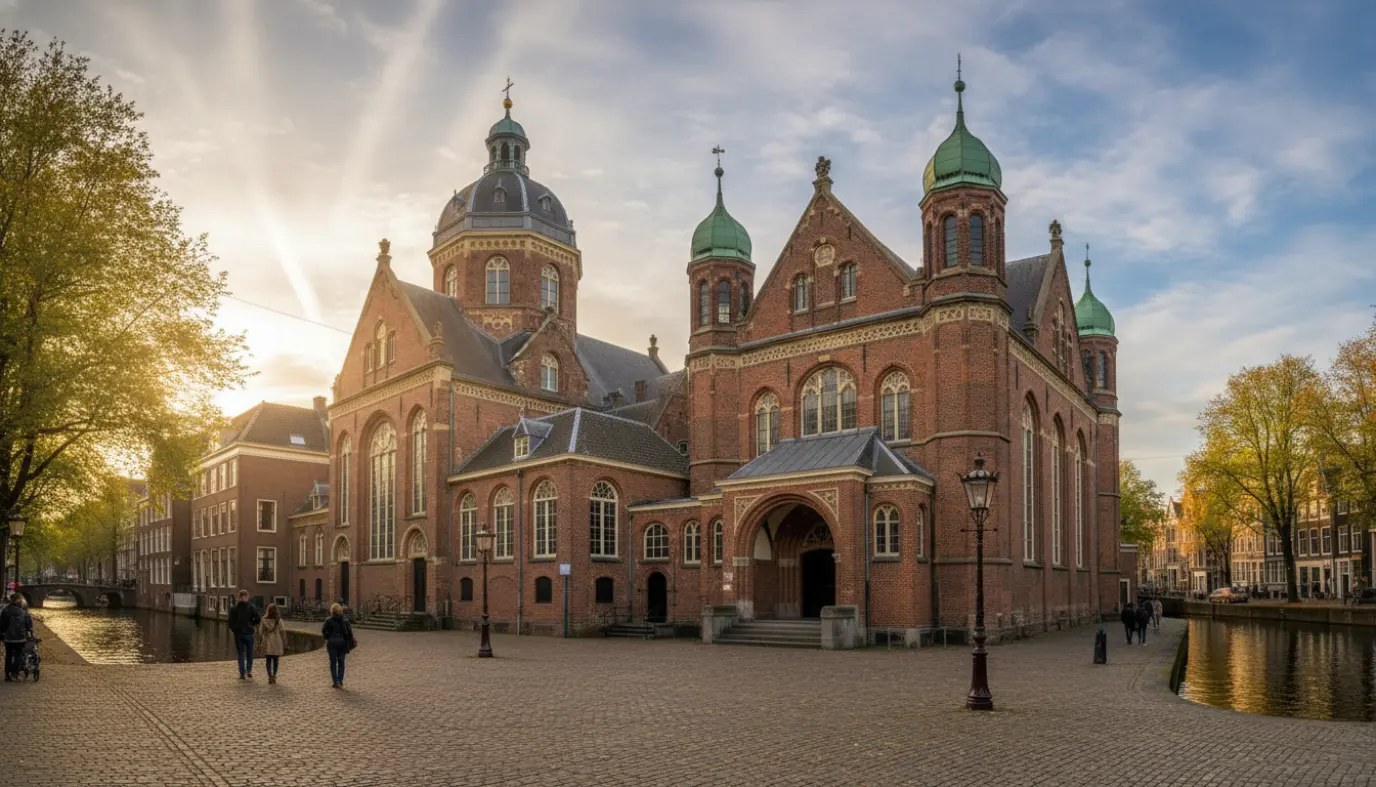
Amsterdam: “The Jerusalem of the North”: How It Earned That Name
In 1593, a small group of Sephardic Jews arrived in Amsterdam. They had been expelled from Spain a century earlier, then from Portugal, then from wherever they tried to settle next. They came to the Netherlands not because they were invited, but because Amsterdam, unlike nearly every other city in Europe, did not turn them away.
What happened next is one of the most remarkable chapters in Jewish history.
Within a few decades, the Sephardic community in Amsterdam grew into the largest and most prosperous in Europe. They built synagogues. They established a printing industry that produced Torah scrolls and religious texts distributed across the Jewish world. They traded with communities in the Ottoman Empire, North Africa, and the Americas. Baruch Spinoza grew up in this community. Rabbi Menasseh ben Israel, who would eventually persuade Oliver Cromwell to readmit Jews to England, preached in Amsterdam.
The city earned the name “the Jerusalem of the North” not as a courtesy, but because it genuinely functioned as a center of Jewish intellectual and spiritual life. For a rabbi bringing a Jewish group to Amsterdam today, this is the story that opens the door. Your congregants are not visiting a city that happened to have Jews. They are visiting the place that sheltered Jewish life when almost nowhere else would.
The Portuguese Synagogue: 350 Years and Still Lit by Candlelight
The Esnoga, as the Sephardic community calls it, was completed in 1675. It was the largest synagogue in the world at the time, modeled on descriptions of Solomon’s Temple. When you walk inside, the first thing you notice is the light, or rather, the quality of it. Over a thousand candles illuminate the interior. No electric lights have ever been installed. The wooden floors, the brass chandeliers, the high windows, everything is original.
The Portuguese Synagogue is not a museum piece. The Sephardic community still holds services here. On Friday evenings, the candles are lit, the prayers are chanted in the Sephardic tradition, and the space comes alive the way it was meant to. For a Jewish group, attending a Shabbat service here is not a cultural excursion. It is participation in a living tradition that survived the Inquisition, survived exile, and survived the war.
Arranging a group visit during services requires advance planning and respectful coordination with the community. This is something Heritage Tours handles as part of the itinerary, because it matters too much to leave to chance.
The Jewish Historical Museum: Four Synagogues, One Story
Across the street from the Portuguese Synagogue, the Jewish Historical Museum occupies four connected Ashkenazi synagogues. The museum tells the full arc of Jewish life in the Netherlands, from the golden age through the destruction to the present.
What makes this museum different from others is its honesty. It does not romanticize the golden age or rush past the war. It gives weight to every period: the vibrant religious and cultural life of the 17th and 18th centuries, the slow integration of Jews into Dutch society, the shock of the German occupation, and the complicated aftermath in which survivors returned to find their homes occupied and their community gone.
For a Jewish group, the museum requires at least two hours. There is a children’s museum, a section on Jewish religion and ritual, and rotating exhibits that keep the collection current. The building itself, four synagogues joined together, tells its own story about what a community builds when it is given the freedom to stay.
Anne Frank House: What the House Actually Teaches
The diary makes Anne Frank the most famous Dutch Jew in history. But the house teaches something the diary cannot fully convey: how small the hiding place was. How close the street was. How two years of silence felt in rooms that barely fit the people inside them.
For a Jewish group, the Anne Frank House is both essential and difficult. Essential because every member of your community should stand in that space. Difficult because the house confronts visitors with the reality that hiding, the most desperate act of survival, was not enough. Anne’s family was betrayed, sent to Westerbork, and then to Bergen-Belsen, where Anne died weeks before liberation.
Group visits require advance booking, often two to three months ahead. The house is small and visits are timed, so your group may need to enter in smaller sections. A good guide or group leader will prepare participants before the visit, not with historical facts (they already know these) but with permission to feel what they feel inside the house. Tears are common. Silence is appropriate.
The Holocaust and Dutch Jewry: Westerbork, Razzia, and What Remains
The numbers are staggering and they deserve to be stated clearly. Before the war, approximately 140,000 Jews lived in the Netherlands. By 1945, about 38,000 survived. Seventy-five percent of Dutch Jews were murdered in the Holocaust, the highest proportion in Western Europe.
The deportations were organized with bureaucratic precision. The razzia, or roundups, moved through Amsterdam neighborhood by neighborhood. Families were taken from their homes and brought to the Hollandsche Schouwburg, a theater in the Jewish quarter that served as a gathering point. From there, they were sent to Westerbork, a transit camp in the Dutch countryside, and from Westerbork to Auschwitz, Sobibor, or Bergen-Belsen.
Westerbork is two hours from Amsterdam, and visiting it changes something in a person. The camp is mostly gone, but the memorial site preserves the layout, the railway tracks, and 102,000 stones representing each person who passed through. On Tuesday mornings, lists were read aloud naming who would be on the next transport. People lived in Westerbork for weeks or months, knowing that every Tuesday could be their last.
A rabbi who brings a Jewish group to Westerbork should prepare for the weight of this place. It is not the kind of site you visit and then move on to lunch. Build quiet time into the schedule. Let people process what they have seen.
What a Jewish Group Can Experience Today: Prayer, Memory, Community
The story of Jewish Amsterdam does not end with the war. It continues.
The Portuguese Synagogue still holds Shabbat services. The Liberal Jewish community in Amsterdam is active and welcoming. Kosher restaurants serve the neighborhood. The Jewish Historical Museum keeps expanding. And the National Holocaust Names Memorial, opened in 2021, gives individual recognition to every Dutch Jewish victim.
For a rabbi bringing a group, the Netherlands offers something rare: the chance to experience the full arc of Jewish history in one place. The golden age. The destruction. And the quiet, determined survival that followed. Your congregants can pray in a synagogue that has held services for 350 years. They can read the names of the lost. And they can see, with their own eyes, that Jewish life in Amsterdam did not end. It continues.
Heritage Tours builds Jewish heritage itineraries that honor all of this, the celebration and the grief, the history and the living community. We arrange Shabbat services, memorial site visits, and connections with local Jewish organizations so your group’s experience is not just educational but spiritual.
FAQ: Jewish Heritage Travel in the Netherlands
Why was Amsterdam called “the Jerusalem of the North”? Amsterdam earned this name in the 17th century because it became the largest center of Sephardic Jewish life in Europe. Jews expelled from Spain and Portugal built thriving communities, synagogues, and religious institutions in a city that offered them unusual freedom and tolerance.
Is the Portuguese Synagogue in Amsterdam still active? Yes. The Portuguese Synagogue has held continuous services since 1675. The Sephardic community still worships there, including Friday evening Shabbat services held entirely by candlelight.
What happened to Amsterdam’s Jewish community during World War II? Approximately 75% of Dutch Jews were murdered in the Holocaust, the highest proportion in Western Europe. Of roughly 140,000 Jews in the Netherlands before the war, about 38,000 survived. The community has rebuilt slowly but has never returned to its pre-war size.
Can a Jewish group hold a prayer service at Amsterdam’s synagogues? Yes. Heritage Tours coordinates access to Shabbat services at the Portuguese Synagogue and connections with other active Jewish congregations in Amsterdam. This requires advance arrangement out of respect for the local community.
What is the difference between the Portuguese Synagogue and the Jewish Historical Museum? The Portuguese Synagogue is an active Sephardic house of worship, built in 1675 and still holding regular services. The Jewish Historical Museum, located in four connected Ashkenazi synagogues, is a museum that tells the full story of Jewish life in the Netherlands from the golden age to the present.
Jewish heritage in the Netherlands is not a single site or a single story. It is an arc that stretches from the golden age of Sephardic Amsterdam through the darkest chapter of European history to a community that persists today. If you are ready to bring your congregation to experience that arc firsthand, explore our Netherlands heritage tours and we will help you shape a journey worthy of the history.