Beyond Anne Frank House: What Most Groups Miss
Every group that visits Amsterdam goes to the Anne Frank House. And they should. But if that is where your itinerary begins and ends when it comes to heritage sites, your group is missing the places that stay with people the longest.
Over 40 years of organizing heritage journeys, I have watched thousands of travelers return home. The sites they talk about most are rarely the ones they expected. It is the quiet field in the countryside. The monument with no tourists around it. The Friday evening service in a 350-year-old synagogue where they were the only visitors. These are the places I want to share with you, because they are the ones that change people.
Westerbork Transit Camp: The Field That Remembers Everything
About two hours east of Amsterdam, in the flat, green countryside of Drenthe province, there is a field. It looks peaceful. There is grass, open sky, a few low structures. Nothing about it announces what happened here.
Between 1942 and 1944, more than 107,000 Dutch Jews passed through Westerbork on their way to Auschwitz, Sobibor, and Bergen-Belsen. Anne Frank and her family were among them. The camp was not a death camp. It was a transit point, a place of waiting, of lists read aloud on Tuesday mornings naming who would be on the next train east.
Today, the site is marked by 102,000 stones laid in the shape of the original camp map. Each stone represents a person. The railway tracks that led out of the camp have been preserved, ending at a twisted piece of rail that bends upward toward the sky, as if reaching for something that cannot be reached.
Most tour groups never come here. The distance from Amsterdam discourages day-trippers, and the site does not advertise itself the way a city museum does. But for a heritage group, especially one led by a rabbi or pastor who understands the weight of memory, Westerbork is not optional. It is essential.
The Joods Monument: 102,000 Names on Four Blocks of Stone
In the heart of Amsterdam, near the former Jewish neighborhood, the National Holocaust Names Memorial lists every single Dutch Jewish victim of the Holocaust by name. All 102,000 of them. Each name is engraved on an individual brick, and the bricks form four walls arranged in the shape of Hebrew letters spelling the word “In Memoriam.”
This monument opened in 2021, and it is still relatively unknown to international visitors. Most guidebooks mention it briefly, if at all. But standing in front of those walls, reading name after name, is a different experience than looking at numbers in a textbook. It makes the loss personal. A group leader who brings their community here should plan for quiet time. People will want to search for names. Some will want to stand still for a while. That is exactly the right response.
Haarlem’s St. Bavo Church: Where Handel and Mozart Played the Same Organ
Twenty minutes by train from Amsterdam, the Grote Kerk in Haarlem holds one of the most remarkable instruments in Europe. The Christian Muller organ, built in 1738, was played by both Handel and the ten-year-old Mozart. It has 5,068 pipes and a sound that fills the entire nave.
For a Christian heritage group, this is not just a concert venue. This is a church that has held continuous worship for over 600 years, through the Reformation, through wars, through the transformation of Dutch society. The organ itself survived because the community believed it mattered enough to protect. Sitting in those pews and listening to even a brief recital connects your group to something living, not preserved behind glass.
Most Amsterdam itineraries skip Haarlem entirely. That is a mistake. The train ride is short, the church is extraordinary, and the town itself has a quiet beauty that gives your group a break from Amsterdam’s intensity.
The Portuguese Synagogue at Night: A Service, Not a Museum Visit
The Portuguese Synagogue in Amsterdam is open for daytime visits, and it is beautiful. But what most visitors never experience is what the synagogue was built for: prayer.
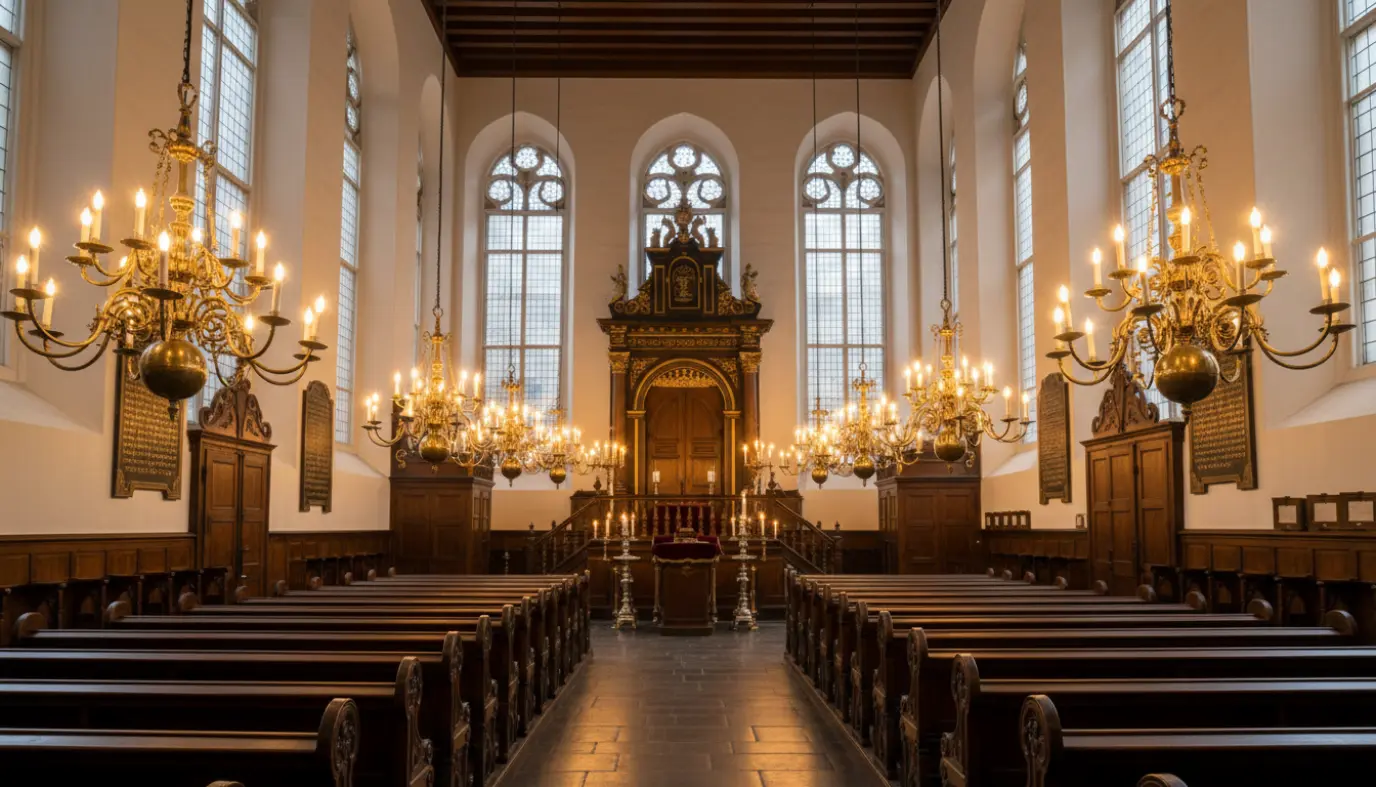
On Friday evenings, the Sephardic community still holds Shabbat services by the light of hundreds of candles. No electric lighting has ever been installed. The flickering glow on the wooden interior, the sound of prayers that have been recited in this same space since 1675, the warmth of a community that refused to disappear, this is something a daytime visit cannot replicate.
Attending a Shabbat service here requires advance coordination. It is a working synagogue, not a tourist attraction, and the community is protective of the sanctity of their worship. Heritage Tours can arrange access for Jewish groups, but it must be done respectfully and well in advance. If your group can experience this, they will remember it for the rest of their lives.
How to Build These Sites Into a Group Itinerary
These sites require planning. Westerbork needs a full day, including travel time from Amsterdam. The Joods Monument is in the city but benefits from unhurried time. St. Bavo in Haarlem fits naturally into a half-day excursion. The Portuguese Synagogue Shabbat service means structuring your Friday evening around it.
None of this is difficult when you work with someone who knows the territory. Heritage Tours builds itineraries that include these deeper sites alongside the essential ones, so your group gets both the landmarks they expect and the experiences they did not know to ask for. Hotel pickup and dropoff is included, which makes the Westerbork day trip possible without renting a fleet of vehicles.
The difference between a good heritage trip and one that transforms your group often comes down to these less obvious sites. They are the ones that require a guide who has been there before and knows what matters.
FAQ: Hidden Heritage Sites in the Netherlands
Is Westerbork transit camp worth visiting for a heritage group? Absolutely. Westerbork is one of the most significant Holocaust memorial sites in Western Europe. The experience of standing where over 107,000 people waited before deportation is profoundly moving. Plan for a full day including travel from Amsterdam.
How do you book a group visit to the Portuguese Synagogue in Amsterdam? Daytime visits can be booked through the synagogue’s visitor center. For Shabbat services, advance coordination with the Sephardic community is required. Heritage Tours handles this arrangement for Jewish groups as part of the itinerary planning.
What is the Joods Monument in Amsterdam? The National Holocaust Names Memorial, opened in 2021, lists all 102,000 Dutch Jewish victims of the Holocaust by name on individual bricks. It is located near the former Jewish neighborhood in central Amsterdam.
Are there Christian heritage sites in the Netherlands beyond the main churches? Yes. Beyond St. Bavo in Haarlem, the Netherlands holds significant Reformation-era sites in Delft, Utrecht, and Leiden. Many of these are active churches with centuries of continuous worship.
How much time should a group spend at sites outside Amsterdam? At minimum, plan one full day for Westerbork and a half-day for Haarlem. If your schedule allows, adding Delft and Utrecht gives Christian heritage groups significantly more depth. A full week in the Netherlands allows time for all of these without rushing.
The places that change people are not always the ones in the guidebook. If you want your group to come home with something deeper than photographs, explore our Netherlands heritage tours and let us help you find the sites that matter most.