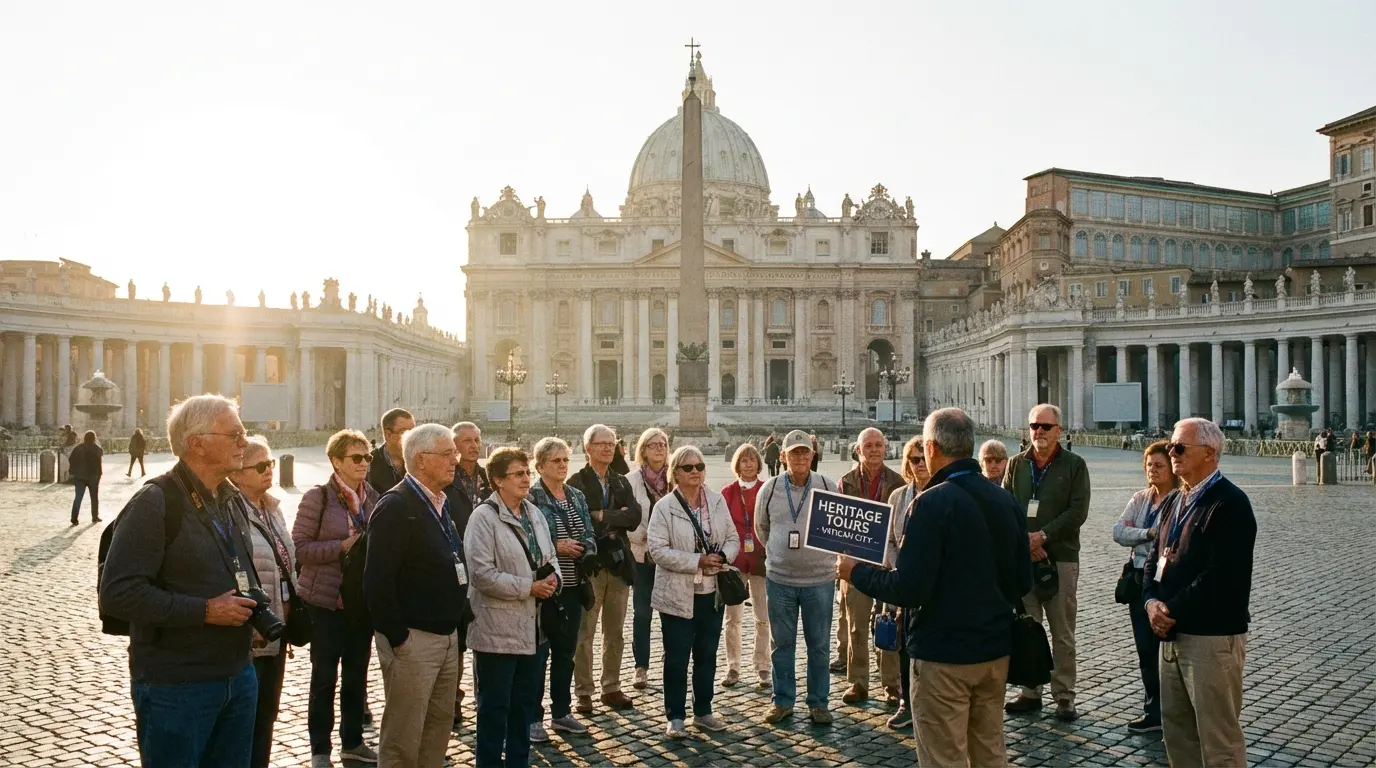
What Makes Group Heritage Travel to Italy Different
You already know that organizing a group trip is not the same as booking a personal one. But organizing a heritage trip for your congregation is something else entirely. You are not just coordinating travel. You are responsible for a spiritual experience that your group will carry with them for years.
That means the itinerary has to serve two things at once: the sacred significance of what you are visiting, and the practical reality of moving twenty or thirty people through an unfamiliar country without the travel itself becoming the story. When those two things are not in balance, the trip suffers. Either the meaning gets lost in confusion, or the planning becomes so rigid that there is no room for the moments that matter.
I have been helping spiritual leaders plan these trips for over forty years. First through my work with the Israel Ministry of Tourism, and now through Heritage Tours. What I have learned is that the leaders who have the best experience are the ones who start early, ask the right questions, and work with someone who understands what faith groups need, which is fundamentally different from what leisure travelers need.
This guide is for you, the person who is going to stand in front of your congregation and say, “I think we should do this.” I want to help you feel prepared. If you want a framework that applies beyond Italy, the complete guide for group leaders walks through planning any group pilgrimage step by step.
The Leader’s Checklist: 12 Months Out to Day One
12 months out: Have an initial conversation with a heritage tour operator. At this stage, you are not committing. You are exploring. Tell them about your group’s faith tradition, size, interests, and preferred travel dates. A good operator will listen more than they pitch.
10 months out: Share the trip concept with your congregation. You do not need a final itinerary yet. What you need is an honest description of what the trip will include, an approximate cost range, and a sense of what makes it different from a standard tour. Ask for expressions of interest, not deposits.
8 months out: Finalize the itinerary with your operator. This is when you confirm which cities, which heritage sites, how many days, and what level of accommodation. If your group has specific interests, a particular synagogue in Venice, a day in Assisi, a visit to Sicily, this is when those become part of the plan.
6 months out: Collect deposits and confirm your participant count. If you reach fifteen participants, your own travel costs are covered. This is also the time to share a detailed itinerary with your group so they can prepare, read, and begin to understand what they will be experiencing.
3 months out: Confirm flights, travel insurance, and any special needs (dietary requirements, mobility considerations, Shabbat observance). Share a packing list and a brief cultural orientation with your group. Italy is welcoming, but heritage sites often have dress codes and access protocols that your group should know about in advance.
30 days out: Final headcount confirmation. Review the day-by-day schedule with your operator. Prepare any teaching materials, readings, or discussion guides you want to use at specific sites. This is the part that transforms a tour into a heritage experience, and it is entirely in your hands as the leader.
Day one: You arrive. The hotel pickup is arranged. The local guide is waiting. Your job now is to be present with your group, not to manage the details. That is what the operator is for.
How to Choose the Right Operator (Questions to Ask)
Not every tour operator understands heritage travel. Many are excellent at organizing group trips but have no experience with the specific needs of a faith community. Here are the questions that will help you tell the difference.
Do you build custom itineraries, or do we choose from fixed packages? A heritage trip should reflect your group’s identity. If the operator only offers set itineraries, they are not equipped for this kind of work.
Who are your local guides, and do they have experience with faith groups? A guide who can narrate the history of the Rome Ghetto with knowledge and sensitivity is not the same as one who points out architectural features. Ask specifically.
How do you handle Shabbat observance, dietary requirements, and religious holidays? If the operator seems unfamiliar with these considerations, they have not worked with enough faith groups to serve yours well.
What happens if a group member has a medical issue or a site is unexpectedly closed? The answer should be specific and confident, not vague reassurances.
Does the group leader travel free, and at what group size? At Heritage Tours, the leader travels at no cost with fifteen or more participants. This is standard for us because we believe the person who organizes and leads the trip should not bear the financial burden of it.
Costs, Perks & the “Leader Travels Free” Rule
Money is the question that every group leader has to face, both for themselves and for their group. Let me be direct about it.
Heritage tour costs vary based on the itinerary, the time of year, the level of accommodation, and the size of the group. A typical faith group tour of Italy, covering Rome, Venice, and Florence over eight to ten days, with hotels, ground transportation, local guides, and site admissions, will fall in a range that depends on these variables. We provide a detailed quote once the itinerary is built, so there are no surprises.
What does not vary is this: with fifteen or more participants, the group leader’s costs are covered. Flights, hotels, meals, everything that the group receives, the leader receives at no charge.
This is not a promotional incentive. It reflects a belief that I have held since I started this work. The person who recruits the group, who prepares the teaching, who carries the spiritual and organizational responsibility for the entire trip, should not also be reaching into their own pocket to make it happen. If you are a rabbi or pastor reading this, I want you to know that your role is valued, practically and not just in words.
For the group members, costs are typically shared equally and can often be spread over several months of payments leading up to the trip. Many congregations build the trip cost into their annual programming budget. Others hold fundraisers or offer subsidies for members who need assistance. Your operator should be willing to discuss payment structures that work for your community.
Building an Itinerary Your Group Will Thank You For
The best heritage itineraries balance three things: the sites that carry the deepest spiritual significance, the pace that allows your group to absorb what they are seeing, and enough variety that no single day feels repetitive.
For a Christian group, a strong Italy itinerary might anchor in Rome (the Vatican, the catacombs, the early Christian basilicas), move to Assisi (St. Francis, the Basilica frescoes), and include either Ravenna (Byzantine mosaics) or Florence (Renaissance sacred art). Each city offers a different lens on Christian history, and the progression from ancient Rome through the medieval period to the Renaissance creates a natural narrative arc.
For a Jewish group, Rome (the Ghetto, the Great Synagogue), Venice (the five synagogues of the original Ghetto), and Florence (the Great Synagogue, the Medici connection) form a strong core. Adding Ferrara, Livorno, or Pitigliano deepens the story. A Sicily extension, covering the 1492 expulsion and its traces in Syracuse, adds an emotional and historical dimension that is difficult to match.
For interfaith or mixed groups, Italy is one of the few destinations where both traditions can be explored in the same city, on the same day, without either feeling secondary. In Rome, the Jewish Ghetto and St. Peter’s are separated by a short walk. The stories they tell are different, but they are connected by the same centuries.
Whatever your group’s composition, build in unstructured time. An afternoon in a piazza. A meal together without a scheduled activity afterward. A morning where the group can revisit a site that moved them or simply walk and talk. These are the moments where the trip becomes more than a tour.
FAQ: What Group Leaders Ask Us Most
Does the group leader pay for a heritage tour to Italy?
No. With fifteen or more participants, the group leader’s costs are fully covered, including flights, accommodation, meals, and all included activities. Heritage Tours believes the person leading the spiritual experience should not carry the financial burden. This applies to rabbis, pastors, ministers, and any designated group leader.
How many people do I need for a group heritage tour?
Most group heritage tours work well with fifteen to forty participants. Fifteen is typically the minimum for group pricing and for the leader to travel at no cost. Groups larger than forty can be accommodated but may be divided into smaller units at certain sites for a better experience.
What’s included in a group heritage tour package to Italy?
A typical package includes accommodation, ground transportation with hotel pickup and dropoff, local heritage guides, site admissions, and most meals. International flights may be arranged through Heritage Tours or booked independently, depending on your group’s preference. The itinerary is custom, so every package reflects what your specific group needs.
How far in advance should I start planning a group tour to Italy?
Twelve months is the recommendation, especially for spring or autumn departures when demand is highest. This gives time to design the itinerary, build interest within your congregation, collect deposits, and handle the details that make the trip meaningful rather than just functional.
Can I customize the itinerary for my congregation’s specific interests?
Yes, and this is one of the most important things to ask any operator. Heritage Tours builds every group itinerary from scratch based on the leader’s priorities. If your congregation has a particular connection to Sephardic history, or wants to focus on early Christian communities, or needs Shabbat-observant scheduling, the itinerary is designed around those needs.
If you are at the beginning of this process, wondering whether Italy is the right choice and whether you are the right person to lead it, I would encourage you to start with a conversation. If your congregation is weighing more than one destination, many leaders also consider church group trips to Israel alongside Italy. Explore our Italy heritage tours and reach out when you are ready. There is no commitment, no pressure. Just two people talking about what a meaningful trip could look like for your community.