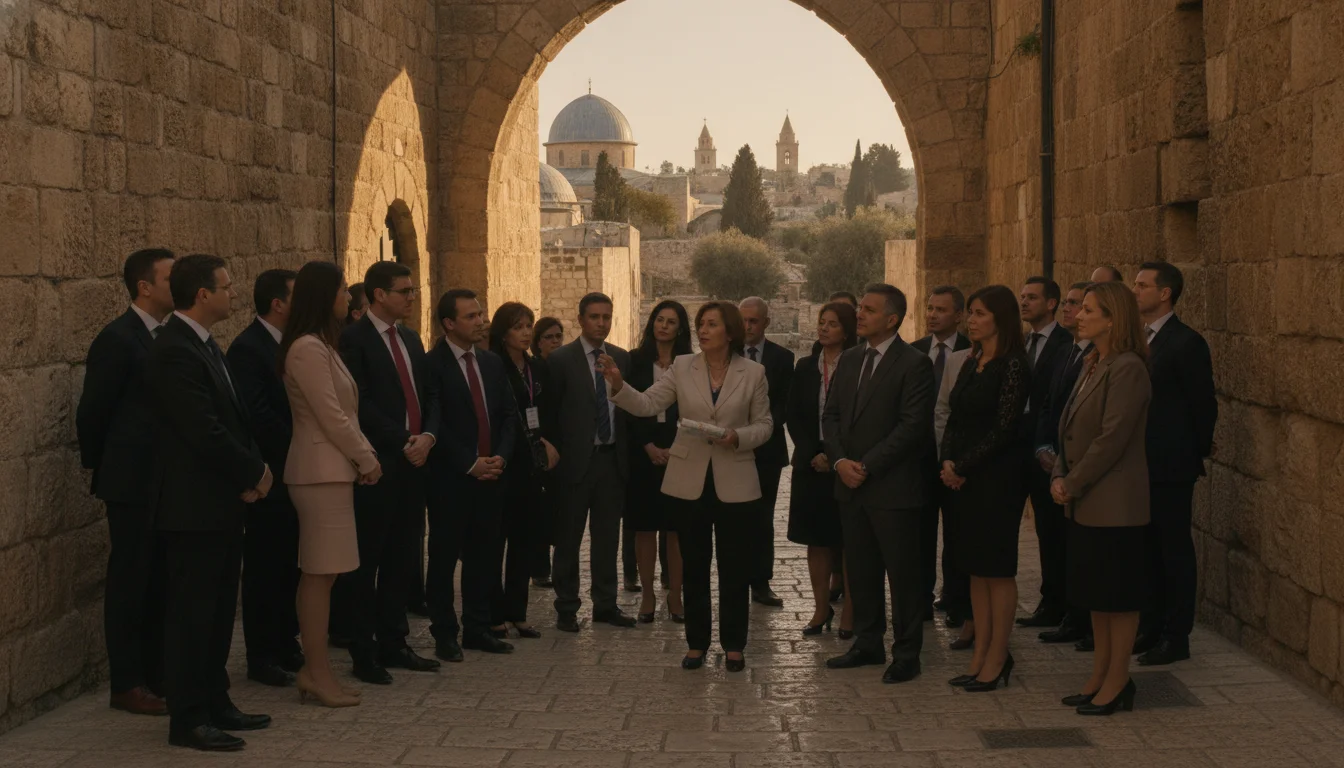
Group size is both a budget question and an experience question, and the two do not always push in the same direction.
Below a certain threshold, per-person costs get expensive quickly. Above a certain threshold, the intimacy that makes an incentive program feel earned starts to erode. The practical challenge is finding the range where the experience quality and the cost per person are both in a good place.
For Israel specifically, there is a sweet spot that I have seen work consistently well, and a set of real trade-offs worth understanding for groups that fall outside it.
Why Group Size Matters More Than Most People Assume
The instinct is to treat group size as a logistics question: more people, more buses, more hotel rooms. It is that, but it is also more.
An incentive program derives part of its motivational value from the exclusivity signal. A qualifier is not just getting a trip; they are getting admission to a group of people who also performed at the level required to earn it. That signal is strongest when the group is small enough to feel curated. When 40 percent of the sales force qualifies, the trip loses some of that signal even if the experience quality is high.
There is also the social dynamics question. An incentive group of 12 people has a different social texture than a group of 45. The conversations that happen over a dinner table for 12 are fundamentally different from the ones that happen at a banquet for 45. For a program whose value comes from the relationships built and the conversations had, the intimate format produces a better return.
And there is the pure experience question: some of the best moments an incentive program produces, the private dinner at a restaurant that fits 20, the sunrise at Masada with a guide who can have a conversation with every person in the group, a cooking class where everyone is at the same table, simply do not work the same way above a certain size.
Below 10: The Trade-offs
A group of fewer than ten qualifiers has a specific set of challenges.
The per-person costs are higher. Fixed costs, the guide, the vehicle, the private dining room, the program coordinator, do not scale down proportionally with the group. A program that costs $6,000 per person for 20 qualifiers may cost $8,500 per person for eight qualifiers covering the same itinerary.
The communal energy is softer. Part of what makes an incentive trip feel significant is the experience of being in a room with other top performers. A group of eight people at a private dinner in Jerusalem is an exceptional experience. But it has a different energy than a group of 20. Some programs benefit from that intimacy. Others need a larger group to feel like a meaningful gathering.
When does a group under ten work? For senior leadership programs, where the small size is itself the signal of exclusivity. For programs where the per-person cost increase is manageable and the intimacy is the point. For a first-year program where the qualification bar is high and the group is genuinely small.
What to avoid with a very small group: over-programming. A group of eight does not need a full conference-style evening program. They need excellent experiences and unstructured time together.
The Sweet Spot: 15-30 Participants
This is the range I recommend for most incentive programs, and it is where Israel performs best.
At 15 to 30 participants, the per-person cost is at a reasonable range, the experiences scale well, and the communal energy is genuinely good. A private dinner for 20 feels like an occasion. A guided day in Jerusalem for 25 keeps the group cohesive while giving individuals enough space to have their own experience of the sites.
The logistical format at this size: one private coach or two minibuses, one primary guide with potentially a second guide for activities, a program coordinator, and private dining configurations that put the full group at one or two tables.
The sweet spot within this range: 18 to 24 people. Large enough to feel like a genuine group, small enough that every qualifier has real access to every other qualifier and to the program hosts.
The same sweet spot applies to heritage-focused corporate group programs. For companies planning a cultural or heritage trip to Israel outside of a performance-based incentive structure, 15 to 30 people is also the range where the experience works best. See corporate group tours in Israel for how those programs are structured.
Above 40: What Changes and Why
A group of more than 40 qualifiers starts to tip into a different category of experience.
The logistics shift. Private dining for 45 requires a different venue than private dining for 20. A single guide working with 45 people is less effective than two guides each working with a group of 20. The vehicle configuration changes from intimate to coach.
The social dynamics change. A group of 45 people naturally fragments into smaller clusters. The conversational texture becomes more like a conference and less like an intimate gathering. The program can still be excellent, but it requires different design.
The intimacy signal erodes. At some point, the exclusivity that makes an incentive program feel earned is compromised by the sheer number of qualifiers. This is not a fixed threshold, it depends on the company’s total sales team size, but it is worth thinking about before setting the qualification bar.
How to Split a Large Group Into Cohorts
For programs where the qualifying group naturally exceeds 35 or 40, splitting into cohorts is often the right approach.
Running two separate programs, Cohort A in October and Cohort B in November, produces a better experience for each cohort than combining all 60 qualifiers into a single program. Each cohort gets the intimacy and the private access that the program is supposed to deliver.
The splitting should be done thoughtfully. Random assignment works fine for most programs. Some companies assign cohorts by region or business unit, which creates a coherent peer group for each trip. Some companies offer qualifiers a choice of dates, which tends to produce self-selected cohorts with good internal chemistry.
The downside of cohort splitting: the two groups have different shared memories. The program does not produce a single group of qualifiers who all experienced the same trip together. For programs where the shared experience of the full qualifying group has organizational value, cohort splitting trades that benefit for experience quality.
How Group Size Affects Budget Per Person
The relationship is not linear, but it is significant.
Below 10 qualifiers: per-person cost is 30 to 50 percent higher than at the 20-person baseline, primarily due to fixed costs being spread over fewer people.
10 to 15 qualifiers: per-person cost is 15 to 25 percent higher than the 20-person baseline.
15 to 30 qualifiers: this is the baseline range. The program costs are in the range they are designed to be at.
30 to 50 qualifiers: per-person cost is roughly flat or slightly lower than the baseline, depending on how much the program can take advantage of group pricing on transportation and dining.
Above 50 qualifiers: some economies of scale apply, but the program design costs (additional guides, larger venues, more complex logistics) tend to offset the group-pricing benefits.
Groups of 15 or more qualify for a complimentary group leader spot, which covers the program director or executive host accompanying the group. This is a meaningful cost offset and makes the effective per-person cost of a 15-person program closer to the 20-person range.
Our incentive travel hub covers the full design of an Israel incentive program. For a detailed budget breakdown at different group sizes, our incentive travel budget per person guide has the numbers.
FAQ
What is the minimum group size for a meaningful incentive trip to Israel?
Six to eight participants is a practical minimum, though the per-person costs are higher at that size. Below six, the program starts to feel like an individual travel experience rather than a group incentive trip. The minimum that produces the social energy a qualifying program depends on is usually around ten.
What is the maximum group size that still feels like an incentive program?
There is no fixed maximum, but above 35 the experience starts to require different design choices to maintain the intimacy and exclusivity that characterize a premium incentive program. Above 50, cohort splitting is almost always the right approach.
Does group size affect which Israel experiences are available?
Yes. Some of the best experiences, a private wine dinner at a boutique winery in the Judean Hills, a cooking class in a Jerusalem kitchen, a private sunrise at Masada, have capacity limits that make them ideal for groups of 15 to 25 and more logistically complex for groups of 40 or more.
Is it better to run one larger program or two smaller cohort trips?
For groups above 35, two cohort trips almost always produce a better experience than one large program. The cost may be slightly higher due to running two separate logistics operations, but the experience quality is meaningfully better.
What if our qualifying group ends up smaller than expected?
Run the program for the group you have. A smaller group than expected is worth examining from a program-design perspective: was the bar set too high? Was the program communicated effectively? But for the year in question, the qualifiers who earned it deserve the program they were promised regardless of the total count.
Does group size affect the choice of hotel in Israel?
Somewhat. For groups above 40, the hotel block requirements become a real logistical consideration. Premium properties in Jerusalem and Tel Aviv have limited room counts, and a large group may require spreading across two properties or planning farther in advance to secure a sufficient block.