Why France Is a Pilgrimage Destination, Not Just a Tourist One
France receives more tourists than any other country on earth. But beneath the surface of Parisian cafes and Riviera beaches lies a sacred landscape that has drawn pilgrims for more than a thousand years.
Lourdes alone brings five million visitors annually, most of them on pilgrimage. Chartres has called the faithful since the 12th century. Mont Saint-Michel has stood as a place of prayer since the 8th century. And alongside these Christian sites, France holds some of the most significant Jewish sacred spaces in Europe, from the synagogues of Alsace to the memorial sites of Paris.
For a pastor or rabbi planning a group journey, France is not a tourist destination with a few churches attached. It is a place where faith communities have been gathering, praying, and building for centuries. This guide walks you through the sites that matter most, one by one.
Lourdes: The Marian Shrine That Draws Five Million Pilgrims a Year
Lourdes is, for many Christian travelers, the single most meaningful pilgrimage site in France.
In 1858, a young woman named Bernadette Soubirous reported seeing visions of the Virgin Mary at a grotto near the Gave de Pau river. The spring that emerged from the grotto became associated with healing, and within a few years, Lourdes had become one of the most visited pilgrimage sites in the world. It has not slowed down since.
What makes Lourdes extraordinary for groups is the scale and the intimacy at the same time. The Grotto of Massabielle is surprisingly small and quiet, even with the crowds. The healing baths are available to visitors. The Basilica of the Immaculate Conception rises above the grotto. And in the evening, the candlelight procession draws thousands of pilgrims walking together, each holding a candle, singing hymns across the esplanade. Many participants describe this as the single most moving moment of their spiritual lives.
For a pastor bringing a church group, Lourdes requires at least two days to experience fully. One day for the grotto, the basilica, and the baths. A second for the broader sanctuary, the Stations of the Cross, and the evening procession. Rushing Lourdes defeats its purpose.
For guidance on when to visit Lourdes, see our best time to visit France for heritage travel.
Notre Dame de Paris: Restored and More Meaningful Than Ever
The fire of April 2019 devastated Notre Dame, and the world watched in grief. The cathedral’s restoration, completed and celebrated with a reopening in December 2024, is itself a story of devotion and renewal that resonates deeply with faith travelers.
Notre Dame has stood at the heart of Paris since the 12th century. It is not just a Gothic masterpiece. It is a living cathedral where Mass is celebrated, where pilgrims come to pray, and where the spiritual history of France is written in stone.
Visiting Notre Dame now carries a double significance. You are entering one of the great sacred spaces of Western Christianity, and you are witnessing a place that was nearly lost and then brought back. For a group that understands what it means to rebuild after catastrophe, that resonance will not be lost.
Group visits to Notre Dame require advance booking, especially since the reopening. Heritage Tours handles this coordination.
Mont Saint-Michel: The Abbey at the Edge of the World
Mont Saint-Michel sits on a tidal island off the coast of Normandy, connected to the mainland by a causeway. The abbey perched at its summit has drawn pilgrims since the 8th century, when the Bishop of Avranches reported a vision of the Archangel Michael.
The approach to Mont Saint-Michel is part of the experience. As you cross the causeway, the abbey rises above you, its spire visible for miles. The climb through the village to the abbey church at the top is, for many visitors, a physical pilgrimage in miniature.
Inside, the abbey is a masterwork of medieval architecture. The cloister, the refectory, and the church itself are built on multiple levels, carved into the rock. Standing in the nave, looking out over the bay, you understand why this place has called pilgrims for over a thousand years.
Mont Saint-Michel works well as a day trip from Paris or as a stop on a route through Normandy. For groups, Heritage Tours arranges timed entry to avoid the heaviest tourist crowds.
Chartres Cathedral: Where Medieval Faith Left Its Greatest Mark
Chartres is about an hour southwest of Paris, and its cathedral is one of the supreme achievements of the Gothic age.
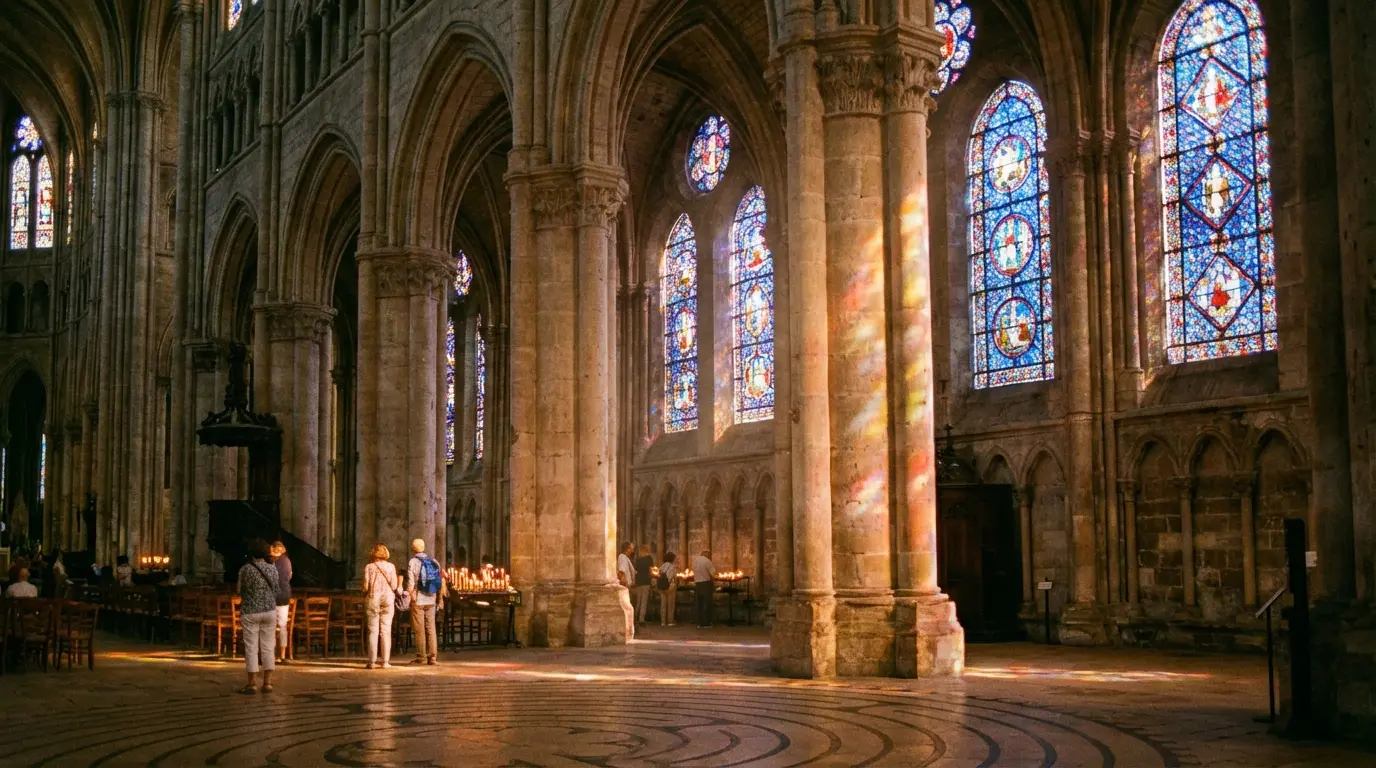
The stained glass windows of Chartres are the most complete set of medieval windows surviving anywhere in Europe. The blue light that fills the interior, especially in the morning, is something that must be experienced in person. The labyrinth on the nave floor, laid out in the early 13th century, has been walked by pilgrims for over 800 years. Walking the labyrinth in silence with your group is a form of prayer that needs no explanation.
The sculptural program on the cathedral’s exterior, particularly the Royal Portal, tells the stories of the Old and New Testaments in stone. For a pastor or teacher, these carvings are a visual Bible that medieval pilgrims could “read” even if they were illiterate.
Chartres is best visited in the morning when the light through the windows is at its most vivid and the crowds are thinnest.
Vezelay and the Romanesque Road
Vezelay, perched on a hilltop in Burgundy, is one of the starting points of the Way of Saint James pilgrimage to Santiago de Compostela. The Basilica of Sainte-Madeleine is a Romanesque treasure, its carved tympanum depicting Christ sending the Apostles into the world.
In 1146, Bernard of Clairvaux preached the Second Crusade from this hillside to an assembled crowd. The historical weight of that moment, whatever you think of the Crusades themselves, is undeniable.
Vezelay is also a UNESCO World Heritage Site, yet it remains remarkably uncrowded. For a group that wants to experience a sacred site without the tourist pressure of Paris or Lourdes, Vezelay offers something rare: quiet, beauty, and a direct connection to medieval Christian devotion.
Sites for Jewish Faith Travelers: Memorial de la Shoah, Synagogues of Alsace
France’s spiritual sites are not only Christian. For Jewish groups, several places carry deep sacred significance.
The Memorial de la Shoah in Paris is both a museum and a place of remembrance. The Wall of Names lists the 76,000 Jews deported from France during the Shoah. It is a solemn, powerful space that deserves time and quiet. For a rabbi leading a group, the memorial is part of the spiritual journey, a place to hold grief and memory together.
The synagogues of Alsace, including the rebuilt Great Synagogue of Strasbourg, represent centuries of continuous Jewish worship. The older synagogues in smaller towns and the medieval cemeteries with their ancient headstones carry a sanctity that is palpable.
The Carpentras and Cavaillon synagogues in Provence, dating to the 14th and 15th centuries, are among the oldest in Europe. Visiting them is a pilgrimage in the truest sense, traveling to places where Jewish life persisted against the odds.
For a full guide to Jewish heritage sites in France, see our Jewish heritage in France guide.
FAQ: Planning a Faith Travel Itinerary in France
Is Lourdes appropriate for Protestant groups as well as Catholic? Many Protestant groups visit Lourdes and find it deeply meaningful. The grotto, the spring, and the candlelight procession are spiritual experiences that transcend denominational lines. Some Protestant groups focus on the story of Bernadette and the themes of faith and humility rather than the Marian doctrine specifically.
What is the best way to visit Notre Dame after its 2024 restoration? Group visits require advance booking through the cathedral’s reservation system. Heritage Tours handles this for our groups. Morning visits offer the best light and the smallest crowds. Plan at least two hours to experience the cathedral properly.
Can a group visit Mont Saint-Michel as a day trip? Yes. Mont Saint-Michel is accessible as a day trip from Paris (about 3.5 hours by road) or from nearby towns in Normandy. Heritage Tours arranges timed entry and ground transport. Allow a full day, as the climb to the abbey and the visit itself take several hours.
Are there Jewish spiritual sites in France comparable to Christian pilgrimage sites? In terms of historical and spiritual significance, yes. Rashi’s Troyes, the Carpentras synagogue, and the Memorial de la Shoah each carry a weight for Jewish travelers that parallels what Lourdes or Chartres means for Christians. The experiences are different in nature but equal in depth.
How do you book a faith group visit to Chartres Cathedral? Chartres welcomes group visits and can accommodate guided tours with advance notice. Heritage Tours coordinates group bookings, guide arrangements, and timed visits to ensure your group experiences the cathedral at its best.
France’s spiritual sites have the power to change the way your group sees their faith. If you are considering a journey that includes any of these places, visit our France destination page or contact us. We would be honored to help you plan it.