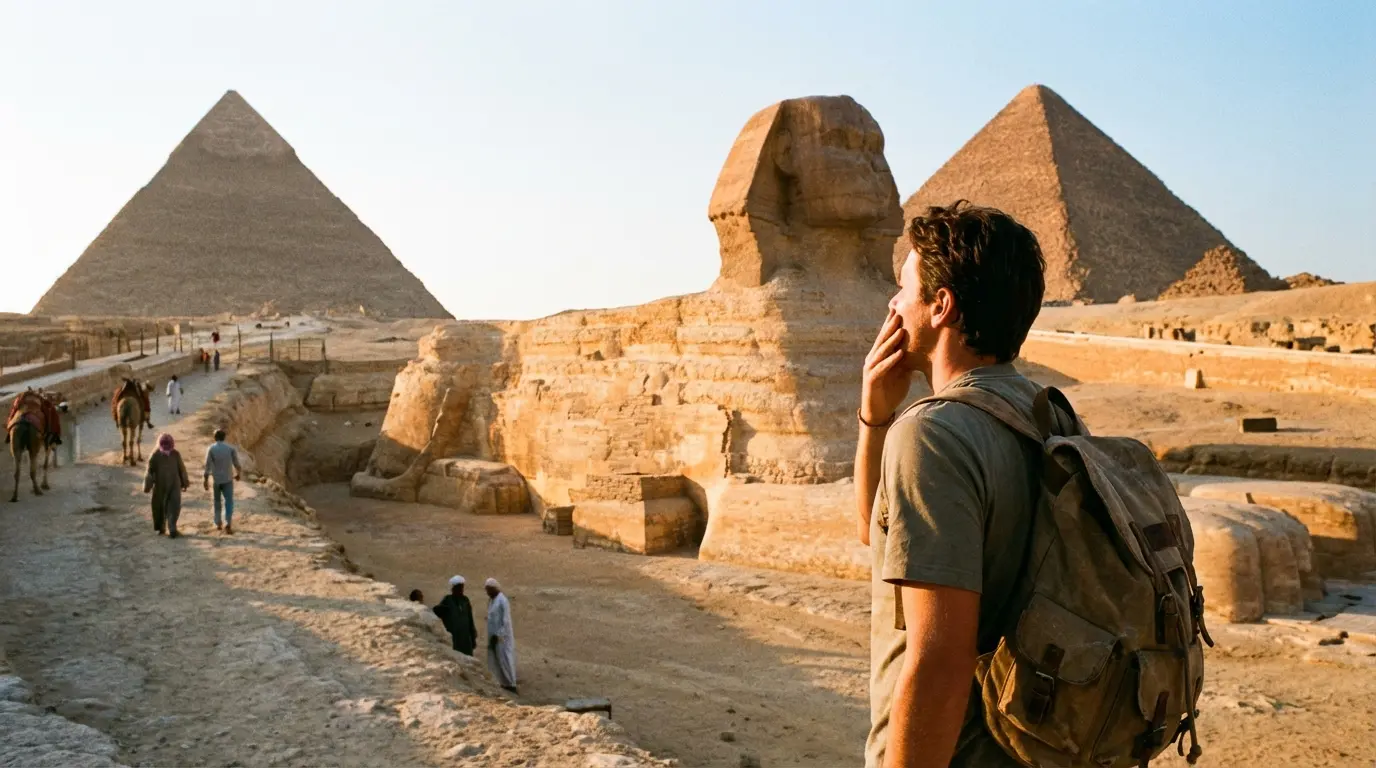
I’ve been taking faith groups to Egypt for over twenty years. And without exception, every single first-time visitor arrives with the same look on their face. Part awe, part nerves, part “I can’t believe I’m actually here.” The nerves are usually biggest at the airport. By day two, they’re gone.
That transformation is what this guide is about. Not reassurance for reassurance’s sake, but honest, grounded information from someone who has walked this ground hundreds of times, with pastors, rabbis, church groups, synagogue communities, and families who had never left North America before. Egypt is extraordinary. It is also genuinely manageable when you know what you’re walking into.
So let’s talk about what you actually need to know.
What First-Timers Get Wrong About Egypt (And What You Don’t Need to Worry About)
The first thing most people get wrong is imagining Egypt through the filter of news headlines. The Egypt of the international media and the Egypt you actually walk through are two very different places. Cairo is not a war zone. The Nile Valley is not dangerous. The locals are not hostile. What Egypt is, honestly, is one of the most hospitable places I’ve ever set foot in.
The second thing first-timers get wrong is imagining they can figure it out as they go. Egypt is not Jordan. It is not a place where you can land at the airport, take an Uber to your hotel, and improvise your way through. Cairo is one of the most complex urban environments on the planet. The traffic alone will stop you cold. The scale of it. The noise of it. That’s not a warning to scare you. It’s just context for why having an experienced team on the ground makes all the difference.
The third thing? People imagine Egypt requires months of preparation. It doesn’t. It requires the right guidance.
Is Egypt Safe for Faith Travelers?
I want to give you a real answer here, not a polished one.
The Reality of Egypt Today
The main tourist areas of Egypt, including Cairo, the Nile Valley, Luxor, Aswan, the Sinai Peninsula, and the Red Sea coast, have had sustained security and a strong tourism industry for years. The Egyptian government has invested heavily in protecting tourist sites and pilgrimage routes. Our groups move through all of these areas regularly. We do not avoid them and we do not hesitate.
That said, there are parts of Egypt that are genuinely not appropriate for tourist travel, particularly remote areas of the Sinai interior and the Western Desert near the Libyan border. We simply don’t go to those areas. Our itineraries stay on established heritage and pilgrimage routes that have been traveled by faith groups for decades.
The honest answer to “is Egypt safe?” is: the Egypt that matters for a heritage pilgrimage, yes. With an experienced team who knows the routes and the current situation, yes.
Sinai-Specific Safety Considerations
The Sinai has a complicated reputation. Let me be direct about this. The northern Sinai, near the border with Gaza, has had security issues for years. We do not go there. The southern Sinai, which is where St. Catherine’s Monastery and the Mount Sinai sunrise climb are located, is a separate world. It has been traveled by Christian pilgrims and Jewish communities for centuries. It continues to be. Our groups climb that mountain regularly.
The Egyptian military maintains checkpoints in the Sinai, and the protocol for navigating them is something our team handles. You will go through checkpoints. They are not alarming once you’ve done it a few times.
What Faith Groups Should Be Aware Of
Egypt is a majority Muslim country. That shapes the culture, the rhythm of daily life, the significance of certain sites, and the dress expectations. None of that is a problem for a faith group. In fact, most of the faith travelers I work with feel an immediate sense of kinship with the deep spiritual culture of Egypt. The Egyptians take their faith seriously. So do you. That’s common ground.
During Ramadan, some things change (more on that later in a separate post). But Egypt’s religious calendar and your own don’t have to conflict. They can actually deepen the experience.
Getting Into Egypt: Visas and Entry
Visa on Arrival and E-Visa Options
Most Western travelers, including Americans and Canadians, can obtain a visa on arrival at Cairo International Airport. As of 2026, the cost is approximately $25 USD, paid in cash. You can also apply for an e-visa in advance through Egypt’s official e-visa portal. We generally recommend the e-visa for groups because it reduces the time spent at the arrivals hall. For a group of 20 people all getting visas on arrival at the same time, the paperwork queue can take a while.
Passport validity matters: your passport must be valid for at least six months beyond your travel dates.
Coming from Israel: What Changes
Many of our groups visit Egypt as part of a larger itinerary that includes Israel. If you’re coming overland from Israel, you’ll cross at either the Taba border crossing (into the Sinai) or Eilat/Nitzana (into the Sinai and on toward Cairo). These are established crossings used regularly by faith travelers.
A few practical notes. The Taba crossing is the most common for groups coming from Eilat. It deposits you directly into the Sinai, which is convenient if your first stop is St. Catherine’s. The crossing itself takes time, usually one to three hours depending on the day and the queue. Budget for it. Don’t plan a 4pm arrival at the monastery if you’re crossing at 1pm.
If you have Israeli stamps in your passport, that is not a problem at the Egyptian border. Egypt and Israel have had formal peace since 1979, and the crossings are well-practiced.
Navigating Egypt as a Faith Group
What to Wear at Mosques, Churches, Synagogues, and Sinai
This is one of the most practical questions I get from first-time group leaders, and the answer is simpler than people think.
At mosques, including the Mosque of Muhammad Ali at the Citadel, women cover their heads and remove shoes. Loose, modest clothing is appropriate for everyone. Shorts and sleeveless tops are not appropriate.
At Coptic Christian churches, including the Hanging Church and the Church of St. Sergius and Bacchus in Old Cairo, modest clothing is expected but the rules are somewhat more relaxed than at mosques. Women do not need to cover their heads, but bare shoulders and short skirts are not appropriate.
At Ben Ezra Synagogue, the rules are similar to any synagogue visit. Men should cover their heads. Modest dress. Ben Ezra is a working heritage site, not a functioning congregation, but the respect you’d bring to any sacred space applies here.
On the Mount Sinai climb, practicality takes over. Layers are essential because the temperature swings dramatically between the base at midnight and the summit at dawn. Closed-toe shoes. A headlamp. You’re not worrying about dress codes on that mountain. You’re worrying about keeping warm.
Photography Rules at Religious Sites
This is where first-timers get into the most trouble, and I say that kindly. The rules at each site are different, they’re not always clearly posted, and the consequences for violating them can range from a guard asking you to stop to having your phone or camera confiscated.
At Ben Ezra Synagogue, photography is generally not permitted inside the main hall. Some guards are more lenient than others. The respectful approach is to ask before raising your camera.
At the mosques, the rules depend on the site. The Muhammad Ali Mosque allows photography in most areas. Some smaller neighborhood mosques do not welcome tourists with cameras at all.
At the Pyramids and Sphinx, photography is permitted outdoors freely. Inside the chambers? Different story. Some chambers allow it with a special paid permit, some don’t allow it at all. Our team will walk you through exactly what applies on the day.
Inside the Valley of the Kings in Luxor, no photography of any kind is permitted inside the tombs. This is enforced.
Our team briefs every group on the specific photography rules for each site we visit. First-timers should not have to research this independently. That’s our job.
The Genuine Warmth of Egyptian Hospitality
I want to spend a moment on this because it surprises nearly every group. Egyptians are among the most welcoming people I have encountered anywhere in the world. The culture of hospitality runs deep. A stranger offering you tea. A market vendor who genuinely seems happy to chat even if you buy nothing. Children waving at tour buses. Old men playing backgammon in a courtyard, perfectly content to be photographed.
This warmth is real. It is also layered, in a city like Cairo, with the persistent attention that tourism brings. Vendors will approach you. Guides you haven’t hired will offer their services. People will call out to your group. That’s Cairo. It’s not malicious. It’s the energy of a city that has welcomed pilgrims and travelers for thousands of years. Learn to smile and say “la shukran” (no thank you) and you’ll be fine.
Cairo’s Complexity: What First-Timers Need to Know
Getting Around the City
Cairo is a city of 20 million people, depending on how you count the greater metro area. It is loud. It is enormous. The traffic follows a logic that only becomes apparent after you’ve been sitting in it for an hour. Lane markings are suggestions. Horns are a form of communication, not aggression. Pedestrian crossings exist in theory.
None of this is meant to alarm you. But if you’re imagining Cairo as navigable in the way that, say, Tel Aviv or Rome is navigable, recalibrate. Getting from the Egyptian Museum to Old Cairo at the wrong hour of the day can take an hour for what looks like a ten-minute drive on the map.
How Heritage Tours Handles Cairo Navigation for Groups
We pick up your group at your hotel and we drop you off at your hotel. Every day. You do not navigate Cairo independently. You do not figure out which bus goes where. You do not stand on a corner trying to hail a cab for 22 people. Our vehicles, our driver relationships, our knowledge of which routes work at which times of day, that is what we bring.
This is not about hand-holding. It is about your group arriving at the Egyptian Museum with energy for the Egyptian Museum, not depleted from an hour of stress. The sites of Egypt deserve your full presence. That’s what you came for.
Sinai and the Red Sea: What to Prepare For
The southern Sinai is its own world. Desert landscape that feels biblical because it is biblical. Mountains that have been walked by pilgrims for two thousand years. St. Catherine’s Monastery, still operational, still home to a small community of monks, still holding one of the oldest continuously inhabited libraries in the world.
And then there’s the climb.
The Mount Sinai night climb begins around midnight or 1am. You hike by headlamp. It takes between two and three hours to reach the summit. You arrive in darkness. You sit on cold rock or on rented camel blankets. And then the sun comes up.
I’ve watched hundreds of people see that sunrise. Pastors and rabbis who have spent their whole lives reading about this mountain. First-timers who didn’t fully understand where they were until the light hit the peaks. People who cried. People who laughed. People who simply sat in silence because there were no words.
Prepare physically. The climb is not technically difficult, but it is long and it is steep in sections. For a mixed-age group, plan the pace conservatively. Bring layers. Bring water. And then give yourself permission to be fully present for what happens at the top.
The Sites That Surprise First-Timers the Most
People arrive expecting the Pyramids to be the peak of the Egypt experience. And the Pyramids are extraordinary, genuinely. But they are rarely the moment that undoes people.
The moment that undoes people is usually one of these: standing inside Ben Ezra Synagogue, where Maimonides studied and where the Cairo Geniza was discovered, one of the most significant finds in Jewish scholarship. Or walking through the Coptic quarter of Old Cairo and realizing that Christian communities have worshipped here without interruption for two thousand years. Or sitting inside the burial chamber of a Pharaoh in the Valley of the Kings with a small group, reading the hieroglyphs by torchlight, understanding that you are inside four thousand years of history.
Egypt is not one thing. It is three and a half millennia of layered civilization. The first-timer who comes expecting the Pyramids often goes home talking about the synagogue, or the monastery, or the sunrise.
For Group Leaders Who’ve Never Been to Egypt
If you are a rabbi or pastor reading this and you have never been to Egypt, I want to speak directly to you for a moment.
I understand the weight of considering bringing your congregation somewhere you have never been. The sense of responsibility. The questions your people will ask that you won’t be able to answer from personal experience. The not-quite-knowing what to expect.
Here’s what I want you to know. You don’t need to have been to Egypt to lead your group there. You need to be in the hands of people who have. That is exactly what we are built for.
Our team has taken group leaders through Egypt for the first time dozens of times. We know the questions your congregation will ask before you do. We know what concerns will surface on the flight from Tel Aviv to Cairo. We know what needs to be said at the Pyramids, at St. Catherine’s, at Ben Ezra Synagogue, to make the experience meaningful for a faith community. We are your support system so that you can be your congregation’s spiritual guide.
You don’t have to know Egypt before you bring your group there. You just have to choose the right partners.
Explore our Egypt heritage destination to see how we structure the full journey.
FAQ: First-Time Travel to Egypt
Is Egypt safe for first-time visitors right now?
For the main heritage and pilgrimage routes, Cairo, the Nile Valley, southern Sinai, Luxor, and Aswan, yes. Egypt has maintained consistent tourism infrastructure for years. The areas relevant to a faith heritage trip have been traveled safely by groups throughout this period. The areas of Egypt that do have security concerns (northern Sinai, certain Western Desert regions) are simply not part of heritage itineraries, and our team doesn’t go there.
Do I need a visa to visit Egypt?
Most Western travelers (including Americans, Canadians, Australians, and most EU citizens) can obtain a visa on arrival at Cairo International Airport for approximately $25 USD cash, or apply in advance for an e-visa. Your passport must be valid for at least six months beyond your travel dates. For groups, we recommend the e-visa to reduce arrival processing time.
What should I wear when visiting religious sites in Egypt?
Modest clothing is the standard across all sites. At mosques, women cover their heads and shoulders, and everyone removes shoes. At Coptic churches, modest dress is expected but head coverings for women are not required. At Ben Ezra Synagogue, men cover their heads. For the Mount Sinai climb, the priority is warmth and practicality: layers, closed-toe shoes, and a headlamp. Our team briefs every group on site-specific requirements before each visit.
Can you travel from Israel to Egypt without flying?
Yes. The Taba border crossing connects Eilat (Israel) with the Sinai peninsula (Egypt), and is commonly used by faith travelers doing a combined Israel and Egypt itinerary. The crossing typically takes one to three hours. There is also the Nitzana crossing, which is used for certain organized tour arrangements. Our team coordinates the crossing details as part of the full itinerary.
How should a group leader prepare for their first Egypt trip?
Honestly? The most important preparation is choosing the right partner. You don’t need to have visited Egypt before you lead your group there. You need experienced people on the ground who can handle the complexity so you can focus on your congregation’s spiritual experience. Beyond that: communicate to your group what Egypt is (a heritage journey, not a resort holiday), prepare them physically for the Sinai climb if that’s in the itinerary, and let your team handle the rest. We’ll get you ready well before departure.
Egypt has been receiving pilgrims for three thousand years. The people who arrive with open hands, a little curiosity, and the right support almost always leave transformed.
If you’re considering bringing your community here for the first time, we’d love to talk through what that could look like. There’s no pressure, no sales pitch. Just a conversation about whether Egypt is the right next step for your group.
Contact us here when you’re ready.