What “Spiritual” Means in a Young City
Dubai does not have ancient spiritual sites. There is no 2,000-year-old church here, no medieval synagogue, no centuries-old mosque whose stones carry the prayers of generations. The city is barely a century old in its modern form, and most of what you see was built within the last fifty years.
But Dubai has something different. It has a 21st-century statement about what coexistence between faiths can look like. And for a faith traveler, a rabbi or a pastor who cares about where the world is heading, that statement is worth the journey.
The spiritual sites in Dubai are not about the past. They are about the present and the future. They ask a question that matters to every person of faith: can we build something together?
The Abrahamic Family House: Three Faiths, One Campus, One Statement
On Saadiyat Island in Abu Dhabi, three buildings sit side by side. A mosque. A church. A synagogue. They were designed by architect David Adjaye, commissioned by the UAE government, and opened in 2023. The project is called the Abrahamic Family House.
Each building is distinct. The mosque draws on traditional Islamic architectural forms. The church reflects Christian worship traditions. The synagogue carries Jewish design elements. But they are equal in scale, equal in dignity, and they share one campus and one garden.
These are not exhibits. They are functioning houses of worship. The mosque holds Friday prayers. The church holds Sunday services. The synagogue is a place of Jewish prayer and study. People worship here. That is the point.
The UAE government built this campus as a declaration. It says that the children of Abraham, Jews, Christians, and Muslims, can pray in peace, side by side, in a place that was designed for exactly that purpose. Whether you agree with every aspect of the politics that surrounds it, the building itself is extraordinary. I have visited sacred sites around the world for more than forty years. I have not seen anything quite like this.
For an interfaith group, or for any faith group that cares about the relationship between religions, the Abrahamic Family House is the most significant new spiritual site anywhere in the Gulf, and possibly in the world.
Jumeirah Mosque: A Rare Welcome for Non-Muslim Visitors
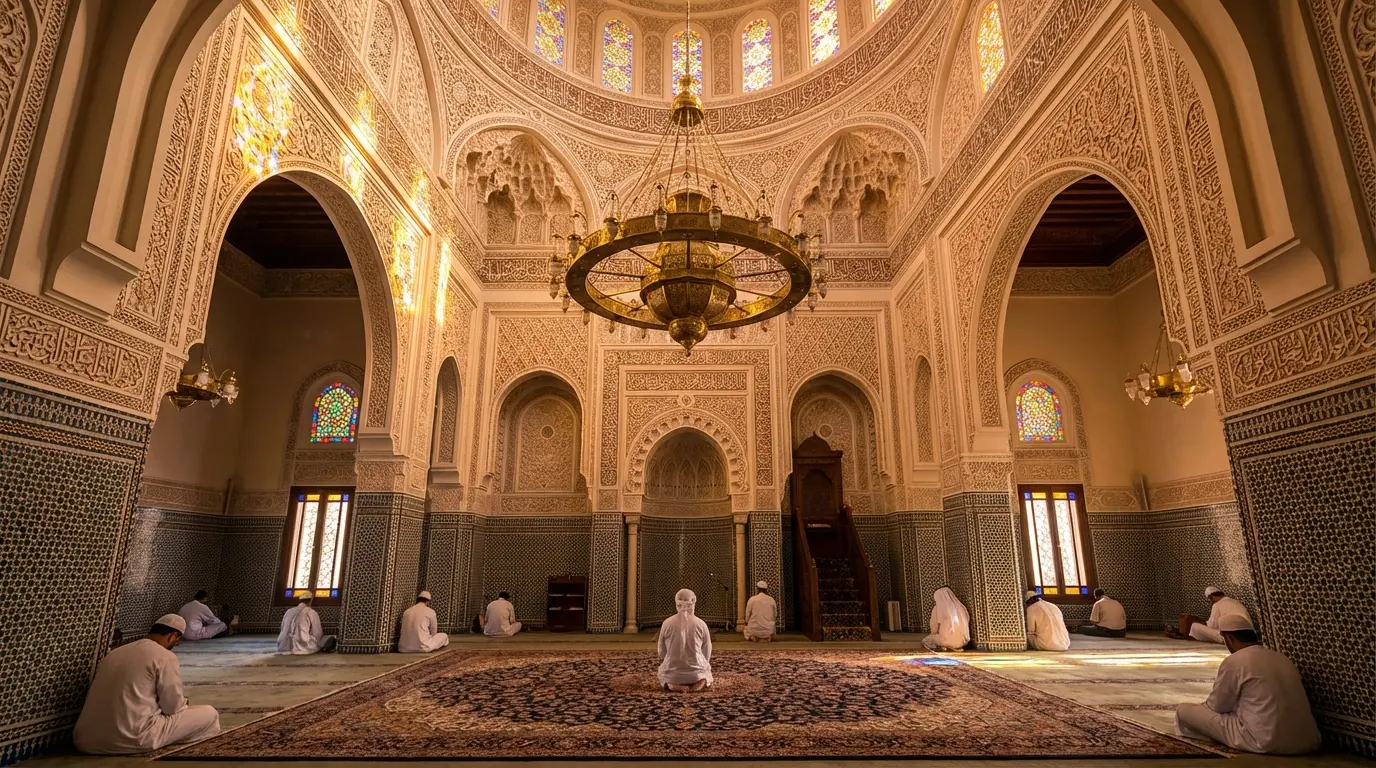
The Jumeirah Mosque is one of the few mosques in the UAE that opens its doors to non-Muslim visitors, and the way it does so is worth understanding. The Open Doors program is not a museum tour. It is an act of hospitality.
Visitors are welcomed inside the prayer hall. Traditional Arabic coffee and dates are served. A local guide explains the principles of Islamic faith, the structure of prayer, and the significance of the architectural elements. Questions are encouraged, and the conversation is genuinely open.
For a Christian or Jewish group, this is a rare opportunity. Most mosques around the world are closed to non-Muslim visitors, and the few that allow entry often do so with distance. The Jumeirah Mosque invites you in as a guest and treats you as one. The guide is not performing for tourists. He or she is sharing their faith with people who have a different one.
Modest dress is required. Women should bring a scarf, though the mosque provides abayas for visitors. The experience takes about an hour, and groups consistently describe it as one of the most meaningful parts of a Dubai visit.
St. Mary’s Catholic Church: The Largest Christian Gathering in the UAE
St. Mary’s Catholic Church in Dubai serves thousands of worshippers every week and is the largest church in the UAE. For Christian travelers, its existence in a Muslim-majority country says something important about the religious landscape of the Emirates.
The UAE government has allocated land for churches and permits public Christian worship. St. Mary’s is not hidden or restricted. It is a thriving, active congregation with multiple services in multiple languages, serving a Christian community that has grown alongside Dubai’s international population.
For a pastor bringing a group, visiting St. Mary’s or one of Dubai’s other active churches provides a real connection to the local Christian community. It is one thing to read that Christians worship freely in the UAE. It is another to sit in a full church and see it happening.
Dubai’s Growing Jewish Community and Its Spaces of Prayer
Dubai’s Jewish community is small, young, and still growing. Before the Abraham Accords, it existed quietly. Since 2020, it has become visible, organized, and increasingly confident.
Chabad Dubai, led by Rabbi Levi Duchman, provides the backbone of Jewish communal life in the UAE. Shabbat services, holiday programs, kosher meals, and community gatherings are all available for residents and visitors. For a visiting Jewish group, Chabad is the entry point to experiencing Jewish life in a place most people never expected to find it.
The Abrahamic Family House synagogue in Abu Dhabi, named after Maimonides, is the most visible Jewish worship space in the Gulf. It is new, purposefully built, and carries the weight of being a synagogue that exists because a peace agreement made it possible.
For a rabbi bringing a group, the spiritual significance is not in the age of these spaces but in their existence. Jewish prayer in the Gulf is a fact of the present, not of history. Standing in these spaces and praying in them is an act of participating in something that is still being written.
For Interfaith Groups: Sites Worth Visiting Together
If your group includes people of different faiths, or if your congregation is interested in interfaith dialogue, Dubai offers something that most destinations cannot.
Start at the Abrahamic Family House, where your group will walk through a mosque, a church, and a synagogue on the same campus. Continue to the Jumeirah Mosque for the Open Doors program. Visit Chabad Dubai for a conversation about Jewish life in the Gulf. End at St. Mary’s Church to see the local Christian community in worship.
Over the course of three or four days, your group will have entered sacred spaces of three different faiths, been welcomed at each one, and had genuine conversations with people who practice those faiths daily. This is not theoretical interfaith dialogue. It is the real thing, happening in a real place.
Heritage Tours builds Dubai interfaith itineraries around exactly this sequence of experiences. For clergy who want to model interfaith respect for their community, this trip offers something concrete and powerful.
Frequently Asked Questions
What is the most spiritually significant site in Dubai for faith travelers?
The Abrahamic Family House in Abu Dhabi is the most spiritually significant site in the Dubai region. It is the only place in the world where a mosque, a church, and a synagogue were built together on one campus as functioning houses of worship.
Is non-Muslim worship permitted in Dubai?
Yes. The UAE permits and supports non-Muslim worship. Churches, synagogues, and other houses of worship operate openly. The government has allocated land for religious buildings and has made religious tolerance a stated national priority.
Can a Jewish group hold prayer services in Dubai?
Yes. Chabad Dubai provides spaces and support for Jewish prayer services. The Abrahamic Family House in Abu Dhabi includes a functioning synagogue. Jewish groups can observe Shabbat, hold minyan, and celebrate holidays in the UAE.
What is St. Mary’s Catholic Church in Dubai?
St. Mary’s Catholic Church is the largest church in the UAE, serving thousands of worshippers weekly with services in multiple languages. It is an active, thriving congregation in the heart of Dubai and welcomes visiting groups.
Is the Abrahamic Family House open to tourists?
Yes, but the Abrahamic Family House is not a museum. It is a campus of functioning houses of worship that welcomes visitors. Group visits require advance booking. Guided tours explain the architecture and the interfaith vision behind the project.
If you would like to bring your group to these sites, we would be honored to help you plan the visit. The spiritual landscape of Dubai is new and still evolving. Experiencing it firsthand is the best way to understand what it means.