Before 2020: What Dubai Was for Jewish Travelers
Before the Abraham Accords, Jewish travelers in the Gulf states kept a low profile. Israeli passport holders could not enter the UAE at all. Jewish visitors from other countries came quietly, often removing visible signs of identity. There was no public synagogue, no Chabad house, no kosher restaurant listed in any guide. A small Jewish community existed in Dubai, but it operated with discretion.
I knew families who visited the Gulf during those years. They described a beautiful place with genuine hospitality, but also a place where they felt they could not be fully themselves. For a rabbi considering a group trip, this was not a conversation that went very far.
That was the reality until September 2020.
The Abraham Accords: What the Normalization Actually Changed
The Abraham Accords, signed in September 2020 between Israel and the United Arab Emirates, did something specific and measurable. Israeli passport holders could now enter the UAE. Direct flights opened between Tel Aviv and Dubai. Business, tourism, and cultural exchange began moving in both directions almost immediately.
For Jewish travelers, the changes were concrete. You could now fly El Al from Ben Gurion Airport to Dubai International. You could wear a kippah in the street. You could observe Shabbat openly. You could find kosher food.
These were not symbolic gestures. They were practical changes that made it possible for a rabbi to bring a group to Dubai and know that his congregants could live their Jewish lives freely during the visit. That had not been true before.
Chabad Dubai and the Jewish Community That Emerged
Rabbi Levi Duchman has been leading Jewish community life in the UAE since 2014, years before the Abraham Accords. But after normalization, what had been a quiet operation became something visible and growing.
Chabad Dubai now offers regular Shabbat services, holiday programs, and kosher meals. For visiting Jewish groups, Chabad is the first point of connection. They can arrange Shabbat dinners, help with kosher food planning, and provide a sense of Jewish community life that many travelers do not expect to find in the Gulf.
The community itself is a mix of businesspeople, families who relocated for work, and a growing number of Israeli expats. It is small, but it is real. For a group visiting Dubai, spending time with this community is part of the heritage story. You are witnessing something that is only a few years old, still taking shape, still finding its footing in a part of the world where Jewish life is genuinely new.
The Abrahamic Family House Synagogue: Praying in Abu Dhabi
On Saadiyat Island in Abu Dhabi, the Abrahamic Family House includes a synagogue alongside a mosque and a church. The synagogue is named after Moses Ben Maimon, Maimonides. It is a clean, modern space designed by architect David Adjaye, and it holds regular services.
This is not a grand historic synagogue like those in Prague or Amsterdam. It carries no centuries of accumulated prayer. What it carries is a different kind of weight: it was built by a Muslim-majority government as a declaration that Jewish worship belongs alongside Islamic and Christian worship, on equal ground, under the same sky.
For a rabbi bringing a group here, the experience is not about architecture. It is about standing in a place of Jewish prayer that exists because a peace agreement made it possible. That is its significance.
Interfaith Dubai: Where Jewish, Christian, and Muslim Heritage Meet
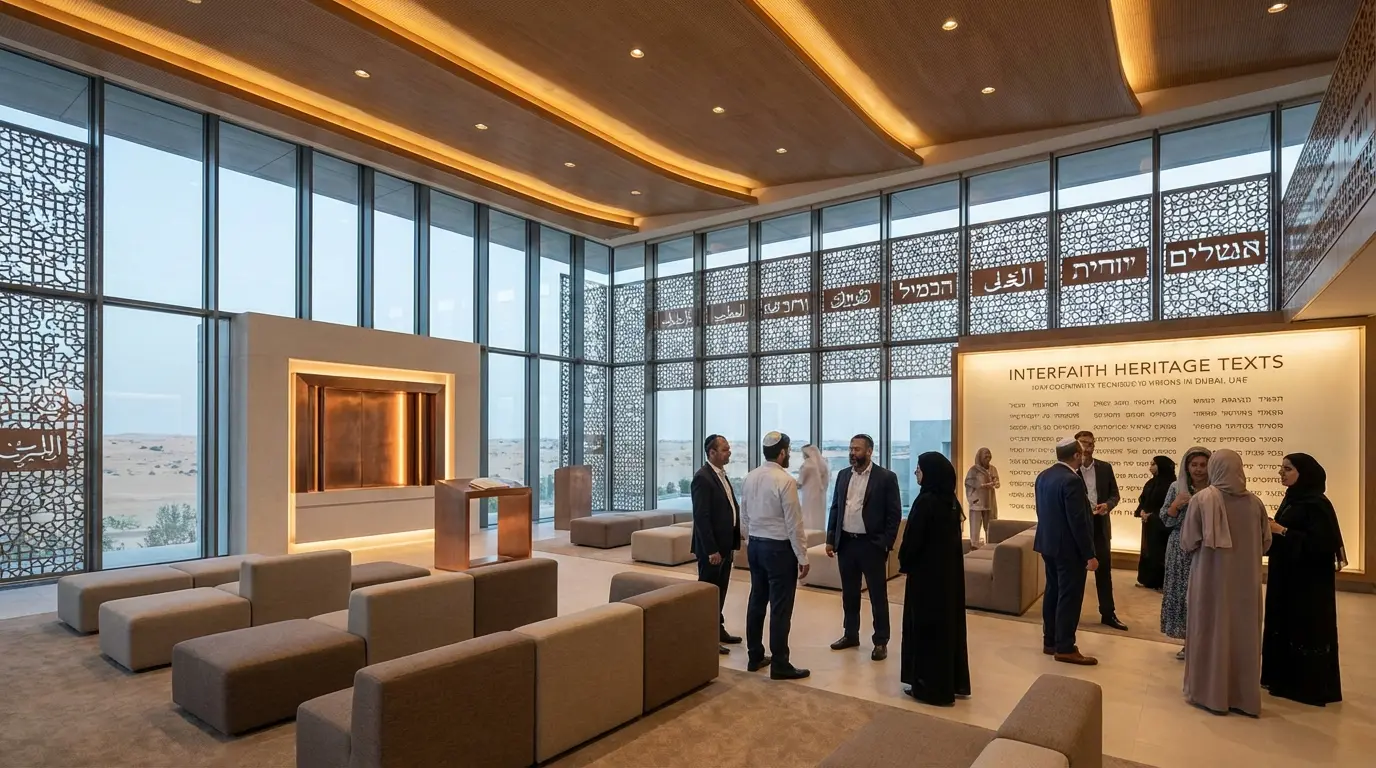
Dubai and Abu Dhabi together offer something that very few places in the world can: the experience of visiting a mosque, a church, and a synagogue that were built to sit together. The Abrahamic Family House is the clearest expression of this, but the broader environment in Dubai reflects it too.
The Jumeirah Mosque welcomes non-Muslim visitors through its Open Doors program. St. Mary’s Catholic Church serves one of the largest Christian congregations in the Gulf. And Chabad Dubai provides a home for Jewish community life.
For an interfaith group, or for a Jewish group that wants to understand the broader religious landscape, Dubai offers a real and honest picture of what coexistence looks like in practice. It is not perfect. It is still new. But it is genuine.
Combining Dubai with Israel: The New Post-Accords Itinerary
One of the most meaningful developments since the Abraham Accords is the possibility of a combined Israel and Dubai trip. Direct flights between Tel Aviv and Dubai take approximately three hours. A group can spend a week in Israel visiting the Western Wall, the Church of the Holy Sepulchre, and the ancient sites of the Galilee, and then continue to Dubai to see what normalization looks like on the ground.
This combination is powerful because it connects the ancient and the modern. Israel holds thousands of years of Jewish, Christian, and Islamic history. Dubai holds a statement about the future. Together, they tell a story that neither destination tells alone.
Heritage Tours offers this combined itinerary as one of our most meaningful programs. For a rabbi who wants to show a congregation both where we come from and where the world might be going, this trip does exactly that.
What a Jewish Group Can Actually Do in Dubai Today
Let me be specific about what is available. A Jewish group in Dubai today can attend Shabbat services at Chabad Dubai. They can eat kosher meals arranged through Chabad or at certain hotels that accommodate kosher dietary needs. They can visit the Abrahamic Family House synagogue in Abu Dhabi with advance booking. They can visit the Jumeirah Mosque as welcomed guests. They can walk through Al Fahidi Historical Neighbourhood with a guide who explains Dubai’s trading heritage. They can visit the Dubai Museum and the Coffee Museum.
They can do all of this openly, comfortably, and without hesitation. That is the change the Abraham Accords brought.
What Dubai does not have is ancient Jewish history. There is no medieval synagogue, no centuries-old cemetery, no Jewish quarter that carries the weight of generations. The heritage here is contemporary. It is the heritage of peace-making, of new community, of doors that opened in our lifetime.
For some groups, that is exactly the point.
Frequently Asked Questions
Is Dubai safe and welcoming for Jewish travelers?
Yes. Since the Abraham Accords, Jewish travelers are openly welcomed in Dubai and throughout the UAE. Jewish religious practice, including wearing kippot and observing Shabbat, is respected. The UAE government has actively promoted religious tolerance as a national value.
What is Chabad Dubai and what services does it provide?
Chabad Dubai, led by Rabbi Levi Duchman, provides regular Shabbat services, holiday programs, kosher meals, and community support for Jewish residents and visitors in the UAE. Visiting groups can coordinate Shabbat dinners and other Jewish life services through Chabad.
Can Jewish groups hold a Shabbat service in Dubai?
Yes. Jewish groups can hold Shabbat services through Chabad Dubai, which provides space and support for communal prayer. Some hotels also accommodate private Shabbat services for visiting groups. Advance coordination is recommended.
What is the Abraham Accords and how did it change travel between Israel and the UAE?
The Abraham Accords, signed in September 2020, normalized diplomatic relations between Israel and the UAE. It enabled Israeli passport holders to enter the UAE, opened direct flights between Tel Aviv and Dubai, and made it possible for Jewish travelers to visit the Gulf openly for the first time.
Is there a synagogue in Dubai?
The Abrahamic Family House in Abu Dhabi includes a functioning synagogue named after Maimonides, designed by architect David Adjaye and opened in 2023. Additionally, Chabad Dubai provides spaces for regular Jewish worship and communal prayer in Dubai.
If you are a rabbi considering Dubai for your congregation, or if you want to explore the combined Israel and Dubai journey, we would be glad to share what we have learned. See our Dubai heritage programs and let us help you understand what this destination can mean for your group.