The Abrahamic Family House: Three Places of Worship on One Campus
I have been in this industry for over forty years, and I can count on one hand the places that made me stop and reconsider what I thought I knew about the world. The Abrahamic Family House is one of them.
On Saadiyat Island in Abu Dhabi, about ninety minutes from Dubai, three buildings stand side by side on a shared campus: a mosque, a church, and a synagogue. They were designed by the British-Ghanaian architect David Adjaye, commissioned by the UAE government, and opened in 2023. Each building is distinct in design but equal in scale. None towers over the others. None is set back. They face each other across a shared garden.
These are not symbolic buildings. The mosque holds Friday prayers. The church holds Sunday worship. The synagogue is a place of Jewish prayer and study. They are functioning houses of worship that happen to share the same campus, the same architect, and the same founding principle: that the children of Abraham can pray in peace, side by side.
For a faith group visiting Dubai, this is not a detour. It is the reason to come. No guidebook gives it the weight it deserves because it is too new, too unusual, and too far outside the standard tourism narrative. But if your group visits one site in this region, let it be this one.
Jumeirah Mosque: A Rare Invitation for Non-Muslim Visitors
The Jumeirah Mosque is one of the few mosques in the UAE that welcomes non-Muslim visitors, and it does so through a program called Open Doors. This is not a roped-off tour where you peer at the interior from a distance. Visitors are invited inside, offered traditional Arabic coffee and dates, and guided through the mosque by a local host who explains the principles and practices of Islam with warmth and patience.
The program was created as an act of cultural hospitality. The hosts answer questions openly, from the meaning of the call to prayer to the significance of the mihrab that points toward Mecca. For a Jewish or Christian group, this is a rare chance to experience Islamic worship space not as outsiders looking in, but as welcomed guests.
Modest dress is required. Women are offered an abaya if needed. The atmosphere is one of genuine welcome, and groups who have done this consistently describe it as one of the most moving parts of their Dubai visit.
Al Fahidi: The Neighborhood That Remembers What Dubai Looked Like
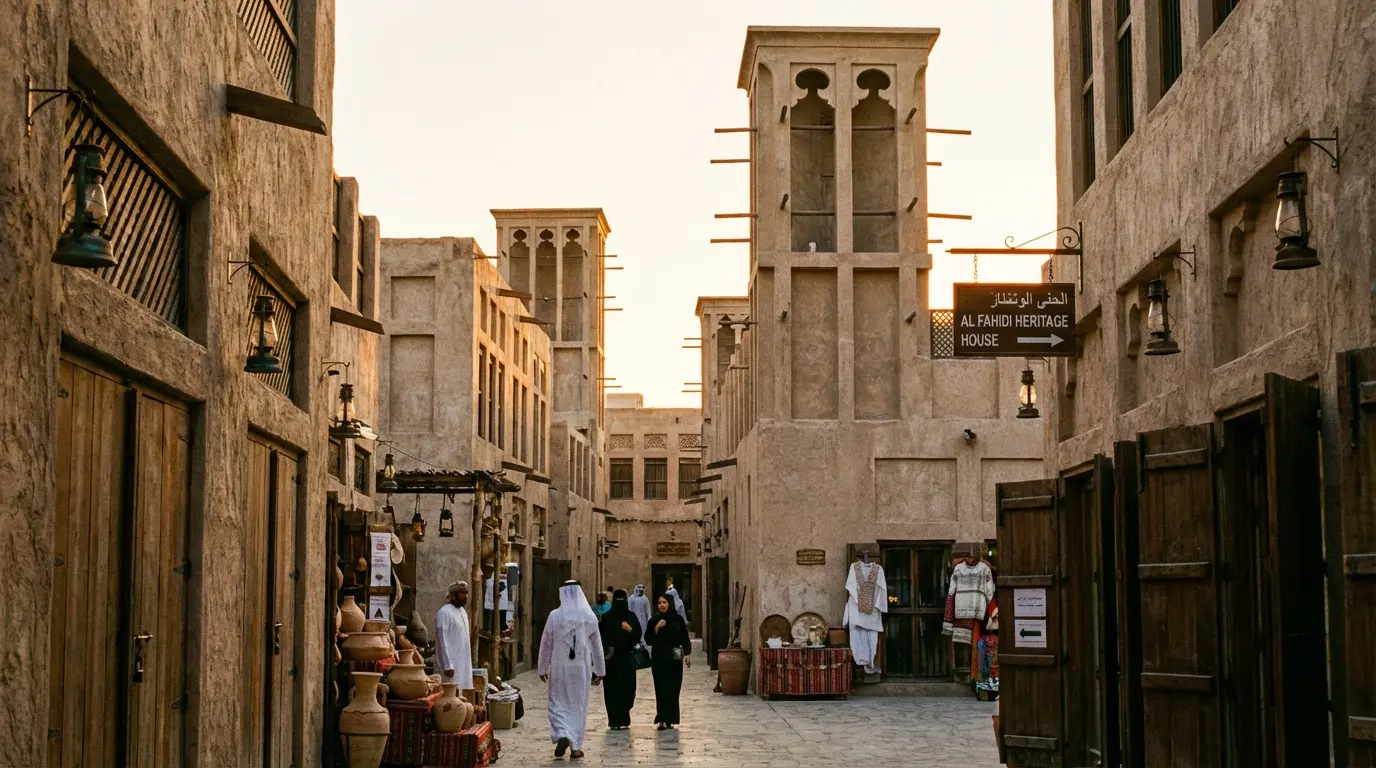
Before the towers, before the artificial islands, before the world’s tallest building, Dubai was a small trading settlement on a creek. Al Fahidi Historical Neighbourhood is what remains of that earlier city. Its wind-tower houses, built from coral stone and gypsum, date to the 1890s, and its narrow lanes feel like a different world from the glass and steel a few kilometers away.
The neighborhood is home to small museums, art galleries, and the XVA Art Hotel, which occupies a traditional wind-tower house and is itself a living piece of old Dubai. The Dubai Museum sits inside Al Fahidi Fort, the oldest surviving structure in the city, built in 1787.
For heritage groups, Al Fahidi is where the real Dubai story begins. Not the story of ambition and construction, but the story of a community that lived by trade, survived by the creek, and built with the materials the desert and the sea provided. A good guide here changes everything.
Dubai Frame: Old City, New City, and What Stands Between Them
The Dubai Frame is 150 meters tall and shaped like an enormous picture frame. Stand on one side and you look out at Old Dubai, the creek, the modest skyline of Deira. Turn around and you face the towers of Sheikh Zayed Road, the Burj Khalifa, and the modern city that rose in a single generation.
Most tourists treat it as a photo opportunity. For a heritage group, it is something more interesting: a physical marker of one of the most dramatic urban transformations in human history. Dubai went from a fishing and pearl-diving settlement to a global city in less than fifty years. The Frame literally places you between those two realities.
The glass-floor walkway at the top is not for everyone, but the view on both sides tells the story better than any lecture could.
Coffee Museum and the Trade Routes That Built Dubai
Tucked into Al Fahidi, the Coffee Museum is a small space dedicated to the history of coffee and its role in the trade routes that connected the Arabian Peninsula to East Africa, India, and beyond. Dubai’s identity as a trading hub long predates oil, and coffee was one of the goods that moved through its creek.
For a heritage group, the museum offers a quiet moment of reflection on how trade, culture, and hospitality are connected in this region. Arabic coffee is not just a drink. It is a gesture of welcome, a social ritual, and a thread that ties together the cultures your group is encountering.
The museum is small. You will not spend more than forty-five minutes there. But paired with a walk through Al Fahidi, it adds a layer of meaning that the bigger attractions cannot.
How to Build These Into a Heritage Group Day
These sites fit naturally into a three-to-four-day heritage itinerary. A first day in Al Fahidi, the Coffee Museum, and the Dubai Frame gives your group the historical foundation. The Abrahamic Family House deserves a full day trip to Abu Dhabi, which also allows time at the Sheikh Zayed Grand Mosque. The Jumeirah Mosque visit works well as a morning before exploring Dubai’s Jewish community in the afternoon.
Heritage Tours builds Dubai group itineraries around these sites specifically because they carry genuine meaning. We are not interested in filling days with attractions that look impressive but leave your group unchanged. These are the places that stay with people.
Frequently Asked Questions
What is the Abrahamic Family House in Abu Dhabi?
The Abrahamic Family House is a campus containing three functioning houses of worship, a mosque, a church, and a synagogue, built side by side on Saadiyat Island in Abu Dhabi. It was designed by architect David Adjaye and opened in 2023 as a symbol of interfaith coexistence.
Can non-Muslims visit mosques in Dubai?
Yes. The Jumeirah Mosque in Dubai runs an Open Doors program that welcomes non-Muslim visitors for guided tours. Visitors are offered traditional coffee and dates and can ask questions about Islamic faith and practice. Modest dress is required.
What is the Al Fahidi Historical Neighbourhood?
Al Fahidi is the oldest surviving neighborhood in Dubai, dating to the 1890s. It features traditional wind-tower houses built from coral stone, narrow lanes, small museums, art galleries, and the Dubai Museum inside Al Fahidi Fort, the city’s oldest structure from 1787.
Is the Dubai Frame worth visiting for a heritage group?
Yes. Beyond the view, the Dubai Frame places visitors between Old Dubai and the modern city, making the dramatic transformation of the past fifty years physically visible. For a heritage group, it provides a powerful visual context for understanding what Dubai was and what it became.
How far is Abu Dhabi from Dubai and is it worth the trip?
Abu Dhabi is approximately ninety minutes from Dubai by road. For heritage travelers, it is absolutely worth the trip. The Abrahamic Family House and the Sheikh Zayed Grand Mosque are both in Abu Dhabi and are among the most significant faith and heritage sites in the entire Gulf region.
These are the sites we build our Dubai heritage itineraries around. If you would like to know more about what a heritage-focused visit to Dubai looks like for your group, we are here to help you plan it.