Dubai as a Heritage Destination: A Different Kind of Journey
I want to be honest with you from the start. Dubai is not Jerusalem. It is not Rome or Prague. It does not carry thousands of years of Jewish or Christian history within its walls. But something happened in 2020 that changed what Dubai means for faith travelers, and if you are a rabbi or a pastor considering this destination for your group, that story is worth understanding.
Dubai is a young city built on trade, ambition, and a very particular vision of the future. But since the Abraham Accords, it has also become a place where Jewish and Christian travelers can walk openly, pray freely, and encounter something genuinely new: a Muslim-majority country that has chosen, as a matter of national policy, to build spaces of coexistence. That is not a small thing.
For more than forty years, I have helped faith groups find meaning in the places they visit. Dubai surprised me. Not because of the skyscrapers, but because of what is happening quietly beneath them.
The Abraham Accords and What Changed for Jewish Travelers
In September 2020, Israel and the United Arab Emirates signed the Abraham Accords, a normalization agreement that changed the relationship between the two countries overnight. Before that moment, Israeli passport holders could not enter the UAE. Jewish travelers who visited the Gulf did so quietly, sometimes removing visible signs of their identity.
After the Accords, direct flights opened between Tel Aviv and Dubai. Israeli tourists began arriving in the tens of thousands. A Chabad house opened in Dubai. Kosher food became available. Jewish community life, which had existed in the shadows for years, moved into the open.
For a rabbi considering a group trip, this matters. Your congregants can travel to Dubai with their identity fully visible. They can attend Shabbat services. They can visit a functioning synagogue in Abu Dhabi. Five years ago, none of this was possible.
Al Fahidi Historical Neighbourhood: The Old Dubai That Survives
Most of Dubai is less than fifty years old. Al Fahidi is the exception. This small neighborhood along Dubai Creek dates to the 1890s, and its narrow lanes, wind-tower houses, and coral-stone walls are the closest thing Dubai has to a historic quarter.
Walking through Al Fahidi with a knowledgeable guide, you begin to understand what Dubai was before the oil and the construction boom: a trading settlement on the edge of the desert, connected to the world through its creek and the merchants who used it. The Dubai Museum sits inside Al Fahidi Fort, the oldest surviving structure in the city, built in 1787.
For heritage groups, Al Fahidi is where you start. It grounds the visit in something real before the modern city takes over.
The Abrahamic Family House: A Landmark Worth Understanding
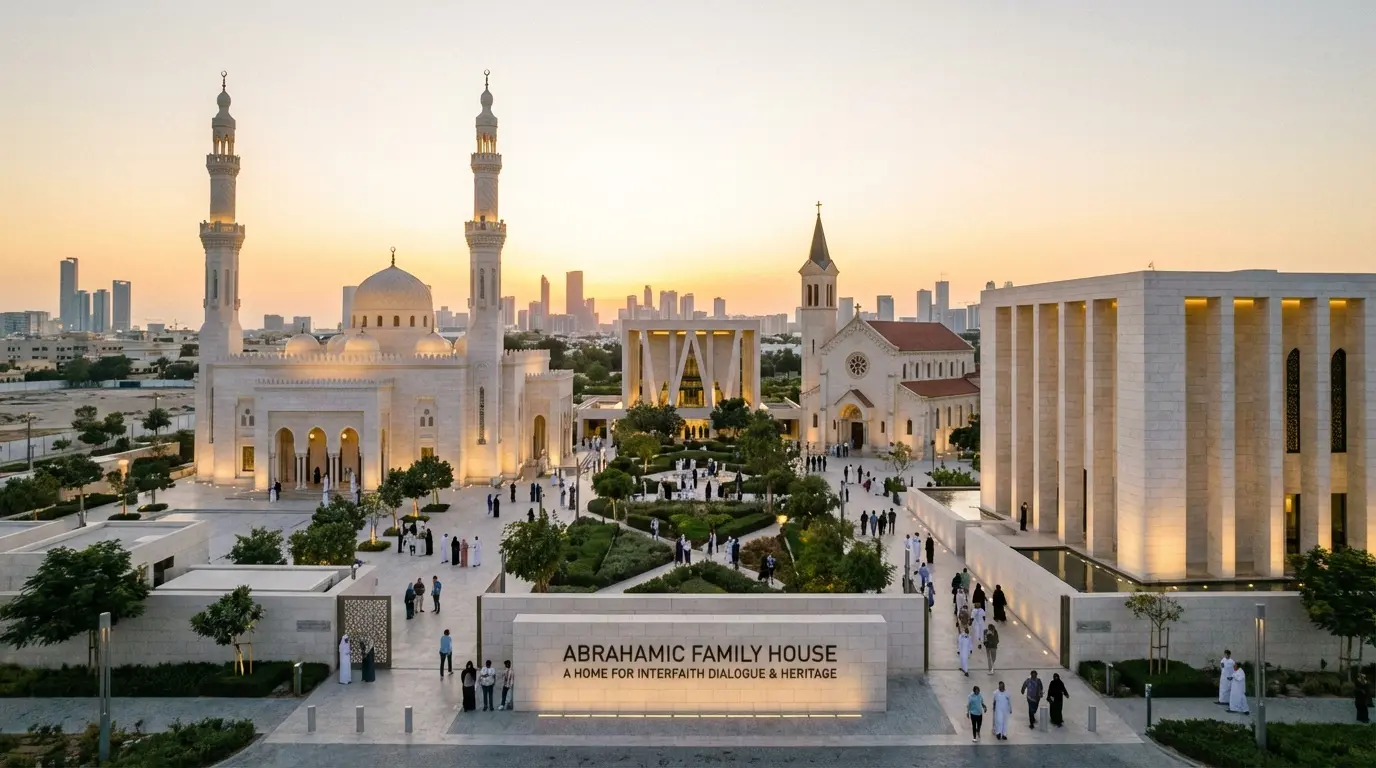
On Saadiyat Island in Abu Dhabi, about ninety minutes from Dubai by road, three buildings sit side by side on a single campus: a mosque, a church, and a synagogue. They were designed by the architect David Adjaye and opened in 2023. The complex is called the Abrahamic Family House.
This is not a museum. These are functioning houses of worship. The mosque holds Friday prayers. The church holds Sunday services. The synagogue is a place of Jewish prayer. They share one campus, one architect, and one statement: that the children of Abraham can worship in peace, side by side.
I have visited many sacred sites around the world. This one is different because it is new, because it was built deliberately, and because it says something about what the world might become rather than what it once was. For an interfaith group, there may be no more powerful site to visit anywhere in the world right now.
Dubai’s Jewish Community and What It Means to Visit
Dubai’s Jewish community is small but growing. What was once a handful of families keeping a low profile has become a visible, organized community with a Chabad presence, regular Shabbat services, and kosher food options.
Rabbi Levi Duchman, who leads Chabad in the UAE, has been a quiet force behind much of this growth. Visiting groups can coordinate Shabbat meals and services through Chabad Dubai. For a Jewish group, this is not just a convenience. It is evidence that something has genuinely changed.
The community is young. It does not carry the weight of centuries. But for a rabbi bringing a group to Dubai, meeting this community and understanding how it came to exist is part of the heritage story.
Christian Heritage and Community in Dubai
Dubai is home to a significant and active Christian community. St. Mary’s Catholic Church is the largest church in the UAE and serves thousands of worshippers every week. There are also Anglican, Orthodox, and evangelical congregations throughout the city.
For Christian group leaders, this is worth knowing: Dubai is not a place where Christianity exists at the margins. The UAE government has allocated land for churches and permits public worship. The Jumeirah Mosque, through its Open Doors program, invites non-Muslim visitors for guided tours that include conversation and tea. This is a genuine gesture of hospitality, not a tourism exercise.
A pastor bringing a group to Dubai will find a city that respects Christian faith and welcomes Christian visitors with real warmth.
How to Build a Heritage Itinerary Around Dubai
A heritage-focused visit to Dubai works best as a four-to-five-day trip. The core sites can be covered thoughtfully without rushing: Al Fahidi and Old Dubai on the first day, the Abrahamic Family House day trip to Abu Dhabi, a day exploring Dubai’s Jewish community and Chabad, and time at the Jumeirah Mosque and Christian heritage sites.
Some groups add Dubai to an Israel itinerary, flying directly between Tel Aviv and Dubai. This combination did not exist before the Abraham Accords, and for many Jewish groups, it is the most meaningful way to experience both destinations.
Heritage Tours builds Dubai itineraries around these heritage anchors, not around shopping malls or desert safaris. If your group is looking for meaning, that is what we focus on.
Frequently Asked Questions
Is Dubai a good destination for Jewish heritage travelers?
Yes. Since the Abraham Accords of 2020, Dubai has become genuinely welcoming for Jewish travelers. There is an active Chabad community, kosher food options, and the Abrahamic Family House in Abu Dhabi includes a functioning synagogue. Jewish groups can travel openly and practice their faith freely.
What are the main heritage sites in Dubai for faith travelers?
The key sites include Al Fahidi Historical Neighbourhood and Dubai Museum for cultural heritage, the Jumeirah Mosque for interfaith dialogue, and the Abrahamic Family House in Abu Dhabi for the most significant interfaith landmark in the region. Chabad Dubai is also a meaningful stop for Jewish groups.
What is the Abrahamic Family House and where is it located?
The Abrahamic Family House is a campus on Saadiyat Island in Abu Dhabi containing a mosque, a church, and a synagogue, all designed by architect David Adjaye and opened in 2023. It is about ninety minutes from Dubai by road and requires advance booking for group visits.
Can Jewish groups travel freely in Dubai and the UAE?
Yes. Since the Abraham Accords, Israeli passport holders can enter the UAE, direct flights operate between Tel Aviv and Dubai, and Jewish religious practice is welcomed. Jewish travelers can wear kippot, observe Shabbat, and access kosher food without difficulty.
Is Dubai a good destination to combine with a trip to Israel?
Very much so. Direct flights between Tel Aviv and Dubai make this combination practical and meaningful. Many groups now visit Israel for its deep biblical and Jewish heritage and then continue to Dubai to experience the interfaith reality that the Abraham Accords created. Heritage Tours offers this as a combined itinerary.
If you are considering Dubai for your group, we would welcome the conversation. Explore our Dubai heritage programs or reach out to us directly. We will give you an honest picture of what this destination offers and help you decide if it belongs on your group’s journey.