
A rabbi asked me once whether his group of twelve even needed a full escorted tour, or whether they could just hire a guide for a few key days and handle the rest themselves. It was not a naive question. He had traveled independently before and trusted his people to manage. I told him the honest answer, which is that it depends far more on the destination and the depth you want than on how capable your group is. That is the real question underneath “escorted or self-guided,” and it deserves a straight answer rather than a sales pitch for whichever format costs more.
What Each Format Actually Means
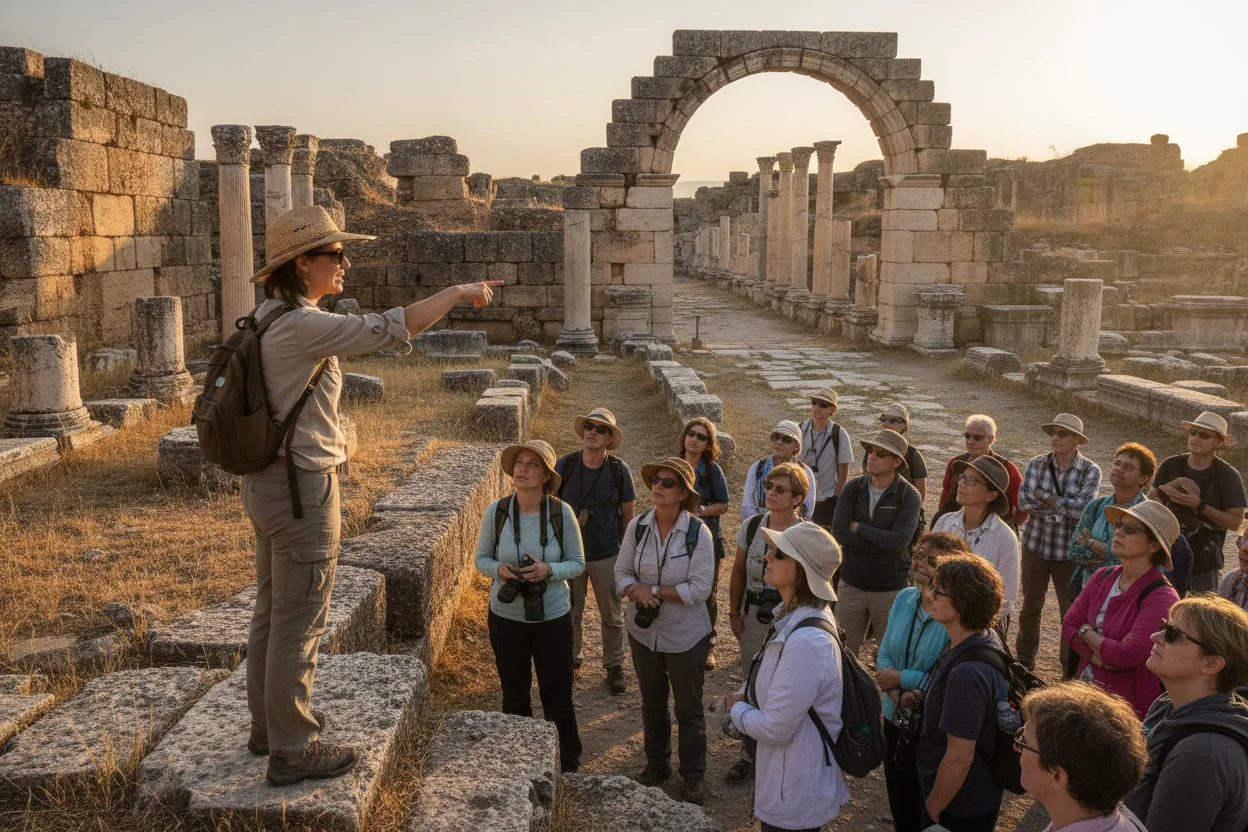
An escorted heritage tour means a guide travels with your group for the entire trip, coordinating the coach, the schedule, meals, and the narrative at every site. Your leader still leads the spiritual or educational side, but the guide handles the moving parts and provides the site-specific context throughout.
A self-guided heritage tour means your group travels with a planned itinerary, pre-booked hotels and transport, but no guide present for the whole trip. You might still hire a local guide for specific days at complex sites, but day-to-day movement and pacing are in your own group’s hands.
Both are real options we run. Neither is automatically better. The right one depends on a few specific factors.
When an Escorted Tour Is the Better Fit
Complex, multi-site itineraries. Countries with a lot of ground to cover and sites that are not obviously connected without context, Turkey’s Seven Churches, Israel’s layered historical sites, Egypt and Jordan’s ancient ruins, benefit enormously from a guide who can carry the narrative thread across days. Without that thread, a self-guided group often ends up seeing beautiful places without understanding how they connect.
Larger groups. Once you are past ten or twelve people, the logistics of moving a group through a country, coordinating meals, managing a coach, adjusting for a mixed-age pace, become a full-time job on their own. An escorted tour absorbs that job so your group leader can actually lead people instead of managing a spreadsheet on the road.
First-time international travelers. A group with many members who have never traveled abroad benefits from having someone present who can handle the unexpected: a delayed flight, a closed site, a language barrier at a pharmacy. That is exactly the kind of problem an escort exists to solve quietly, before your group even notices it happened.
Kosher or specific dietary needs. As we cover in depth for kosher travel in Turkey, coordinating specialized meals across multiple cities takes active, on-the-ground management. This is much harder to do well without a guide present managing it day to day.
When Self-Guided Makes More Sense
Smaller, experienced groups. A group of six to ten seasoned travelers, comfortable navigating on their own, can move through a well-planned self-guided itinerary efficiently and often at a lower cost, since you are not paying for a full-time guide across every day.
Simpler, more concentrated itineraries. A trip focused on one or two cities rather than a sprawling multi-region route needs less continuous narrative connecting distant sites, which reduces how much a full-time guide adds.
Groups wanting more flexibility. Self-guided trips let a group linger longer at a site that moves them and skip past one that doesn’t, without coordinating that change with a guide’s fixed schedule. Some leaders value that freedom more than the convenience of full escort.
Return travelers. A congregation that has done a heritage trip before and knows generally how these trips work sometimes prefers the lighter structure of a self-guided return trip, often adding a guide only for the most complex days.
The Cost Difference
Self-guided trips are generally less expensive per person, since you are not paying for a guide’s full-time presence across every day of the trip. The gap varies by destination and length, but it is a real and meaningful difference worth knowing before you commit to either format. That said, groups sometimes end up spending guide fees anyway on the two or three most complex days, at which point the cost gap narrows considerably. Our heritage tour packages guide breaks down what’s typically included in each pricing structure.
The Honest Middle Ground
Most groups land somewhere in between, and this is usually the right answer rather than a compromise. A partially escorted trip, full guide support at the most complex, historically dense sites, self-guided time in simpler stretches or free days, gets you most of the depth of a full escort at a lower overall cost. We build this hybrid model often, and it tends to fit congregation and educational groups especially well, since it protects the leader’s own bandwidth for teaching without paying for full escort on days that don’t need it.
How to Decide for Your Group
Ask yourself three questions honestly. How complex is the itinerary, meaning how many disconnected sites need narrative context to make sense together? How large and how experienced is your group? And how much does your group value flexibility versus the reassurance of full support? Answer those three and the right format for your trip usually becomes clear on its own.
If you want to talk through which format fits the trip you have in mind, our group heritage tours page and private tours page both show how we structure each option, across all nineteen of our destinations.
FAQ: Escorted vs. Self-Guided Heritage Tours
Which is better, escorted or self-guided?
Neither is universally better. Escorted tours suit complex, multi-site itineraries, larger groups, and first-time international travelers. Self-guided tours suit smaller experienced groups, simpler itineraries, and travelers who want more flexibility and a lower cost.
Is a self-guided tour cheaper?
Generally yes, since you are not paying for a guide’s full-time presence throughout the trip. The gap narrows if your group ends up hiring local guides for the most complex individual days anyway.
Can we mix the two formats in one trip?
Yes, and many groups do. A hybrid approach, full guide support at the most complex sites and self-guided time elsewhere, is often the best balance of depth and cost, and we build this model regularly.
Does a self-guided trip still include hotels and transport?
Yes. Self-guided means no full-time guide traveling with the group, not an unplanned trip. Hotels, transport, and the itinerary are still arranged in advance; only the continuous guide presence is removed.
What group size works best for a self-guided tour?
Roughly six to ten experienced travelers tends to work best for self-guided trips. Larger groups usually benefit more from an escorted format, since the logistics of moving many people through unfamiliar sites become harder to manage without dedicated support.
If you are not sure which format is right for your group, tell me your group size and the destinations you’re considering and I will give you a straight recommendation.
Contact us whenever you’re ready to figure it out together.