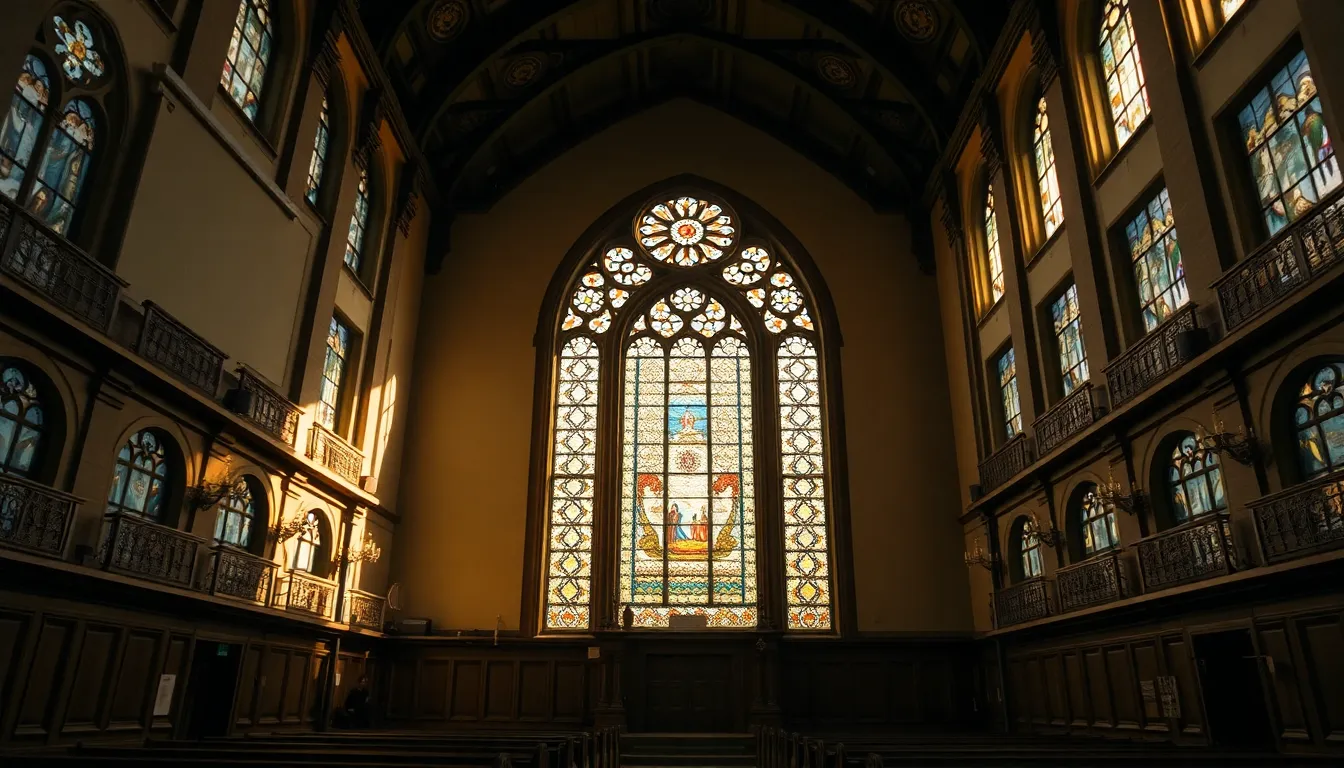
People assume Scotland has one synagogue, maybe two, tucked away somewhere and barely used. Then I take them to Garnethill in Glasgow, and they walk into a soaring Victorian sanctuary with stained glass and a gallery and an archive in the basement, and they have to recalibrate everything they thought they knew.
Scotland’s synagogues are one of the best-kept secrets in Jewish Britain. Some are grand and historic. Some are small and still warm with use. Some have closed, their buildings now serving other lives, but their stories still legible to anyone who knows where to look. If you are a rabbi or educator planning a heritage trip, this is your map. Let me walk you through what is there.
Glasgow: The Heart of Scottish Jewry
Glasgow is where Scottish synagogue heritage is richest, and Garnethill is the crown of it. Opened in 1879, Garnethill was Scotland’s first purpose-built synagogue, and it announced that the community had arrived. The building is a confident statement of Victorian Jewish self-assurance, with a beautifully decorated interior, fine stained glass, and an elegant sanctuary that still takes visitors by surprise.
What makes Garnethill essential, beyond its beauty, is the Scottish Jewish Archives Centre housed within it. This is the institutional memory of Scottish Jewry, photographs, records, ritual objects, the documentary backbone of the whole community’s story. For a heritage group, visiting Garnethill means seeing a magnificent historic synagogue and walking through the archive that explains it, in a single stop. I cannot think of a better place to begin a Scottish itinerary.
As the immigrant community grew through the Gorbals and then spread south and to the suburbs, Glasgow developed other congregations. Giffnock and Newlands in the southern suburbs became the center of gravity for active Jewish life as families prospered and moved out of the inner city. Several of the older inner-city synagogues that once served the Gorbals generation have since closed, but a good guide can still show your group where they stood and what they meant.
Edinburgh: The Capital’s Congregation
Edinburgh’s Jewish community has always been smaller than Glasgow’s, but its synagogue story is no less worth telling. The congregation moved through several premises over the generations as it grew and changed, before settling into its present home. The Edinburgh Hebrew Congregation continues to serve the city, and its synagogue carries the dignity of a community that valued learning and quiet continuity over grandeur.
For a group, Edinburgh provides a different register from Glasgow. Where Glasgow shows you the scale and energy of an immigrant community building big, Edinburgh shows you the steadiness of a smaller congregation rooted in a great university city. Visiting both gives your people the full spectrum of how synagogue life took shape in Scotland.
Beyond the Two Cities
Scottish Jewish life was concentrated in Glasgow and Edinburgh, but it was not confined to them. At various points there were small congregations in other places, including in Dundee and Aberdeen, where modest communities formed and maintained their own places of worship for a time. These were small, and most have not survived as active congregations, but they are part of the map.
I mention this with groups because it corrects an oversimplified picture. Jewish Scotland was not only a tale of two cities. It was a scattering of smaller communities too, each with its own rise and quiet ending. For an educator, that fuller picture, the small congregations that flickered and faded, is part of the honest history.
Synagogues That Have Closed, and Why That Story Matters
Not every synagogue on the Scottish map is still in use. As communities shifted, prospered, and dispersed, some congregations dissolved and their buildings passed into other hands. This is not a sad footnote to skip over. It is central to the story, and I treat it that way.
A closed synagogue tells you about a community’s whole life cycle, its arrival, its flourishing, its movement, its consolidation. When I show a group where an old Gorbals synagogue once stood, or a former congregation’s building now serving another purpose, the lesson is not about loss alone. It is about how communities move and change while the thread of Jewish life continues elsewhere. That is a more honest and ultimately more hopeful story than pretending nothing ever closed.
How to Read a Synagogue With Your Group
A synagogue is a text, and I encourage leaders to help their groups read it. The orientation toward Jerusalem, the placement of the ark and the bimah, the women’s gallery, the memorial boards with their lists of names, the dedications carved by families who built the place, all of it tells you who this community was and what they valued.
In a historic synagogue like Garnethill, the architecture itself speaks of a moment of confidence and arrival. In a smaller working synagogue, the worn prayer books and the warmth of a living congregation speak of continuity. Teaching a group to notice these things turns a building from a stop on a list into a window onto a community.
And where it can be arranged, nothing compares to experiencing a synagogue in use. Sharing a service or a Shabbat with a living Scottish congregation is, for many of my groups, the high point of the trip.
Building Your Scottish Synagogue Itinerary
The synagogues of Scotland are best understood as a connected map rather than a string of separate visits. Garnethill and its archive anchor the story. The Glasgow suburbs show where the living community went. Edinburgh adds the capital’s quieter chapter. The closed congregations and smaller-city communities fill in the honest, fuller picture.
I weave these into a coherent route alongside the cemeteries and the wider history, so your group leaves with the whole shape of Scottish Jewry. For the broader landscape, our Jewish heritage of the UK overview sets the stage, and the pieces on the history of Jewish Scotland and the Jewish cemeteries of Scotland, Wales, and Northern Ireland deepen the picture.
Heritage Tours builds every itinerary around the specific interests of your community, and with 15 or more participants, the group leader travels free. You can see the full picture on our United Kingdom destination page or learn how the group experience works on our group heritage tours page.
FAQ: The Synagogues of Scotland
What is the most important synagogue in Scotland?
Garnethill Synagogue in Glasgow, opened in 1879, was Scotland’s first purpose-built synagogue and remains the most significant. Its beautiful Victorian interior is matched by the Scottish Jewish Archives Centre housed within it, which preserves the documentary record of the whole community. For a heritage group, it combines a magnificent building and a deep archive in a single essential stop.
Are there still active synagogues in Scotland?
Yes. Glasgow’s living community is centered in the southern suburbs around Giffnock and Newlands, and the Edinburgh Hebrew Congregation continues to serve the capital. Several older inner-city synagogues that served the Gorbals generation have closed, but active congregational life continues. Where it can be arranged, sharing a service with a living congregation is often the highlight of a Scotland trip.
Were there synagogues outside Glasgow and Edinburgh?
Yes. While Jewish life concentrated in the two main cities, smaller congregations also formed at various points in places such as Dundee and Aberdeen. Most of these did not survive as active congregations, but they are part of the fuller map of Jewish Scotland and a useful corrective to the idea that it was only ever a tale of two cities.
Why visit synagogues that have closed?
A closed synagogue tells the whole life cycle of a community, its arrival, flourishing, movement, and consolidation. Showing a group where an old Gorbals synagogue stood, or a former congregation’s building now in other use, teaches how communities change while the thread of Jewish life continues elsewhere. It is an honest and ultimately hopeful part of the story, not a sad footnote.
What should a group look for inside a Scottish synagogue?
Read the building as a text. Note the orientation toward Jerusalem, the placement of the ark and bimah, the women’s gallery, the memorial boards, and the family dedications. In a grand synagogue like Garnethill, the architecture speaks of confidence and arrival. In a small working synagogue, the warmth of a living congregation speaks of continuity. We help groups learn to read these details.
Scotland’s synagogues surprise nearly everyone who comes with me, and they reward a careful, guided visit. If you are considering Scotland for your community, I would welcome the chance to map it out with you. Contact us whenever you are ready to begin.