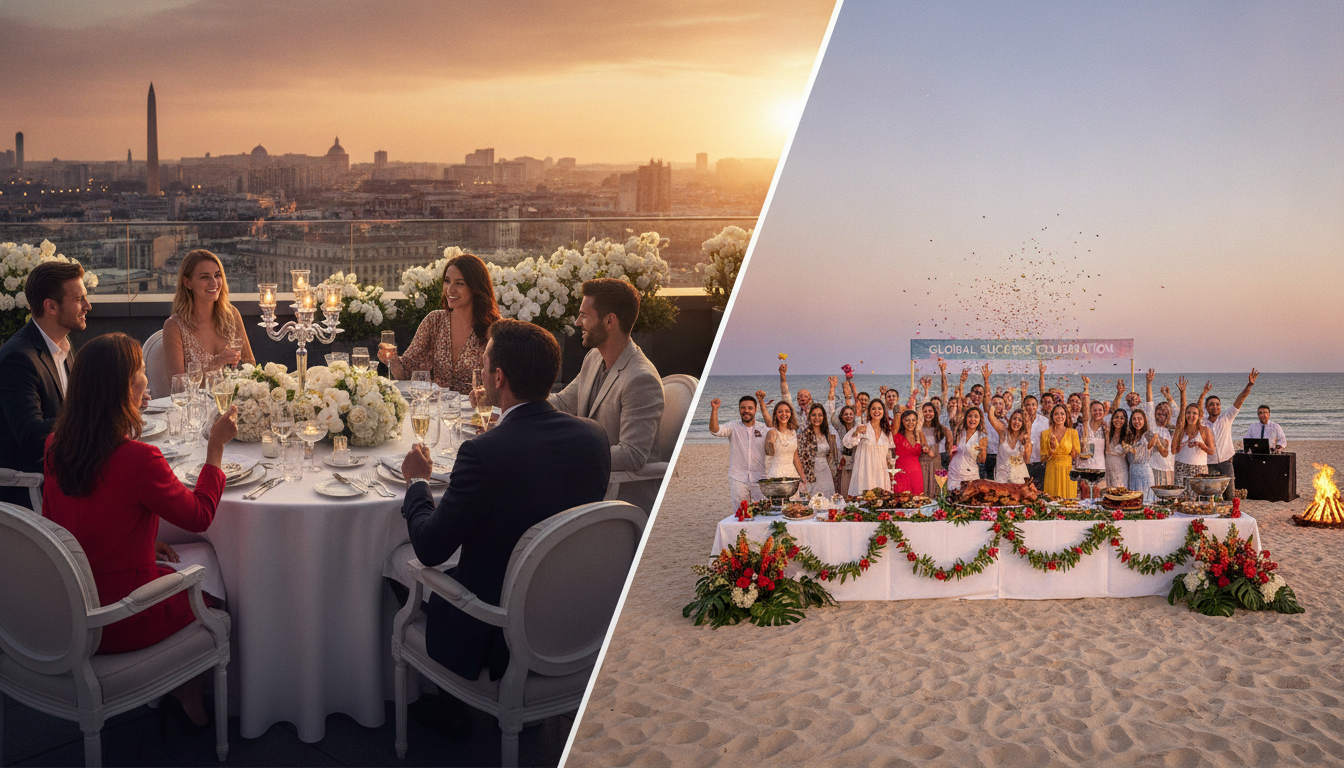
Group size is the variable that most incentive travel buyers underestimate. Companies start planning around a destination, a budget range, or a timeframe. They treat group size as a fixed input: we have 85 qualifiers, so we are planning for 85 people.
But group size is not just a number on a logistics sheet. It shapes what kind of program you can run, which destinations make sense, what the experience feels like to a participant, and what you are paying per person. Two programs with identical budgets can produce dramatically different results depending on whether the group is 18 people or 80.
The Incentive Research Foundation puts the average program size at 38 participants. That average hides a wide range. I work with groups as small as 10 and as large as several hundred. Each band requires a different approach.
Small Groups (10-25): Ultra-Exclusive, Premium Access, High Per-Person Cost
This is the category where the program can feel most like a true personal reward rather than a company event.
With 10 to 25 people, you have access to experiences and venues that simply cannot scale. A private villa rental in the hills above Florence. A small-ship charter along the Dalmatian Coast where the group is the only guests. A private dinner in a Marrakech riad with a chef cooking specifically for your party. These experiences exist in every market, but they require a group small enough to fit them.
The tradeoff is per-person cost. Small groups do not benefit from the volume discounts that apply at 40, 50, or 80 people. A private yacht charter split 12 ways costs more per person than the same experience allocated across 30 people on a larger vessel. Hotel buyouts at small boutique properties are often all-or-nothing, which means your group pays for the full property whether you use every room or not.
The destinations that work best for small groups are the ones where intimacy is the product:
- Malta: a compact destination with remarkable history, limestone cities, and harbor views. Works beautifully for 10 to 20 people and is difficult to execute well at larger sizes.
- Cappadocia, Turkey: private cave hotel properties have 10 to 30 rooms. The balloon experience is intimate by nature. This destination rewards small groups more than large ones.
- Fez, Morocco: the medina, the private riads, the artisan workshops. A group of 20 can experience this in a way that feels personal. A group of 80 becomes a tour bus.
- Dubrovnik, Croatia: the Old City is stunning but small. Exclusive dinner venues in the walls of the old town book up to a year in advance and rarely accommodate more than 30 people at a time.
If your company runs a true top-tier tier within an existing program, 10 to 20 people in one of these destinations is the most powerful incentive program per dollar you can design.
Mid-Size Groups (25-75): The Sweet Spot for Value and Venue Selection
The 25 to 75 range is where most successful incentive programs land, and for good reason. This is the band where per-person cost starts to become meaningfully more efficient, venue selection opens up, and you can still build an experience that feels personal.
When a group doubles from 20 to 40 people, all-in per-person cost typically falls by 15 to 20 percent. The fixed costs of program management, private guides, and ground coordination get spread across more participants. Hotels and venues in this range offer full buyout terms that give the group exclusive access without the boutique-property premium.
Mid-size groups also unlock a broader set of destinations. Italy, Greece, Israel, Portugal, Turkey in its larger-scale form, Jordan, the broader Moroccan circuit beyond Fez. These countries have the infrastructure to handle groups of 40 to 60 without the experience becoming generic, but they also have the venue depth to accommodate that scale with genuine quality.
One practical point: at 25 or more participants, ask about the complimentary group leader spot. It is standard practice in the industry at that threshold. At 40 or more, some hotel contracts include room upgrades or food and beverage credits that are worth negotiating explicitly.
The challenge in this band is the temptation to over-program. With 50 people, the instinct is to fill every hour and control every variable. Top performers in this size range still respond strongly to a free afternoon or an evening with genuine personal choice. Build that in deliberately. For a detailed look at per-person cost at different group sizes, the incentive travel budget per person guide has the numbers.
Large Groups (75-200): Logistical Complexity, Parallel Programming
At 75 to 200 people, the program design question changes fundamentally. You are no longer asking what experience can we create for this group. You are asking how do we create a coherent, high-quality experience for a group large enough that not everyone can be in the same room at the same time.
Large groups require parallel programming. If your group is 100 people, a private rooftop dinner might seat them all at once. A private cooking class almost certainly does not. A morning site visit to a popular location with 100 people feels like a regular tour, not an incentive trip, unless you have divided into sub-groups with separate guide teams.
At this scale, logistics management is itself a full-time job. Ground transportation for 120 people requires a coordinated fleet. Check-in for a large group at a hotel requires a dedicated room and a staffed welcome desk. Meal service for a group of 150 needs restaurant buyouts that can handle the volume, or a private dining setup that has been specifically contracted for the size.
The destinations that handle large groups well:
- Israel: strong infrastructure for corporate groups, can move large parties efficiently through diverse experiences
- Dubai: hotel and venue scale that accommodates 200 people without it feeling like a conference
- Italy, France, Spain: deep inventory of hotel properties and private event venues, though logistics require more advance planning in peak season
- Portugal: increasingly capable at this scale and significantly less expensive than France or Italy for comparable quality
The risk with large groups is that the experience flattens. Everything starts to look like a conference, and the incentive value erodes. Good program design at this scale uses sub-group structures, personalized touchpoints within the larger event, and clear moments of genuine exclusivity that the group could not have found on their own.
How Destination Choice Constrains Group Size
Not every destination can handle every group size. This is a planning reality that affects more programs than companies expect.
The constraint is not always physical capacity. Sometimes it is the experience quality itself. Cappadocia works perfectly for 15 people and becomes a logistics problem at 90. The hot air balloon experience, which is the anchor of most Cappadocia programs, operates in baskets of 16 to 24 people. To put 80 people in the air at the same time, you need five or six balloons, which is possible but changes the feel of the experience entirely. For a deeper look at incentive destination options by group type, the incentive travel overview covers the full picture.
Some destinations have a physical or cultural character that works against large groups:
- Small Mediterranean islands (Malta, Santorini, smaller Croatian islands) have limited hotel inventory and narrow logistics windows
- Walled old cities (Dubrovnik, Fez, Jerusalem Old City) require timed entry management for large groups to avoid overwhelming the space
- Remote or adventure destinations (Wadi Rum, Sahara camp experiences, glacier or mountain programs) have hard capacity limits built into the infrastructure
Know the destination’s actual upper limit before you plan the group size around a location. Discovering that your preferred destination tops out at 50 people when you have 90 qualifiers forces a late-stage program redesign that is avoidable.
Splitting Large Groups into Sub-Programs (Qualifiers + Top Tier)
One of the most effective structures for groups of 60 to 120 people is the tiered program: a qualifier experience for the full group and a top-tier overlay for a smaller number of highest performers.
A program built for 80 total people might have 60 qualifiers going to a strong-value destination in Southern Europe, while the top 20 go to a more exclusive destination or receive a distinct upgrade layer within the same trip. Both groups feel recognized. The top tier feels particularly distinguished. And the 60-person qualifier group is motivated by having reached the program, with the knowledge that there is a step above them that they can aim for next cycle.
The split structure also solves a planning problem. Eighty people in one group can be difficult to program with genuine intimacy. Sixty is manageable. Twenty in a separate tier is ideal for the most exclusive experiences.
The motivational math works at both levels. The qualifier group is grateful and motivated. The top-tier group is deeply invested. In my experience, the separation into tiers actually increases aspiration in the qualifier group for the following year, because they can see exactly what they missed and exactly what they are working toward.
FAQ
What is the average incentive travel group size?
The Incentive Research Foundation reports the average incentive program size at 38 participants as of 2024. In practice, programs range from 10 to several hundred. The 25 to 75 range represents the largest share of programs by volume and tends to offer the best balance of experience quality and per-person efficiency.
Does group size affect per-person cost?
Significantly. When a group doubles from 20 to 40 people, all-in per-person cost typically falls by 15 to 20 percent. Fixed costs for program management, private guides, and ground coordination are spread across more participants. Hotel and venue contracts at larger group sizes often include credits or upgrades that add value at no additional cost.
What destinations work best for small groups of 10 to 25 people?
Malta, Cappadocia, Fez Morocco, and Dubrovnik Croatia are among the strongest for small groups. These destinations have boutique hotel inventory, intimate venue options, and experiences that reward small groups with genuine personal access. They are also harder to execute well at larger group sizes, which is part of what makes them feel exclusive.
How do you handle a group that is too large for a single program experience?
Parallel programming and sub-group structures. Groups of 75 or more generally need to be divided into sub-groups of 20 to 35 for specific activities, with separate guide teams and staggered timing. At the program design stage, this needs to be built in intentionally rather than managed as a logistics afterthought.
When does a tiered split structure make sense?
When your total qualifying population is 60 to 120 people and you want to preserve an elite tier within the program. A 60 + 20 split, where 60 qualifiers attend a strong-destination program and the top 20 receive a distinct upgrade or separate exclusive experience, increases motivation at both levels. The qualifier group feels recognized. The top tier feels singled out. And both groups have a clear target for the following year.
If you are working on a program where group size is driving destination or budget questions you have not resolved yet, reach out to us at Heritage Tours. We will help you think through the structure before you commit to the planning.