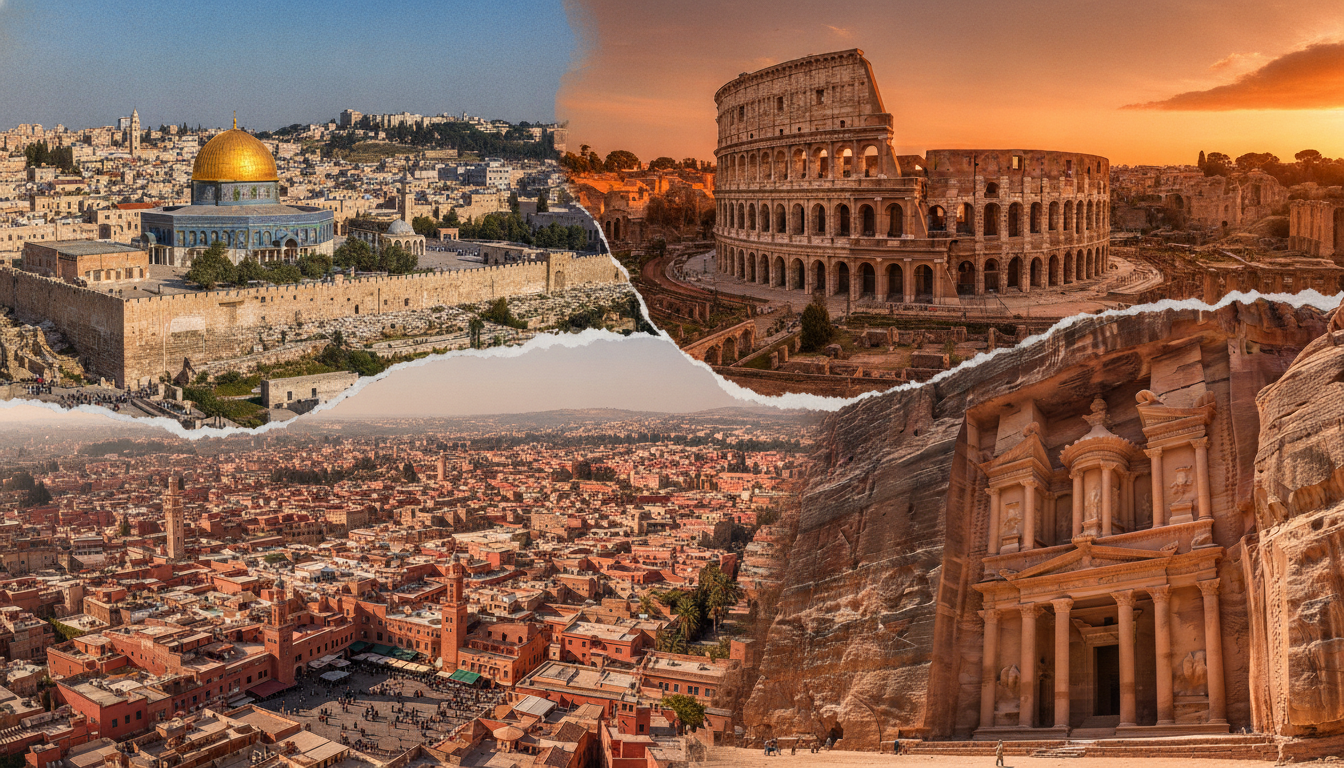
The most common planning mistake I see is choosing a destination before choosing a purpose. A company decides they want to go to Italy because Italy is beautiful, and then tries to build a corporate program around that decision. Sometimes it works. More often, the trip is a pleasant experience that does not quite land because the destination and the objective were never fully aligned.
The question is not “where is a good place to take a corporate group?” It is “what kind of experience does this group need, and which destination delivers it best?”
Heritage Tours works across 18 destinations. I have been planning programs in most of them for more than forty years. This guide is my attempt to give you an honest picture of what each destination is actually good for, in the context of corporate group travel.
How to Match a Destination to Your Group’s Purpose
Before you look at destination options, answer three questions:
What is the primary objective? Celebration and reward, team cohesion, heritage and identity, donor cultivation, professional development. The answer shapes everything downstream.
Who is in the group? Age, cultural background, travel experience, physical ability, religious identity, organizational affiliation. A group of 30-something tech employees has different expectations than a group of major donors in their 60s.
What do you want people to carry home? A changed perspective, a shared reference point, a feeling of recognition, a deeper connection to the organization’s mission. Naming this explicitly helps evaluate whether the destination you are considering actually delivers it.
With those answers clear, here is how the destinations map.
Heritage and Mission-Focused Destinations
These destinations are built for groups whose purpose connects to history, identity, and meaning. They do not work as neutral backdrop for a corporate retreat. They work as the substance of the program itself.
Israel. The most-requested destination Heritage Tours works with, across all organization types. What makes Israel work for so many different groups is that it holds multiple layers simultaneously. The Old City of Jerusalem is relevant to Jewish groups, Christian groups, and secular groups interested in where civilizations have intersected for three thousand years. Tel Aviv is a modern city with world-class food, tech culture, and beaches. The Dead Sea is a once-in-a-lifetime physical experience that no group ever regrets building in. The Galilee is quieter and more reflective in character.
Jewish organizations find the obvious connection, but the destination works beyond that community. We have planned programs for technology companies, healthcare associations, and leadership teams with no particular faith affiliation who chose Israel specifically because they wanted their group to have an experience that was genuinely unlike anything they had done before. That expectation is met consistently.
Peak seasons: April to May and September to October. Avoid the High Holiday period (late September to mid-October) for hotel availability reasons, unless the Jewish calendar is part of the program design.
Poland. Essential for any organization whose purpose connects to Jewish history. Krakow is the base, with Kazimierz (the Jewish quarter), the Remuh Synagogue, and the nearby Auschwitz-Birkenau memorial. Warsaw adds the Warsaw Ghetto area, the POLIN Museum of the History of Polish Jews, and the Umschlagplatz. Lublin and Lodz carry additional historical weight for groups with more time.
The experience Poland delivers is not comfortable. That is part of what makes it work. Groups that travel to Poland together tend to emerge with a shared understanding that is difficult to create any other way. It is not a destination for celebration or reward. It is a destination for reckoning and meaning.
Germany. The two layers Germany offers are Jewish heritage and modern reconciliation. Berlin has the Jewish Museum, the Memorial to the Murdered Jews of Europe, and a visible cultural engagement with history that is unlike any other capital in Europe. Frankfurt has one of the oldest and most significant Jewish communities in the Ashkenazi world. Munich gives additional context for groups interested in the full 20th-century arc.
Tech companies with German industry connections, Jewish organizations doing heritage programs, and leadership teams interested in how a society confronts its past all find genuine substance here. Germany works particularly well as a two-country itinerary with Poland or the Netherlands.
The Netherlands. Amsterdam’s Jewish history is layered and specific. The Anne Frank House is the obvious point of reference, but the Portuguese Synagogue (one of the oldest and best-preserved in the world), the Jewish Historical Museum, and the Hollandsche Schouwburg deportation theater give a program substantial depth. Dutch Jewry had one of the highest pre-war populations in Western Europe and one of the most devastating wartime losses; that context gives Amsterdam a weight that extends well beyond a single landmark.
Works particularly well for groups doing a broader European heritage itinerary. Amsterdam to Berlin, or Amsterdam to Warsaw, both make strong two-destination programs.
Morocco. The Moroccan Jewish story is one of the most undervisited in heritage travel, and one of the most genuinely moving. The mellah (Jewish quarter) of Fez is among the best-preserved in the Arab world. Casablanca and Marrakech both have significant Jewish community histories. The Museum of Moroccan Judaism in Casablanca is world-class. And the King Mohammed VI Foundation for the Restoration of Jewish Sites has done significant restoration work over the last decade that has made these sites meaningfully more accessible.
The broader Morocco experience, the medinas, the riads, the food, the landscape from the Atlas Mountains to the Sahara, makes this a trip with enormous variety even within a focused heritage program. Groups who have done Israel and Poland find Morocco opens a chapter they had not encountered before.
Spain. The Sephardic story. Spain expelled its Jewish community in 1492, and the physical traces of that community are visible across Toledo, Cordoba, Seville, Granada, and Girona. The 2015 law offering citizenship to descendants of expelled Sephardic Jews has given this chapter renewed emotional relevance for many communities. Toledo’s three-culture history, with Christian, Muslim, and Jewish communities coexisting and influencing each other for centuries before the expulsion, is intellectually extraordinary.
Best suited for Sephardic communities, groups exploring the full Jewish diaspora story, and organizations with a particular interest in the complex intersection of religious traditions.
Luxury and Reward Destinations
These destinations work best when the primary objective is recognition and celebration. The program structure is less about historical depth and more about quality of experience, exclusivity, and the feeling that the organization has genuinely invested in its people.
Italy. The strongest overall luxury destination Heritage Tours works with. Rome, Florence, Venice, the Amalfi Coast, and the Dolomites all deliver at a high level. Rome adds Jewish heritage depth through the Great Synagogue, the Jewish Ghetto, and one of the oldest continuous Jewish communities in the diaspora. For groups that want luxury and substance together, Italy is the strongest option in this tier.
Logistics are well-established, the guide quality is high, and the food, wine, and accommodation options are world-class. The main planning consideration is timing: high season in Italy (June through August) means significant crowds at major sites, and the program structure should account for that with earlier starts and private access arrangements.
France. Paris delivers at the top of the luxury tier. The Jewish quarter in the Marais, the Shoah Memorial, and a Jewish community whose Parisian presence goes back centuries give heritage-focused programs genuine content. For non-heritage programs, Paris is simply one of the most layered cultural destinations in the world. The combination of art, architecture, food, and the city’s particular physical beauty creates a baseline quality of experience that is hard to match.
Alsace-Lorraine offers an alternative France itinerary with strong Jewish community history, better logistics than Paris for some group sizes, and a character that is quite different from the capital.
Dubai. A different proposition from the European options. Dubai is newer, purpose-built for hospitality, and operates at an exceptional level of service. Following the Abraham Accords, it has become a genuinely meaningful destination for Jewish organizations: the first kosher restaurants in the UAE have opened, the Abu Dhabi synagogue has been restored, and the broader context of Gulf normalization gives a program in the UAE a specific contemporary relevance.
For pure luxury reward programs without a heritage focus, Dubai offers world-class hotels, extraordinary dining, desert experiences, and operational efficiency that European cities cannot quite match. The heat from May through September is significant; November through March is the right planning window.
United Kingdom. London works well for both luxury incentive programs and for professional groups combining corporate content with cultural experience. The Jewish community history is visible across the East End, Bevis Marks Synagogue (the oldest in the UK, completed in 1701), and a dozen other points across the city. For non-heritage programs, London has theater, museums, and cultural infrastructure that sustains a group for five to seven days without repetition.
Adventure and Culture Destinations
These destinations deliver strong cultural experience with an element of physical and geographic drama. They work for teams that want a trip that feels genuinely different from a standard conference or city tour.
Jordan. Petra is among the most extraordinary sites in the world, and I say that having seen most of them. Carved directly into the rose-red sandstone cliffs, the city is a physical encounter with history that photographs do not adequately convey. Wadi Rum, the desert landscape that served as the backdrop for The Martian and Lawrence of Arabia, adds a completely different texture. The Dead Sea from the Jordanian side, Amman’s emerging food culture, and the warm hospitality that Jordan consistently delivers make this a destination that surprises groups who arrive with modest expectations.
Jordan pairs well with Israel for two-country itineraries. The Allenby Bridge crossing or a flight from Tel Aviv to Amman are both workable logistics. Most Western passport holders can obtain a Jordanian visa on arrival or in advance online.
Morocco. Already covered under heritage destinations, but worth noting here that the physical and cultural experience of Morocco is strong enough to anchor a trip for groups without a specific heritage focus. The Sahara, the medinas of Fez and Marrakech, the Atlas Mountains, and the Atlantic coast at Essaouira give a group five to six days of genuine variety and sensory intensity.
Turkey. Istanbul is one of the most compelling cities in the world for a corporate group. The Blue Mosque and the Hagia Sophia carry the Byzantine and Ottoman layers. The Grand Bazaar is one of the oldest continuously operating covered markets on earth. The Bosphorus gives the city a geographic drama that most cities lack. The Galata Jewish Museum and the historic Jewish neighborhoods of Balat and Fener add heritage depth for organizations interested in the Sephardic Ottoman story.
Turkey also offers Cappadocia, with its volcanic landscape and cave hotels, as a strong add-on for groups with seven or more days.
Croatia. Dubrovnik, Split, and the Dalmatian islands offer a Mediterranean experience at a price point meaningfully below Italy or Greece. The old walled city of Dubrovnik is one of the best-preserved in Europe. Split’s Diocletian’s Palace, partially converted into a functioning city with restaurants and apartments inside the Roman walls, is genuinely distinctive. The coastline is beautiful and the logistics for groups are increasingly well-organized.
For organizations with strong programs but tight budgets who want a Mediterranean experience, Croatia is currently the best value in that category.
Classic European Destinations with Jewish Heritage
East and Central Europe. Hungary, Czech Republic, Romania, and neighboring countries hold a significant portion of the Ashkenazi Jewish world’s history. Budapest’s Dohany Street Synagogue, the largest in Europe, is alone worth the trip. Prague’s Jewish Quarter, with six synagogues and the Old Jewish Cemetery, is among the most intact in the world. The broader region: Bratislava, Cluj, Iasi, and the smaller towns of the Pale of Settlement, gives groups who want to go deeper into Eastern European Jewish history a substantial landscape to explore.
Greece. Thessaloniki was a majority-Jewish city until the Holocaust. The Jewish Museum of Thessaloniki, the Monastir synagogue, and the community’s story from the Ottoman period through the 20th century make this one of the most significant and undervisited heritage sites in Europe. Athens, Crete, and Rhodes all have their own Jewish histories. For groups not focused on heritage, Greece delivers strong cultural and physical experience, particularly in spring and fall.
Portugal. Already noted as a Tier 1 value destination, Portugal is also worth highlighting for the specific Jewish heritage dimension. The Jewish community expelled from Spain in 1492 dispersed partly to Portugal, and the story of conversos (Jews forced to convert to Christianity) who maintained hidden Jewish practice for generations is a striking chapter in the diaspora history. Belmonte, a village in the interior, had a crypto-Jewish community that continued practicing secretly for over five hundred years.
For a full picture of how to plan a program across any of these destinations, our corporate group tours hub covers the complete framework. The tours page has destination-specific program details.
When you have a destination in mind or an objective you want to work from, reach out through our contact page and we will help you build the right program.
FAQ
Which destination is most popular for Jewish corporate groups?
Israel is the most-requested destination overall, across Jewish organizations, nonprofits, and faith-based groups. Poland is the second most common for organizations focused on the full sweep of 20th-century Jewish history. Morocco and Spain have grown significantly in the last decade as Sephardic communities and organizations interested in less-traveled chapters of the diaspora story have increased their travel.
Which destinations work best for luxury incentive programs?
Italy, France, Dubai, and Turkey are the strongest options for programs where the primary objective is recognition and reward. Italy is the most versatile, combining genuine Jewish heritage depth with world-class luxury experience. Dubai offers exceptional service infrastructure and a unique contemporary Jewish context following the Abraham Accords. France is premier for programs where cultural prestige is part of the reward.
What are the best value destinations for corporate groups in 2025?
Portugal, Croatia, and Turkey offer strong programs at lower price points than their Western European counterparts. Portugal in particular has improved meaningfully in quality over the last five years. Turkey spans both the adventure-culture and the value categories. For groups that want a high-quality European experience without the Italy or France price tag, these three are the current best options.
Can we combine two destinations in one corporate group trip?
Yes, and some combinations work particularly well. Israel and Jordan is the most natural two-country itinerary we plan. Poland and Germany give a fuller picture of Central European Jewish history. Spain and Morocco work well as a Sephardic journey across the Mediterranean. Two-destination itineraries typically require a minimum of seven to eight days to give each destination adequate time.
How do we choose between destinations when several seem to fit our objectives?
Bring the shortlist to Heritage Tours at the beginning of the planning conversation. Given your group’s profile, your dates, and your budget range, we can tell you which destination is the most realistic match for what you are trying to accomplish, and which considerations would tip the decision one way or another. There is rarely a single right answer, but there is usually a better answer for your specific situation.